
Space Exploration Technologies (SPCX)
Market Price (9/29/2026): $148.37 | Market Cap: $870.0 BilSector: Industrials | Industry: Aerospace & Defense
Space Exploration Technologies (SPCX)
Market Price (9/29/2026): $148.37Market Cap: $870.0 BilSector: IndustrialsIndustry: Aerospace & Defense
Investment Highlights Why It Matters Detailed financial logic regarding cash flow yields vs trend-riding momentum.
Attractive cash flow generationCFO/Rev LTMCash Flow from Operations / Revenue (Sales), Last Twelve Months (LTM) is 18%, CFO LTM is 3.8 Bil Stock buyback supportStock Buyback 3Y Total is 4.9 Bil Megatrend and thematic driversMegatrends include Advanced Aviation & Space. Themes include Commercial Space Exploration, Satellite Internet, and Space Infrastructure & Logistics. | Weak multi-year price returns2Y Excs Rtn is -44%, 3Y Excs Rtn is -87% | Not profitable at operating income levelOp Inc LTMOperating Income, Last Twelve Months is -2.8 Bil, Op Mgn LTMOperating Margin = Operating Income / Revenue Reflects profitability before taxes and before impact of capital structure (interest payments). is -14% Expensive valuation multiplesP/SPrice/Sales ratio is 41x, P/CFOPrice/(Cash Flow from Operations). CFO is cash before capital expenditures. is 223x Significant share based compensationSBC/Rev LTMShare Based Compensation / Revenue (Sales), Last Twelve Months (LTM) is 10% Not cash flow generativeFCF/Rev LTMFree Cash Flow / Revenue (Sales), Last Twelve Months (LTM) is -158% Yield minus risk free rate is negativeERPEquity Risk Premium (ERP) = Total Yield - Risk Free Rate, Reflects the premium above risk free assets offered by the investment. is -4.7% Key risksSPCX key risks include [1] the significant investment in its next-generation Starship program with no guaranteed returns and [2] sustained, Show more. |
| Attractive cash flow generationCFO/Rev LTMCash Flow from Operations / Revenue (Sales), Last Twelve Months (LTM) is 18%, CFO LTM is 3.8 Bil |
| Stock buyback supportStock Buyback 3Y Total is 4.9 Bil |
| Megatrend and thematic driversMegatrends include Advanced Aviation & Space. Themes include Commercial Space Exploration, Satellite Internet, and Space Infrastructure & Logistics. |
| Weak multi-year price returns2Y Excs Rtn is -44%, 3Y Excs Rtn is -87% |
| Not profitable at operating income levelOp Inc LTMOperating Income, Last Twelve Months is -2.8 Bil, Op Mgn LTMOperating Margin = Operating Income / Revenue Reflects profitability before taxes and before impact of capital structure (interest payments). is -14% |
| Expensive valuation multiplesP/SPrice/Sales ratio is 41x, P/CFOPrice/(Cash Flow from Operations). CFO is cash before capital expenditures. is 223x |
| Significant share based compensationSBC/Rev LTMShare Based Compensation / Revenue (Sales), Last Twelve Months (LTM) is 10% |
| Not cash flow generativeFCF/Rev LTMFree Cash Flow / Revenue (Sales), Last Twelve Months (LTM) is -158% |
| Yield minus risk free rate is negativeERPEquity Risk Premium (ERP) = Total Yield - Risk Free Rate, Reflects the premium above risk free assets offered by the investment. is -4.7% |
| Key risksSPCX key risks include [1] the significant investment in its next-generation Starship program with no guaranteed returns and [2] sustained, Show more. |
Qualitative Assessment
AI Analysis | Feedback
Space Exploration Technologies (SPCX) stock has lost about 10% since it went public on 6/12/2026 because of the following key factors:
1. Significant Capital Expenditures and Net Losses Despite Revenue Growth.
Space Exploration Technologies (SPCX) reported a net loss of $541 million for fiscal Q2 2026 (ended June 30, 2026), despite revenues soaring by 92% year-over-year to $7.8 billion. This net loss, while an improvement from the prior year, was overshadowed by substantial capital expenditures, particularly an $18.4 billion outlay in Q2 2026 with $15.8 billion directed towards its Artificial Intelligence (AI) segment. This heavy spending, necessary for the company's growth initiatives in AI and Starship development, contributed to investor concerns regarding profitability and cash burn, leading to a stock decline of approximately 7% after the Q2 earnings release.
2. Share Lock-up Expirations Creating Supply Overhang.
Upon its IPO on June 12, 2026, only a small fraction (approximately 4% to 5%) of SPCX shares were publicly traded. The subsequent staggered expiration of lock-up periods introduced a significant supply of shares into the market. The first major unlock occurred on August 6, 2026, when 20% of the 180-day locked block, representing up to 911.5 million shares, became eligible for sale following the fiscal Q2 2026 earnings report. Further substantial tranches are anticipated, with up to 1.3 billion shares due after the fiscal Q3 2026 results and an additional 797.6 million shares scheduled for December 2026. This continuous increase in the available public float has created an overhang, contributing to selling pressure and causing the stock to trade more like a "supply schedule" rather than a typical growth IPO.
Show more
Space Exploration Technologies (SPCX) stock has lost about 10% since it went public on 6/12/2026 because of the following key factors:
1. Significant Capital Expenditures and Net Losses Despite Revenue Growth.
Space Exploration Technologies (SPCX) reported a net loss of $541 million for fiscal Q2 2026 (ended June 30, 2026), despite revenues soaring by 92% year-over-year to $7.8 billion. This net loss, while an improvement from the prior year, was overshadowed by substantial capital expenditures, particularly an $18.4 billion outlay in Q2 2026 with $15.8 billion directed towards its Artificial Intelligence (AI) segment. This heavy spending, necessary for the company's growth initiatives in AI and Starship development, contributed to investor concerns regarding profitability and cash burn, leading to a stock decline of approximately 7% after the Q2 earnings release.
2. Share Lock-up Expirations Creating Supply Overhang.
Upon its IPO on June 12, 2026, only a small fraction (approximately 4% to 5%) of SPCX shares were publicly traded. The subsequent staggered expiration of lock-up periods introduced a significant supply of shares into the market. The first major unlock occurred on August 6, 2026, when 20% of the 180-day locked block, representing up to 911.5 million shares, became eligible for sale following the fiscal Q2 2026 earnings report. Further substantial tranches are anticipated, with up to 1.3 billion shares due after the fiscal Q3 2026 results and an additional 797.6 million shares scheduled for December 2026. This continuous increase in the available public float has created an overhang, contributing to selling pressure and causing the stock to trade more like a "supply schedule" rather than a typical growth IPO.
3. Key Executive Insider Selling.
Gwynne Shotwell, President and Chief Operating Officer of Space Exploration Technologies, filed to sell 342,170 Class A shares on September 22, 2026. The aggregate market value of these shares was approximately $51.96 million, implying a price of about $151.85 per share. This transaction was executed under a Rule 10b5-1 trading plan established on June 23, 2026. While such plans are pre-arranged, this significant insider selling by a high-ranking executive added to the market's supply of shares and could be interpreted by investors as a signal, potentially contributing to the stock's downward trend, especially amidst ongoing lock-up expirations.
Show less
Stock Movement Drivers
Fundamental Drivers
nullnull
Market Drivers
5/31/2026 to 9/28/2026| Return | Correlation | |
|---|---|---|
| SPCX | ||
| Market (SPY) | 1.5% | 43.0% |
| Sector (XLI) | -2.3% | 29.6% |
Fundamental Drivers
nullnull
Market Drivers
2/28/2026 to 9/28/2026| Return | Correlation | |
|---|---|---|
| SPCX | ||
| Market (SPY) | 12.2% | 43.0% |
| Sector (XLI) | -4.2% | 29.6% |
Fundamental Drivers
nullnull
Market Drivers
8/31/2025 to 9/28/2026| Return | Correlation | |
|---|---|---|
| SPCX | ||
| Market (SPY) | 20.0% | 43.0% |
| Sector (XLI) | 12.5% | 29.6% |
Fundamental Drivers
nullnull
Market Drivers
8/31/2023 to 9/28/2026| Return | Correlation | |
|---|---|---|
| SPCX | ||
| Market (SPY) | 76.5% | 43.0% |
| Sector (XLI) | 62.8% | 29.6% |
Price Returns Compared
| 2021 | 2022 | 2023 | 2024 | 2025 | 2026 | Total [1] | |
|---|---|---|---|---|---|---|---|
| Returns | |||||||
| SPCX Return | - | - | - | - | - | -8% | -8% |
| Peers Return | -9% | -14% | 69% | -8% | 88% | -12% | 101% |
| S&P 500 Return | 27% | -19% | 24% | 23% | 16% | 13% | 106% |
Monthly Win Rates [3] | |||||||
| SPCX Win Rate | - | - | - | - | - | 75% | |
| Peers Win Rate | 42% | 50% | 58% | 25% | 52% | 49% | |
| S&P 500 Win Rate | 75% | 42% | 67% | 75% | 67% | 56% | |
Max Drawdowns [4] | |||||||
| SPCX Max Drawdown | - | - | - | - | - | - | |
| Peers Max Drawdown | -51% | -48% | -35% | -33% | -24% | -51% | |
| S&P 500 Max Drawdown | -5% | -25% | -10% | -8% | -19% | -9% | |
[1] Cumulative total returns since the beginning of 2021
[2] Peers: FLY, ATRO, FBDT, LYNX, SPCX.
[3] Win Rate = % of calendar months in which monthly returns were positive
[4] Max drawdown represents maximum peak-to-trough decline within a year
[5] 2026 data is for the year up to 9/28/2026 (YTD)
How Low Can It Go
SPCX has limited trading history. Below is the Industrials sector ETF (XLI) in its place.
| Event | XLI | S&P 500 |
|---|---|---|
| 2025 US Tariff Shock | ||
| % Loss | -15.8% | -18.8% |
| % Gain to Breakeven | 18.8% | 23.1% |
| Time to Breakeven | 34 days | 79 days |
| Summer-Fall 2023 Five Percent Yield Shock | ||
| % Loss | -11.7% | -9.5% |
| % Gain to Breakeven | 13.2% | 10.5% |
| Time to Breakeven | 45 days | 24 days |
| 2022 Inflation Shock & Fed Tightening | ||
| % Loss | -20.1% | -24.5% |
| % Gain to Breakeven | 25.1% | 32.4% |
| Time to Breakeven | 125 days | 427 days |
| 2020 COVID-19 Crash | ||
| % Loss | -41.6% | -33.7% |
| % Gain to Breakeven | 71.2% | 50.9% |
| Time to Breakeven | 231 days | 140 days |
| Q4 2018 Fed Policy Error / Growth Scare | ||
| % Loss | -23.7% | -19.2% |
| % Gain to Breakeven | 31.1% | 23.8% |
| Time to Breakeven | 120 days | 105 days |
| 2015-2016 China Devaluation / Global Growth Scare | ||
| % Loss | -11.1% | -12.2% |
| % Gain to Breakeven | 12.5% | 13.9% |
| Time to Breakeven | 51 days | 62 days |
In The Past
State Street Industrial Select Sector SPDR ETF's stock fell -15.8% during the 2025 US Tariff Shock. Such a loss loss requires a 18.8% gain to breakeven.
Preserve Wealth
Limiting losses and compounding gains is essential to preserving wealth.
Asset Allocation
Actively managed asset allocation strategies protect wealth. Learn more.
SPCX has limited trading history. Below is the Industrials sector ETF (XLI) in its place.
| Event | XLI | S&P 500 |
|---|---|---|
| 2022 Inflation Shock & Fed Tightening | ||
| % Loss | -20.1% | -24.5% |
| % Gain to Breakeven | 25.1% | 32.4% |
| Time to Breakeven | 125 days | 427 days |
| 2020 COVID-19 Crash | ||
| % Loss | -41.6% | -33.7% |
| % Gain to Breakeven | 71.2% | 50.9% |
| Time to Breakeven | 231 days | 140 days |
| Q4 2018 Fed Policy Error / Growth Scare | ||
| % Loss | -23.7% | -19.2% |
| % Gain to Breakeven | 31.1% | 23.8% |
| Time to Breakeven | 120 days | 105 days |
| 2011 US Debt Ceiling Crisis & European Contagion | ||
| % Loss | -22.5% | -17.9% |
| % Gain to Breakeven | 29.0% | 21.8% |
| Time to Breakeven | 114 days | 123 days |
| 2008-2009 Global Financial Crisis | ||
| % Loss | -60.5% | -53.4% |
| % Gain to Breakeven | 153.2% | 114.4% |
| Time to Breakeven | 700 days | 1085 days |
In The Past
State Street Industrial Select Sector SPDR ETF's stock fell -15.8% during the 2025 US Tariff Shock. Such a loss loss requires a 18.8% gain to breakeven.
Preserve Wealth
Limiting losses and compounding gains is essential to preserving wealth.
Asset Allocation
Actively managed asset allocation strategies protect wealth. Learn more.
About Space Exploration Technologies (SPCX)
Space Exploration Technologies (SPCX) is a vertically integrated technology company dedicated to advancing humanity's future across space, global connectivity, and artificial intelligence (AI). Its overarching mission is to enable multiplanetary life, deepen our understanding of the universe, and extend consciousness, achieved by designing, manufacturing, launching, and operating advanced hardware and software infrastructure. The company uniquely combines these capabilities to build foundational technologies that are redefining existing industries and creating new ones.
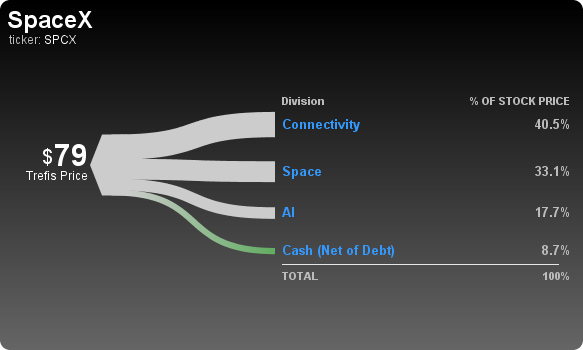
SPCX's core operations are divided into three main segments. The Space segment offers revolutionary, affordable access to orbit using its highly successful Falcon family of reusable rockets, and is developing the next-generation Starship. It transports satellites, astronauts, and other payloads for government and commercial clients worldwide. Its Connectivity segment, powered by the Starlink constellation of approximately 9,600 satellites, delivers high-speed, low-latency broadband internet to millions of consumers, enterprises, and governments in 164 markets, particularly prioritizing underserved rural and remote communities. Additionally, a dedicated satellite-to-mobile constellation provides connectivity services in mobile "dead zones."
The AI segment, incorporating xAI and its frontier model Grok, focuses on developing truth-seeking AI for scientific discovery and advanced reasoning. SPCX is rapidly building gigawatt-scale AI compute infrastructure, with ambitious plans to extend this into space with orbital AI compute satellites by 2028. Grok benefits from deep integration with the X platform, leveraging real-time data for enhanced capabilities. This strategic convergence of SPCX's launch capabilities, global connectivity network, and advanced AI development aims to unlock unprecedented economic expansion and utilize AI as a transformative force for understanding the universe and improving human life.
AI Analysis | Feedback
Here are 1-3 brief analogies for Space Exploration Technologies (SPCX):
- Like Tesla, but for rockets, global internet, and advanced AI.
- The Amazon Web Services (AWS) of space and AI, building foundational infrastructure for humanity's future on Earth and beyond.
AI Analysis | Feedback
Space Launch Services: SpaceX provides reliable and affordable access to space for various payloads, including satellites and astronauts, using its Falcon family of reusable rockets and developing Starship.
Starlink Broadband Internet Service: This global network delivers high-speed, low-latency internet connectivity, primarily targeting underserved rural and remote communities, through its constellation of LEO satellites.
Starlink Satellite-to-Mobile Connectivity: Offering direct data, voice, and messaging services from dedicated satellites to standard mobile devices, substantially reducing "dead zones" worldwide.
Grok AI Model: A truth-seeking artificial intelligence model focused on scientific discovery and understanding the universe, which benefits from real-time data integration with the X platform.
AI Compute Infrastructure: SpaceX designs, builds, and operates advanced compute infrastructure for AI model training and inference, with plans to extend these capabilities to orbital data centers.
Starlink Kits: Essential hardware components, including a dish and router, that enable customers to connect to the Starlink broadband internet network.
AI Analysis | Feedback
Space Exploration Technologies (SPCX) serves a diverse customer base across its various segments. Based on the provided description, the company primarily serves the following three categories of customers:
- Consumer Customers: This category includes millions of individuals who subscribe to Starlink for high-speed, low-latency global broadband internet, especially in underserved rural and remote communities. Additionally, Grok's AI features and the X platform are utilized by millions of monthly active users, falling under the consumer category for AI applications.
- Enterprise Customers: SpaceX provides connectivity services through Starlink to businesses and organizations. The AI segment also targets enterprise AI applications with Grok, indicating businesses as a key customer type for its advanced AI models and compute infrastructure.
- Government Customers: SpaceX's Space segment transports astronauts, satellites, and other payloads on missions, including those for government agencies (e.g., NASA, defense departments). Starlink also delivers connectivity to government customers across various markets.
AI Analysis | Feedback
AI Analysis | Feedback
Elon Musk founded Space Exploration Technologies (SpaceX) in 2002 to advance space exploration. He also co-founded Zip2 in 1995, which was acquired by Compaq Computer Corporation in 1999 for $307 million, and co-founded PayPal (originally X.com) in 1999, which eBay acquired for $1.5 billion in 2002. Musk currently serves as CEO of Tesla, Inc., founder and CEO of xAI (acquired by SpaceX in early 2026), and founder and CTO of X Corp. (formerly Twitter). He is also a co-founder of Neuralink and The Boring Company.
Gwynne Shotwell, President and Chief Operating Officer
Gwynne Shotwell joined SpaceX in 2002 as the 11th employee and Vice President of Business Development. As President and COO, she manages all non-engineering aspects of the company, including legal, finance, sales, and operations, and is responsible for day-to-day operations and company growth. Prior to SpaceX, she spent over 10 years at The Aerospace Corporation in various roles in Space Systems Engineering, Technology, and Project Management, and also served as director of the space systems division at Microcosm Inc.
Bret Johnsen, Chief Financial Officer
Bret Johnsen has served as the Chief Financial Officer of Space Exploration Technologies (SpaceX) since joining in 2011, overseeing the company's financial strategy, planning, risk management, and capital structure. Before his tenure at SpaceX, he spent nearly a decade at Broadcom, advancing to Corporate Controller, and also held the position of Senior Vice President and CFO for Mindspeed Technologies. His experience includes extensive financial leadership in high-growth technology and publicly traded companies.
Phil Alden, Vice President of Starship Production
Phil Alden is responsible for overseeing the manufacturing and production processes of the Starship spacecraft. His expertise lies in production engineering and manufacturing systems. Before his current role, he held positions such as VP of Starlink Production and Senior Director of Production at Space Exploration Technologies (SpaceX), and also had leadership roles at BMW and Jaguar Land Rover.
Kiko Dontchev, Vice President of Launch
Kiko Dontchev oversees Space Exploration Technologies' (SpaceX) launch and recovery operations across sites in California and Florida, ensuring the safety, precision, and operational reliability of all launch missions. He began his career at SpaceX in 2010, initially focusing on developing lithium-ion batteries before transitioning to leadership in launch operations.
AI Analysis | Feedback
Key Risks to Space Exploration Technologies (SPCX)
- Significant Investment in Next-Generation Starship Program with No Guaranteed Returns: The Space segment is funding substantial research and development expenses for its next-generation Starship launch vehicle program, with $930 million in Q1 2026 and $3,004 million in 2025. This program, while key to the company's long-term growth strategy, represents a significant capital outlay with its success and return on investment yet to be fully realized, posing a financial risk.
- Early Stage and High Investment in AI Segment with Sustained Losses: The newly acquired AI segment is in an early stage of development and is currently operating at a significant loss. For the three months ended March 31, 2026, it generated a loss from operations of $(2,469) million and Segment Adjusted EBITDA of $(609) million, with even larger losses in 2025. Capital expenditures for the AI segment were also extremely high, at $7,723 million in Q1 2026 and $12,727 million in 2025. This indicates a high-risk, high-investment strategy with no immediate profitability, requiring sustained capital infusion and carrying the risk of future losses if market adoption or technological advancements do not meet expectations.
- Intense Capital Expenditure Requirements Across All Segments: SpaceX has exceptionally high capital expenditure requirements across all its segments. For the three months ended March 31, 2026, capital expenditures were $1,052 million for Space, $1,332 million for Connectivity, and a staggering $7,723 million for AI. Similarly, in 2025, these figures were $3,832 million for Space, $4,178 million for Connectivity, and $12,727 million for AI. These massive and ongoing capital investments are necessary to maintain and expand its operations and develop new technologies, but they also represent a significant drain on cash flow and expose the company to considerable financial risk if growth or profitability targets are not met.
AI Analysis | Feedback
The rapid advancement and intensifying compute arms race by other leading model providers in the AI industry. While Space Exploration Technologies states that its Grok model achieved "frontier-level performance... on a faster timeline than reported by other leading model providers" and claims a "dual advantage in both cost efficiency and deployment speed at scale" for its compute infrastructure, the existence and rapid progress of these "other leading model providers" represent a continuous and dynamic threat. The massive capital expenditures required for AI compute infrastructure, totaling $7,723 million for the three months ended March 31, 2026, and $12,727 million in 2025, underscore the immense investment needed to compete at the frontier. Should these competitors develop more advanced frontier AI models or superior compute capabilities, they could erode xAI's competitive advantages and challenge Grok's market position.
AI Analysis | Feedback
AI Analysis | Feedback
Space Exploration Technologies (SPCX) is expected to drive future revenue growth over the next 2-3 years through several key areas:
- Expansion of Starlink Connectivity Services: Starlink, primarily within the Connectivity segment, is expected to continue its rapid growth through subscriber acquisition and increasing enterprise adoption. The company explicitly states its intent to expand global access to high-speed internet, prioritizing underserved rural and remote communities. The deployment of Starlink Mobile constellation with satellite-to-mobile capabilities, which began in January 2024, is also a significant driver, aimed at reducing mobile "dead zones" and serving millions of unique devices across more countries.
- Advancement and Commercialization of Starship: The Space segment's significant investment in research and development for the next-generation Starship launch vehicle program is a crucial long-term growth driver. Starship is designed to enable a "step-function change in launch capability across reusability, payload capacity, and launch cadence," which will unlock entirely new categories of missions and revenue streams, fundamentally altering the economics of space access.
- Growth and Monetization of the AI Segment (xAI and Grok): The newly acquired xAI, with its Grok frontier model, is poised for substantial growth. SpaceX plans to prioritize investment in AI applications and compute infrastructure. The rapid construction of AI compute infrastructure, the integration of Grok with X (for real-time data and distribution), and the focus on truth-seeking AI for high-frequency, high-value use cases across consumer and enterprise applications are all expected to generate increasing revenue as the segment matures.
- Deployment of Orbital AI Compute Satellites: A significant future revenue driver is the planned deployment of orbital AI compute satellites, expected to begin as early as 2028. These satellites, leveraging SpaceX's launch capabilities and Starlink's connectivity, are intended to handle energy-intensive AI workloads at greater scale and efficiency than terrestrial alternatives, creating a new market for "orbital data centers" and delivering real-time intelligence globally. This represents a new product/service offering that integrates its core competencies.
AI Analysis | Feedback
Outbound Investments
- SpaceX acquired xAI in early 2026, integrating the AI company, founded in 2023, into its vertically integrated structure.
- The acquisition of xAI aims to unite SpaceX’s launch capabilities and global connectivity network with xAI’s AI development.
Capital Expenditures
- Capital expenditures in 2025 totaled $3,832 million for the Space segment, $4,178 million for the Connectivity segment, and $12,727 million for the AI segment.
- For the three months ended March 31, 2026, capital expenditures included $1,052 million for Space, $1,332 million for Connectivity, and $7,723 million for AI.
- A primary focus of these expenditures includes the Starship launch vehicle program and the rapid construction of AI compute infrastructure, with plans to deploy orbital AI compute satellites starting as early as 2028.
Peer Outperformance in Aerospace & Defense
null| Industry | Names | 1Y med | 3Y med | 5Y med | Top 3 by 5Y |
|---|---|---|---|---|---|
| Construction & Engineering | 31 | 4.6% | 112.2% | 181.7% | FIX 2219% · STRL 2066% · CDNL 2032% |
| Marine Transportation | 9 | 73.4% | 97.7% | 146.2% | HOS 41689% · ASC 475% · MATX 193% |
| Construction Machinery & Heavy Transportation Equipment | 13 | 3.9% | 46.6% | 117.6% | CAT 352% · WAB 242% · ALSN 241% |
| Aerospace & Defense ← | 55 | -9.6% | 67.4% | 70.1% | ATI 969% · FTAI 836% · HWM 626% |
| Rail Transportation | 7 | 19.0% | 58.6% | 52.1% | FSTR 139% · CSX 65% · RAIL 57% |
| Industrial Machinery & Supplies & Components | 72 | 10.9% | 52.2% | 47.3% | CRS 1133% · PSIX 1083% · EROC 583% |
| Trading Companies & Distributors | 19 | 5.0% | 36.0% | 45.4% | DXPE 533% · AIT 282% · WCC 221% |
| Diversified Support Services | 32 | 14.8% | 32.4% | 32.1% | LIME 3263% · TH 412% · WLFC 332% |
| Cargo Ground Transportation | 16 | 34.9% | -0.4% | 28.6% | XPO 257% · R 213% · CVLG 140% |
| Security & Alarm Services | 10 | -24.6% | 48.2% | 25.0% | CIX 163% · VRME 151% · MG 111% |
| Electrical Components & Equipment | 41 | 2.6% | 45.6% | 19.4% | POWL 2297% · BE 1317% · VRT 910% |
| Building Products | 34 | -12.6% | 0.9% | 17.0% | LMB 583% · GFF 373% · PPIH 325% |
| Industrial Conglomerates | 17 | 9.9% | 5.8% | -5.8% | RCMT 566% · CSW 135% · DD 74% |
| Passenger Ground Transportation | 3 | -32.0% | 41.2% | -6.4% | UBER 53% · CAR -6% · LYFT -72% |
| Agricultural & Farm Machinery | 17 | 3.3% | 0.3% | -8.6% | BLBD 172% · DE 109% · GENC 57% |
| Environmental & Facilities Services | 30 | -15.4% | 11.3% | -10.5% | CECO 909% · ADUR 440% · NVRI 306% |
| Research & Consulting Services | 13 | -18.1% | -26.6% | -14.1% | HURN 202% · CRAI 75% · GRNQ 66% |
| Data Processing & Outsourced Services | 6 | -34.5% | -15.9% | -30.0% | EXLS 37% · BR 6% · G -27% |
| Office Services & Supplies | 9 | 15.9% | 17.8% | -33.2% | PBI 168% · TILE 134% · HNI 46% |
| Passenger Airlines | 11 | 16.6% | 16.3% | -34.3% | LTM 2778% · UAL 129% · DAL 101% |
| Human Resource & Employment Services | 22 | 0.2% | -16.1% | -38.2% | BBSI 67% · ADP 47% · HQI 12% |
| Air Freight & Logistics | 12 | -23.3% | -23.7% | -38.6% | CHRW 89% · FDX 81% · EXPD 65% |
| Airport Services | 3 | -71.5% | -77.9% | -68.0% | JOBY -37% · ASLE -68% · UP -100% |
Research & Analysis
Invest in Strategies
Wealth Management
Peer Comparisons
| Peers to compare with: |
Financials
| Median | |
|---|---|
| Name | |
| Mkt Price | 23.43 |
| Mkt Cap | 3.8 |
| Rev LTM | 615 |
| Op Inc LTM | -184 |
| FCF LTM | -167 |
| FCF 3Y Avg | 27 |
| CFO LTM | 48 |
| CFO 3Y Avg | 48 |
Growth & Margins
| Median | |
|---|---|
| Name | |
| Rev Chg LTM | 96.8% |
| Rev Chg 3Y Avg | 15.0% |
| Rev Chg Q | 341.9% |
| QoQ Delta Rev Chg LTM | 30.7% |
| Op Inc Chg LTM | 103.5% |
| Op Inc Chg 3Y Avg | 556.3% |
| Op Mgn LTM | -65.8% |
| Op Mgn 3Y Avg | 6.0% |
| QoQ Delta Op Mgn LTM | 23.1% |
| CFO/Rev LTM | -40.6% |
| CFO/Rev 3Y Avg | 5.2% |
| FCF/Rev LTM | -135.6% |
| FCF/Rev 3Y Avg | 3.0% |
Segment Financials
Revenue by Segment| $ Mil | 2025 | 2024 | 2023 |
|---|---|---|---|
| Connectivity | 11,387 | 7,599 | 3,869 |
| Space | 4,086 | 3,796 | 3,557 |
| Artificial intelligence (AI) | 3,201 | 2,620 | 2,961 |
| Total | 18,674 | 14,015 | 10,387 |
| $ Mil | 2025 | 2024 | 2023 |
|---|---|---|---|
| Connectivity | 4,423 | 2,006 | 469 |
| Space | -657 | 21 | -1 |
| Artificial intelligence (AI) | -6,355 | -1,561 | -3,973 |
| Total | -2,589 | 466 | -3,505 |
Price Behavior
| 1M | 2M | 3M | 6M | 1Y | 3Y | |
|---|---|---|---|---|---|---|
| Beta | 4.51 | 2.76 | 1.35 | 0.51 | 0.62 | -0.52 |
| Up Beta | 3.57 | 2.83 | -2.96 | -2.63 | 1.27 | 1.31 |
| Down Beta | 4.35 | 1.37 | -1.44 | 1.12 | -2.20 | -0.88 |
| Up Capture | 723% | 263% | 311% | 118% | 54% | 5% |
| Bmk +ve Days | 10 | 21 | 32 | 68 | 138 | 427 |
| Stock +ve Days | 13 | 18 | 24 | 24 | 24 | 24 |
| Down Capture | 277% | 345% | 270% | 157% | 98% | 55% |
| Bmk -ve Days | 11 | 21 | 32 | 59 | 113 | 324 |
| Stock -ve Days | 8 | 24 | 30 | 30 | 30 | 30 |
[1] Upside and downside betas calculated using positive and negative benchmark daily returns respectively
Based On 1-Year Data
| Annualized Return | Annualized Volatility | Sharpe Ratio | Correlation with SPCX | |
|---|---|---|---|---|
| SPCX | -9.7% | 84.7% | -0.05 | - |
| Sector ETF (XLI) | 12.6% | 17.2% | 0.52 | 29.6% |
| Equity (SPY) | 17.4% | 13.0% | 0.96 | 43.0% |
| Gold (GLD) | 9.7% | 29.6% | 0.31 | 17.6% |
| Commodities (DBC) | 42.7% | 20.7% | 1.60 | -12.8% |
| Real Estate (VNQ) | 4.3% | 13.6% | 0.06 | -8.2% |
| Bitcoin (BTCUSD) | -23.0% | 44.8% | -0.46 | 11.5% |
Smart multi-asset allocation framework can stack odds in your favor. Learn How
Based On 5-Year Data
| Annualized Return | Annualized Volatility | Sharpe Ratio | Correlation with SPCX | |
|---|---|---|---|---|
| SPCX | -2.0% | 84.7% | -0.05 | - |
| Sector ETF (XLI) | 12.9% | 17.6% | 0.56 | 29.6% |
| Equity (SPY) | 13.5% | 17.2% | 0.60 | 43.0% |
| Gold (GLD) | 18.1% | 18.9% | 0.77 | 17.6% |
| Commodities (DBC) | 11.0% | 19.5% | 0.44 | -12.8% |
| Real Estate (VNQ) | 0.9% | 18.9% | -0.06 | -8.2% |
| Bitcoin (BTCUSD) | 14.4% | 52.4% | 0.45 | 11.5% |
Smart multi-asset allocation framework can stack odds in your favor. Learn How
Based On 10-Year Data
| Annualized Return | Annualized Volatility | Sharpe Ratio | Correlation with SPCX | |
|---|---|---|---|---|
| SPCX | -1.0% | 84.7% | -0.05 | - |
| Sector ETF (XLI) | 13.4% | 20.0% | 0.59 | 29.6% |
| Equity (SPY) | 15.4% | 17.9% | 0.73 | 43.0% |
| Gold (GLD) | 11.7% | 16.4% | 0.58 | 17.6% |
| Commodities (DBC) | 8.5% | 18.1% | 0.38 | -12.8% |
| Real Estate (VNQ) | 4.7% | 20.7% | 0.19 | -8.2% |
| Bitcoin (BTCUSD) | 63.8% | 66.2% | 1.03 | 11.5% |
Smart multi-asset allocation framework can stack odds in your favor. Learn How
Earnings Returns History
Updated 9/4/2026| Forward Returns | |||
|---|---|---|---|
| Earnings Date | 1D Returns | 5D Returns | 21D Returns |
| 8/4/2026 | -13.6% | 6.4% | 12.3% |
| SUMMARY STATS | |||
| # Positive | 0 | 1 | 1 |
| # Negative | 1 | 0 | 0 |
| Median Positive | 6.4% | 12.3% | |
| Median Negative | -13.6% | ||
| Max Positive | 6.4% | 12.3% | |
| Max Negative | -13.6% | ||
| Forward Returns | |||
|---|---|---|---|
| Earnings Date | 1D Returns | 5D Returns | 21D Returns |
| 8/4/2026 | -13.6% | 6.4% | 12.3% |
| SUMMARY STATS | |||
| # Positive | 0 | 1 | 1 |
| # Negative | 1 | 0 | 0 |
| Median Positive | 6.4% | 12.3% | |
| Median Negative | -13.6% | ||
| Max Positive | 6.4% | 12.3% | |
| Max Negative | -13.6% | ||
Space Exploration Technologies — Investor Video Playlist


Industry Resources
| Industrials Resources |
| IndustryWeek |
| Manufacturing.net |
| Aviation Week |
| Aerospace & Defense Resources |
| Defense News |
| FlightGlobal |
External Quote Links
| Y Finance | Barrons |
| TradingView | Morningstar |
| SeekingAlpha | ValueLine |
| Motley Fool | Robinhood |
| CNBC | Etrade |
| MarketWatch | Unusual Whales |
| YCharts | Perplexity Finance |
| FinViz |
Prefer one of these to Trefis? Tell us why.