
Is It Time To Buy Deere Stock?
Here’s what seems confusing at first glance: Deere stock has climbed 12% year-to-date and 15% over the past year, currently trading near $470, even as the company’s earnings have been in free fall. Adjusted earnings dropped from $34.63 in 2023 to $25.62 in 2024, and we expect them to decline further to around $18.55 this year.
But you know what? Despite these falling earnings and the stock already up 15% in a year, we think it’s still a great buy.
Confused?
You’re probably thinking, “Why would anyone buy a stock with declining earnings that’s already run up?”
The answer lies in understanding Deere’s cyclical nature.
Deere isn’t your typical growth stock—it’s a cyclical company tied directly to agricultural demand cycles. Right now, we’re witnessing the agricultural equipment industry near what many believe is the bottom of its current cycle. The consensus among industry watchers points to a recovery beginning around fiscal 2026, with strong growth expected in 2026 and 2027.
Think of it this way: you’re not buying Deere for how it performed yesterday, but for how it will perform tomorrow. And here’s the kicker—when Deere enters an upcycle, the stock moves can be massive. Investors realize this. That’s exactly why the stock keeps climbing despite the weak earnings.
Now, if you’re concerned about the volatility that comes with individual cyclical stocks like Deere, there’s another approach worth considering. The High Quality Portfolio has comfortably outperformed its benchmark—a combination of the S&P 500, Russell, and S&P MidCap indexes—achieving returns exceeding 91% since inception. Why is that? As a group, HQ Portfolio stocks provided better returns with less risk versus the benchmark index; essentially less of a roller-coaster ride, as evident in the HQ Portfolio performance metrics.
But if you’re specifically drawn to Deere’s cyclical upside potential and can handle the volatility, below are the key catalysts that make this story compelling.
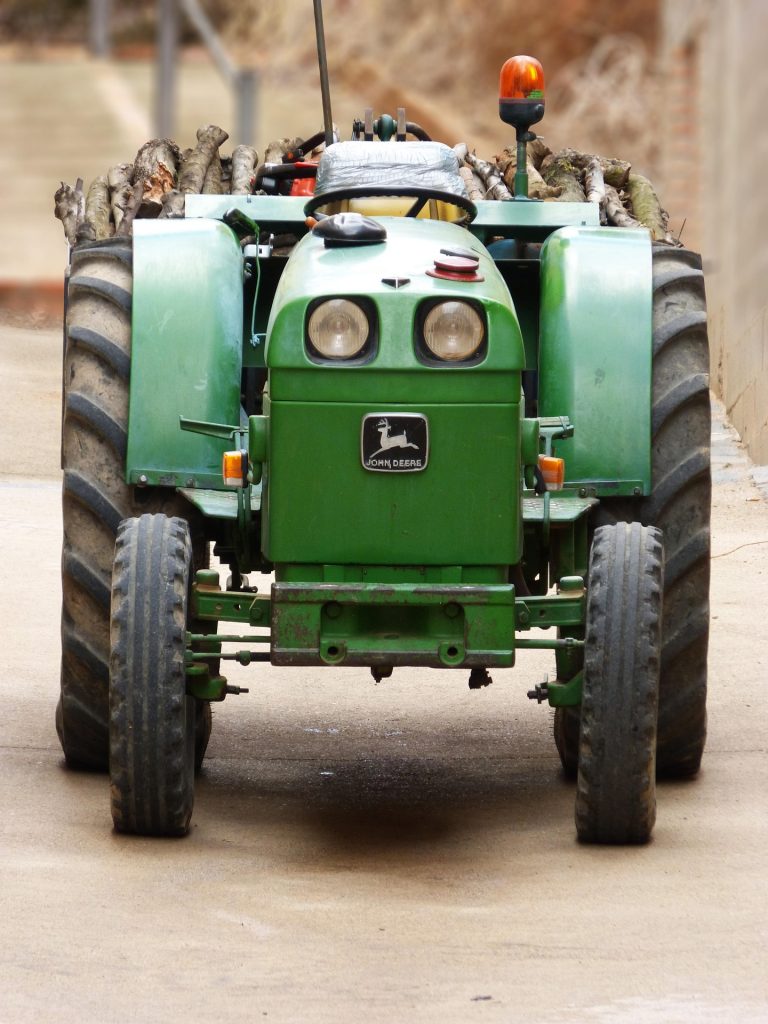
Image by Marc Pascual from Pixabay
Key Catalysts Supporting the Bull Case
- Inventory Normalization: The company has largely completed efforts to stabilize inventory levels in sales channels. This means production is now better aligned with actual retail demand, setting the stage for healthier growth ahead.
- Fed Rate Cuts: Lower interest rates make financing agricultural equipment cheaper for farmers. When money is less expensive to borrow, farmers are more likely to invest in new machinery. The Fed has already cut rates and signaled more cuts ahead—and guess what happens when equipment financing gets cheaper?
- Attractive Valuation: At 2.9 times revenue, Deere trades cheaper than Caterpillar and reasonably compared to the broader market. But is this valuation justified given the cyclical setup?
By The Numbers: Mixed But Not Alarming
Valuation Metrics
- Price-to-Sales: 2.9x (vs. S&P 500’s 3.3x) ✅
- Price-to-Earnings: 24.4x (vs. S&P 500’s 24.0x) ≈
- Price-to-Free Cash Flow: 31.0x (vs. S&P 500’s 21.1x) ❌
Recent Performance Reality Check
The numbers confirm we’re in a cyclical trough:
- Deere’s Revenue declined 20.9% over the last 12 months ($55B to $43B)
- Three-year average revenue decline of 0.6% annually
- Most recent quarter saw 8.3% revenue drop
What’s Still Working
Despite the cyclical headwinds, Deere maintains solid fundamentals—but are these margins sustainable?
- Operating margin: 20.0% (vs. S&P 500’s 18.6%)
- Net income margin: 12.0% (vs. S&P 500’s 12.7%)
- Cash position: $10B representing 9.3% of total assets
Financial Health: Solid Enough
- Debt-to-equity ratio: 52.7% (higher than S&P 500’s 21.0%, but manageable for an industrial company)
But here’s what investors really want to know: can Deere handle the downturn while positioning for the recovery?
Downturn Performance: Battle-Tested Resilience
Deere has proven its mettle during market stress:
- 2022 Inflation Shock: Fell 34.1% but fully recovered within 7 months
- 2020 COVID Pandemic: Dropped 37.4% but bounced back in just 4 months
This track record suggests the DE stock can weather storms and recover strongly when conditions improve.
The Investment Verdict
Here’s our core argument: Deere’s current valuation doesn’t reflect the full upside potential when this cyclical downturn ends. The market seems focused on near-term earnings weakness rather than the company’s positioning for the next upcycle. For investors with a 3-5 year horizon, Deere offers compelling value. You’re essentially getting a market-leading agricultural equipment company at a reasonable price just as the industry appears to be bottoming out.
But here’s the million-dollar question: are you willing to bet that this cyclical downturn is indeed nearing its end?
The Risks to Consider
We could be wrong about the timing—what if the agricultural downturn lasts longer than expected? Or what if investors are hesitant to pay higher premiums for a company with declining earnings? Cyclical investing requires patience and conviction, but are you prepared for potentially more near-term pain?
While there are always risks with investing in single stocks like Deere, you could explore the Trefis Reinforced Value (RV) Portfolio, which has outperformed its all-cap stocks benchmark (combination of the S&P 500, S&P mid-cap, and Russell 2000 benchmark indices) to produce strong returns for investors. Why is that? The quarterly rebalanced mix of large-, mid- and small-cap RV Portfolio stocks provided a responsive way to make the most of upbeat market conditions while limiting losses when markets head south, as detailed in RV Portfolio performance metrics.
Of course, if you believe in the Deere cyclical story and can stomach the individual stock risk, the potential rewards could be significant.
Bottom Line
Deere represents a classic cyclical play: weak current fundamentals masking strong long-term potential. With inventory normalization complete, rate cuts supporting equipment financing, and industry recovery expected by 2026, the setup looks attractive for patient investors.
Invest with Trefis Market-Beating Portfolios
See all Trefis Price Estimates