
CSX (CSX)
Market Price (7/26/2026): $53.38 | Market Cap: $99.0 BilInvestor Relations Sector: Industrials | Industry: Rail Transportation
CSX (CSX)
Market Price (7/26/2026): $53.38Market Cap: $99.0 BilSector: IndustrialsIndustry: Rail Transportation
Investment Highlights Why It Matters Detailed financial logic regarding cash flow yields vs trend-riding momentum.
Attractive operating marginsOp Mgn LTMOperating Margin = Operating Income / Revenue Reflects profitability before taxes and before impact of capital structure (interest payments). is 36% Attractive cash flow generationCFO/Rev LTMCash Flow from Operations / Revenue (Sales), Last Twelve Months (LTM) is 37%, FCF/Rev LTMFree Cash Flow / Revenue (Sales), Last Twelve Months (LTM) is 19%, CFO LTM is 5.3 Bil, FCF LTM is 2.8 Bil Stock buyback supportStock Buyback 3Y Total is 5.7 Bil Low stock price volatilityVol 12M is 23% Megatrend and thematic driversMegatrends include Future of Freight, Automation & Robotics, E-commerce & DTC Adoption, and Sustainable Infrastructure. Show more. | Trading close to highsDist 52W High is 0.0%, Dist 3Y High is 0.0% | Weak revenue growthRev Chg 3Y AvgRevenue Change % averaged over trailing 3 years is -1.1% Key risksCSX key risks include [1] declining revenue from lower export coal and merchandise volumes and [2] operational disruptions from aging infrastructure and challenges maintaining train velocity and terminal dwell times. |
| Attractive operating marginsOp Mgn LTMOperating Margin = Operating Income / Revenue Reflects profitability before taxes and before impact of capital structure (interest payments). is 36% |
| Attractive cash flow generationCFO/Rev LTMCash Flow from Operations / Revenue (Sales), Last Twelve Months (LTM) is 37%, FCF/Rev LTMFree Cash Flow / Revenue (Sales), Last Twelve Months (LTM) is 19%, CFO LTM is 5.3 Bil, FCF LTM is 2.8 Bil |
| Stock buyback supportStock Buyback 3Y Total is 5.7 Bil |
| Low stock price volatilityVol 12M is 23% |
| Megatrend and thematic driversMegatrends include Future of Freight, Automation & Robotics, E-commerce & DTC Adoption, and Sustainable Infrastructure. Show more. |
| Trading close to highsDist 52W High is 0.0%, Dist 3Y High is 0.0% |
| Weak revenue growthRev Chg 3Y AvgRevenue Change % averaged over trailing 3 years is -1.1% |
| Key risksCSX key risks include [1] declining revenue from lower export coal and merchandise volumes and [2] operational disruptions from aging infrastructure and challenges maintaining train velocity and terminal dwell times. |
Qualitative Assessment
AI Analysis | Feedback
CSX (CSX) stock has gained about 30% since 3/31/2026 because of the following key factors:
1. CSX reported exceptionally strong financial results for its fiscal second quarter of 2026, surpassing analyst expectations. The company achieved record quarterly revenue of $3.94 billion, marking a 10% increase year-over-year. Net earnings rose to $1.00 billion, or $0.54 per diluted share, representing a 21% and 23% increase respectively compared to the prior year's fiscal second quarter, and beating the Zacks Consensus Estimate of $0.50 per share. Furthermore, operating income grew by 17% to $1.51 billion, and the operating margin expanded by 240 basis points to 38.3%.
2. The company significantly raised its full-year fiscal 2026 financial outlook, signaling strong confidence in continued performance. Following the robust first-half results, CSX now anticipates full-year revenue growth in the mid-to-high single-digit range, operating margin expansion exceeding 350 basis points, and free cash flow growth of more than 80%. This updated guidance provided a strong positive signal to investors regarding future profitability and operational efficiency.
Show more
CSX (CSX) stock has gained about 30% since 3/31/2026 because of the following key factors:
1. CSX reported exceptionally strong financial results for its fiscal second quarter of 2026, surpassing analyst expectations. The company achieved record quarterly revenue of $3.94 billion, marking a 10% increase year-over-year. Net earnings rose to $1.00 billion, or $0.54 per diluted share, representing a 21% and 23% increase respectively compared to the prior year's fiscal second quarter, and beating the Zacks Consensus Estimate of $0.50 per share. Furthermore, operating income grew by 17% to $1.51 billion, and the operating margin expanded by 240 basis points to 38.3%.
2. The company significantly raised its full-year fiscal 2026 financial outlook, signaling strong confidence in continued performance. Following the robust first-half results, CSX now anticipates full-year revenue growth in the mid-to-high single-digit range, operating margin expansion exceeding 350 basis points, and free cash flow growth of more than 80%. This updated guidance provided a strong positive signal to investors regarding future profitability and operational efficiency.
3. CSX experienced robust volume growth across its key markets, particularly in intermodal, supported by favorable market dynamics. Total volume for fiscal Q2 2026 increased by 6% year-over-year, with broad-based growth in merchandise, intermodal, and coal. Intermodal growth was particularly strong at 9%, driven by factors such as truck-to-rail conversions and new services. This growth was also bolstered by a tightening trucking market, which made rail a more cost-effective shipping option, as well as resilient consumer spending supporting goods movement.
4. Analyst sentiment turned increasingly positive, leading to multiple price target upgrades. Following the strong fiscal Q2 2026 earnings beat and the raised full-year outlook, several analysts increased their price objectives for CSX. For example, TD Cowen raised its price target from $46.00 to $54.00, Robert W. Baird increased its target from $49.00 to $53.00, and B of A Securities moved its target from $53.00 to $56.00. The consensus rating for CSX stock is a "Moderate Buy".
Show less
Stock Movement Drivers
Fundamental Drivers
The 30.1% change in CSX stock from 3/31/2026 to 7/25/2026 was primarily driven by a 16.4% change in the company's P/E Multiple.| (LTM values as of) | 3312026 | 7252026 | Change |
|---|---|---|---|
| Stock Price ($) | 40.92 | 53.23 | 30.1% |
| Change Contribution By: | |||
| Total Revenues ($ Mil) | 14,092 | 14,512 | 3.0% |
| Net Income Margin (%) | 20.5% | 22.2% | 8.3% |
| P/E Multiple | 26.3 | 30.6 | 16.4% |
| Shares Outstanding (Mil) | 1,858 | 1,855 | 0.2% |
| Cumulative Contribution | 30.1% |
Market Drivers
3/31/2026 to 7/25/2026| Return | Correlation | |
|---|---|---|
| CSX | 30.1% | |
| Market (SPY) | 13.6% | 5.4% |
| Sector (XLI) | 12.9% | 48.8% |
Fundamental Drivers
The 47.8% change in CSX stock from 12/31/2025 to 7/25/2026 was primarily driven by a 32.4% change in the company's P/E Multiple.| (LTM values as of) | 12312025 | 7252026 | Change |
|---|---|---|---|
| Stock Price ($) | 36.02 | 53.23 | 47.8% |
| Change Contribution By: | |||
| Total Revenues ($ Mil) | 14,123 | 14,512 | 2.8% |
| Net Income Margin (%) | 20.5% | 22.2% | 8.1% |
| P/E Multiple | 23.1 | 30.6 | 32.4% |
| Shares Outstanding (Mil) | 1,864 | 1,855 | 0.5% |
| Cumulative Contribution | 47.8% |
Market Drivers
12/31/2025 to 7/25/2026| Return | Correlation | |
|---|---|---|
| CSX | 47.8% | |
| Market (SPY) | 8.7% | 27.8% |
| Sector (XLI) | 18.1% | 57.6% |
Fundamental Drivers
The 65.4% change in CSX stock from 6/30/2025 to 7/25/2026 was primarily driven by a 63.0% change in the company's P/E Multiple.| (LTM values as of) | 6302025 | 7252026 | Change |
|---|---|---|---|
| Stock Price ($) | 32.18 | 53.23 | 65.4% |
| Change Contribution By: | |||
| Total Revenues ($ Mil) | 14,282 | 14,512 | 1.6% |
| Net Income Margin (%) | 22.7% | 22.2% | -2.0% |
| P/E Multiple | 18.8 | 30.6 | 63.0% |
| Shares Outstanding (Mil) | 1,890 | 1,855 | 1.9% |
| Cumulative Contribution | 65.4% |
Market Drivers
6/30/2025 to 7/25/2026| Return | Correlation | |
|---|---|---|
| CSX | 65.4% | |
| Market (SPY) | 20.6% | 27.0% |
| Sector (XLI) | 25.1% | 49.4% |
Fundamental Drivers
The 62.9% change in CSX stock from 6/30/2023 to 7/25/2026 was primarily driven by a 93.7% change in the company's P/E Multiple.| (LTM values as of) | 6302023 | 7252026 | Change |
|---|---|---|---|
| Stock Price ($) | 32.67 | 53.23 | 62.9% |
| Change Contribution By: | |||
| Total Revenues ($ Mil) | 15,146 | 14,512 | -4.2% |
| Net Income Margin (%) | 28.0% | 22.2% | -20.7% |
| P/E Multiple | 15.8 | 30.6 | 93.7% |
| Shares Outstanding (Mil) | 2,054 | 1,855 | 10.7% |
| Cumulative Contribution | 62.9% |
Market Drivers
6/30/2023 to 7/25/2026| Return | Correlation | |
|---|---|---|
| CSX | 62.9% | |
| Market (SPY) | 72.6% | 45.4% |
| Sector (XLI) | 77.3% | 60.4% |
Price Returns Compared
| 2021 | 2022 | 2023 | 2024 | 2025 | 2026 | Total [1] | |
|---|---|---|---|---|---|---|---|
| Returns | |||||||
| CSX Return | 26% | -17% | 14% | -6% | 14% | 47% | 88% |
| Peers Return | 24% | -8% | 10% | -9% | 9% | 33% | 66% |
| S&P 500 Return | 27% | -19% | 24% | 23% | 16% | 8% | 97% |
Monthly Win Rates [3] | |||||||
| CSX Win Rate | 58% | 33% | 50% | 50% | 58% | 71% | |
| Peers Win Rate | 52% | 38% | 52% | 45% | 57% | 71% | |
| S&P 500 Win Rate | 75% | 42% | 67% | 75% | 67% | 43% | |
Max Drawdowns [4] | |||||||
| CSX Max Drawdown | -13% | -29% | -15% | -17% | -20% | -12% | |
| Peers Max Drawdown | -16% | -26% | -19% | -21% | -20% | -13% | |
| S&P 500 Max Drawdown | -5% | -25% | -10% | -8% | -19% | -9% | |
[1] Cumulative total returns since the beginning of 2021
[2] Peers: UNP, NSC, CNI, CP, JBHT. See CSX Returns vs. Peers.
[3] Win Rate = % of calendar months in which monthly returns were positive
[4] Max drawdown represents maximum peak-to-trough decline within a year
[5] 2026 data is for the year up to 7/24/2026 (YTD)
How Low Can It Go
| Event | CSX | S&P 500 |
|---|---|---|
| 2025 US Tariff Shock | ||
| % Loss | -17.3% | -18.8% |
| % Gain to Breakeven | 20.9% | 23.1% |
| Time to Breakeven | 59 days | 79 days |
| Summer-Fall 2023 Five Percent Yield Shock | ||
| % Loss | -11.5% | -9.5% |
| % Gain to Breakeven | 13.0% | 10.5% |
| Time to Breakeven | 35 days | 24 days |
| 2023 SVB Regional Banking Crisis | ||
| % Loss | -10.9% | -6.7% |
| % Gain to Breakeven | 12.2% | 7.1% |
| Time to Breakeven | 29 days | 31 days |
| 2022 Inflation Shock & Fed Tightening | ||
| % Loss | -27.8% | -24.5% |
| % Gain to Breakeven | 38.6% | 32.4% |
| Time to Breakeven | 478 days | 427 days |
| 2020 COVID-19 Crash | ||
| % Loss | -40.3% | -33.7% |
| % Gain to Breakeven | 67.6% | 50.9% |
| Time to Breakeven | 176 days | 140 days |
| Q4 2018 Fed Policy Error / Growth Scare | ||
| % Loss | -21.4% | -19.2% |
| % Gain to Breakeven | 27.2% | 23.8% |
| Time to Breakeven | 95 days | 105 days |
In The Past
CSX's stock fell -17.3% during the 2025 US Tariff Shock. Such a loss loss requires a 20.9% gain to breakeven.
Preserve Wealth
Limiting losses and compounding gains is essential to preserving wealth.
Asset Allocation
Actively managed asset allocation strategies protect wealth. Learn more.
| Event | CSX | S&P 500 |
|---|---|---|
| 2022 Inflation Shock & Fed Tightening | ||
| % Loss | -27.8% | -24.5% |
| % Gain to Breakeven | 38.6% | 32.4% |
| Time to Breakeven | 478 days | 427 days |
| 2020 COVID-19 Crash | ||
| % Loss | -40.3% | -33.7% |
| % Gain to Breakeven | 67.6% | 50.9% |
| Time to Breakeven | 176 days | 140 days |
| Q4 2018 Fed Policy Error / Growth Scare | ||
| % Loss | -21.4% | -19.2% |
| % Gain to Breakeven | 27.2% | 23.8% |
| Time to Breakeven | 95 days | 105 days |
| 2015-2016 China Devaluation / Global Growth Scare | ||
| % Loss | -25.0% | -12.2% |
| % Gain to Breakeven | 33.3% | 13.9% |
| Time to Breakeven | 171 days | 62 days |
| 2014-2016 Oil Price Collapse | ||
| % Loss | -27.0% | -6.8% |
| % Gain to Breakeven | 36.9% | 7.3% |
| Time to Breakeven | 240 days | 15 days |
| 2011 US Debt Ceiling Crisis & European Contagion | ||
| % Loss | -27.1% | -17.9% |
| % Gain to Breakeven | 37.2% | 21.8% |
| Time to Breakeven | 541 days | 123 days |
| 2008-2009 Global Financial Crisis | ||
| % Loss | -52.7% | -53.4% |
| % Gain to Breakeven | 111.4% | 114.4% |
| Time to Breakeven | 151 days | 1085 days |
| Summer 2007 Credit Crunch | ||
| % Loss | -20.2% | -8.6% |
| % Gain to Breakeven | 25.3% | 9.5% |
| Time to Breakeven | 137 days | 47 days |
In The Past
CSX's stock fell -17.3% during the 2025 US Tariff Shock. Such a loss loss requires a 20.9% gain to breakeven.
Preserve Wealth
Limiting losses and compounding gains is essential to preserving wealth.
Asset Allocation
Actively managed asset allocation strategies protect wealth. Learn more.
About CSX (CSX)
CSX Corporation is a prominent freight rail transportation company primarily operating in the eastern United States, the District of Columbia, and the Canadian provinces of Ontario and Quebec. The company manages an extensive 19,500-route-mile rail network, supported by approximately 3,500 locomotives, providing essential rail-based services for moving a wide variety of goods across its vast service area.
The company's core services include direct rail transportation for diverse commodities such as chemicals, agricultural and food products, automotive components, minerals, forest products, fertilizers, metals, and equipment. CSX is also a significant transporter of coal, coke, and iron ore, serving electricity-generating power plants, steel manufacturers, and industrial facilities, while also facilitating coal exports. Beyond traditional rail, CSX offers intermodal transportation services, moving manufactured consumer goods in containers through a network of terminals, which includes drayage services for pickup and delivery. Additionally, CSX connects non-rail served customers through rail-to-truck transfer operations, effectively extending its reach to a broad customer base across various industries.
AI Analysis | Feedback
The FedEx/UPS of the rail world: Imagine the massive logistics network and transportation capabilities of FedEx or UPS, but focused on moving heavy, bulk, and containerized freight across a vast railroad system in the eastern U.S. and Canada.
Maersk for North American land freight: Similar to how Maersk dominates global ocean shipping for containers and bulk cargo, CSX is a major player providing the essential rail-based freight transportation across a large part of the North American continent.
AI Analysis | Feedback
- Rail Freight Transportation: The core service involving the movement of various commodities, such as chemicals, agricultural products, automotive components, and coal, across its extensive rail network.
- Intermodal Transportation Services: Transporting manufactured consumer goods in containers and trailers, integrating rail with other modes of transport through a network of terminals.
- Drayage Services: Providing pickup and delivery services for intermodal shipments, completing the crucial first or last mile of transport.
- Rail-to-Truck Transfers: Services that facilitate the transfer of products from rail cars to trucks, enabling connections for customers not directly served by rail.
- Distribution and Storage Services: Offering facilities and logistics support, particularly for the automotive industry, including distribution centers and storage locations.
AI Analysis | Feedback
- Companies in **heavy industries** such as electricity-generating power plants, steel manufacturers, and other industrial plants that transport bulk commodities like coal, coke, and iron ore.
- Manufacturers and distributors in sectors that produce **chemicals, agricultural and food products, automotive components and vehicles, minerals, forest products, fertilizers, and metals and equipment**.
- Companies involved in the **automotive industry**, utilizing CSX for distribution and storage.
- Businesses transporting **manufactured consumer goods** through intermodal containers, including those requiring drayage services for pickup and delivery.
- Companies involved in **exporting commodities**, such as coal, to deep-water port facilities.
- Businesses needing **intermodal transfer services**, such as moving products like plastics and ethanol from rail to trucks for non-rail served locations.
AI Analysis | Feedback
- Wabtec Corporation (WAB)
- Caterpillar Inc. (CAT)
- The Greenbrier Companies (GBX)
- Trinity Industries, Inc. (TRN)
AI Analysis | Feedback
Steve Angel, President and Chief Executive Officer
Steve Angel was appointed President and Chief Executive Officer of CSX, effective September 28, 2025. He brings over 45 years of experience leading large, public companies. Before joining CSX, Angel served as CEO of Linde plc from 2018 to 2022 and as its Chairman since 2022. Prior to that, he was CEO of Praxair, Inc. from 2007 to 2018. His career also includes over 22 years in various management positions at General Electric, where he worked directly with locomotive and rail operations.
Kevin Boone, Executive Vice President and Chief Financial Officer
Kevin Boone is the Executive Vice President and Chief Financial Officer of CSX, a position he assumed on October 29, 2025. In this role, he oversees all financial operations, corporate communications, investor relations, procurement, tax, and treasury. Boone previously served as Executive Vice President and Chief Commercial Officer, leading CSX's Sales and Marketing organization for four years. He also held the CFO role for two years during the COVID-19 pandemic. Before joining CSX in 2017, Boone spent 18 years in the investment industry, with roles at Janus Capital, Morgan Stanley, and Merrill Lynch, focusing on finance, accounting, and mergers and acquisitions.
Mike Cory, Executive Vice President and Chief Operating Officer
Mike Cory serves as Executive Vice President and Chief Operating Officer at CSX. He is responsible for overseeing CSX's operations strategy and coordinating all aspects of the company's Transportation, Mechanical, and Engineering department performance.
Stephen Fortune, Executive Vice President and Chief Digital and Technology Officer
Stephen Fortune is the Executive Vice President and Chief Digital and Technology Officer for CSX. He is responsible for leading CSX's technology strategy development, supporting business growth through innovative digital solutions, and overseeing all aspects of the company's information technology systems operations.
Maryclare Kenney, Senior Vice President and Chief Commercial Officer
Maryclare Kenney is the Senior Vice President and Chief Commercial Officer, a role she was promoted to on October 29, 2025. She has been a pivotal leader in CSX's commercial operations for nearly 14 years, driving growth across various business segments. Her previous roles at CSX include responsibilities across Merchandise Sales and Marketing, TRANSFLO, Automotive, and TDSI, and she previously led Intermodal and Automotive. Before joining CSX in 2011, Kenney held sales leadership and strategy roles at PepsiCo and served seven years in the U.S. Army, achieving the rank of captain.
AI Analysis | Feedback
Key Risks to CSX Corporation (CSX)
- Operational Disruptions and Network Resilience: CSX faces significant risks from operational disruptions, including severe weather events like hurricanes and harsh winters, and major infrastructure projects. These events can lead to network congestion, service slowdowns, and challenges such as locomotive or crew shortages, directly impacting operating efficiency, service levels, and shipment volumes. For example, in the first quarter of 2025, CSX incurred approximately $45 million in costs due to network disruptions and severe winter weather. Major construction, such as the Howard Street Tunnel project, has forced rerouting and constrained the railroad's ability to respond to other challenges, diminishing network flexibility.
- Fluctuations in Freight Demand and Commodity Markets: The company's financial performance is closely tied to overall economic health and the demand for key commodities. CSX is navigating an industrial slowdown, with overall revenue dipping, and faces a persistently weak coal market, which has contributed to below-par revenues and a decline in operating income. While intermodal volume growth is a long-term positive, it is a lower-margin business and may not fully offset the weakness in higher-margin carload segments. Macroeconomic uncertainties and commodity market swings pose ongoing challenges to revenue generation.
- Regulatory and Legal Environment: As a major transportation company, CSX is subject to extensive government regulation and compliance requirements from various federal, state, and local agencies. Changes in legislation or regulations can impact the company's earnings and its ability to independently negotiate prices. Furthermore, CSX faces environmental liabilities and legal risks that could significantly affect its financial health, requiring continuous vigilance and adaptability.
AI Analysis | Feedback
- Autonomous Trucking: The development and commercialization of autonomous long-haul trucking technology represents a clear emerging threat. Should autonomous trucks significantly reduce labor costs and improve efficiency for road freight, they could make trucking a much more cost-competitive option against rail for various types of cargo, especially for intermodal shipments and longer hauls, potentially eroding rail's traditional cost advantages.
- Declining Demand for Coal: CSX's business includes the transportation of coal to electricity-generating power plants and for export. There is an accelerating global trend towards decarbonization, with many power plants transitioning away from coal to cleaner energy sources like natural gas and renewables. This structural shift in the energy market poses a significant and ongoing threat to a substantial segment of CSX's freight volume and revenue.
AI Analysis | Feedback
AI Analysis | Feedback
-
Intermodal Growth and Network Enhancements
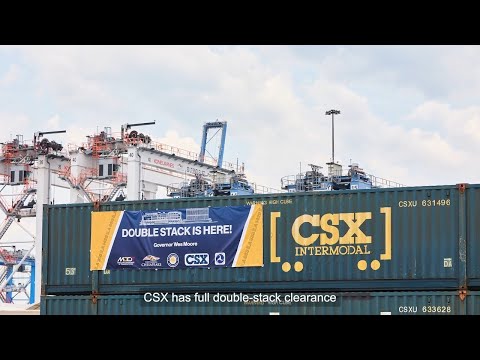
CSX anticipates positive volume growth driven by its intermodal segment, which is expected to see mid-single-digit growth and offset weaknesses in other areas. A significant contributor to this growth is the modernization of Baltimore's Howard Street Tunnel, which is projected to enable double-stack intermodal service by Q1 2026. This project will enhance network capacity along the I-95 corridor, improving intermodal fluidity and creating new growth opportunities. Furthermore, the company's network strength and new business wins are expected to support intermodal expansion. -
Strategic Infrastructure Investments and Acquisitions
CSX is making strategic investments to expand its network and capacity. The acquisition of Genesee & Wyoming Inc.'s Meridian & Bigbee Railroad aims to improve East-West traffic routes and strengthen partnerships, such as with CPKC. The company invested $2.5 billion in 2024 to bolster its infrastructure, which includes maintenance and enhancements to support future demands. These investments are designed to unlock new markets and drive incremental growth. -
Increased Demand from Infrastructure-Related Shipments
CSX is well-positioned to benefit from ongoing infrastructure project activity across its service area, which is driving demand for essential materials such as cement and aggregates. The expansion of its 'Select Site' program, which added 16 new rail-served properties in 2024 and diversified new customer facilities in early 2025, further aims to attract and support businesses seeking rail connectivity, thereby bolstering future freight volumes. -
Pricing Power and Operational Efficiencies
While not solely a revenue growth driver, CSX's focus on achieving "inflation-plus pricing" in the medium to long term and implementing new structures to enhance pricing is expected to contribute to higher revenue per unit. The company aims for a 200-300 basis point operating margin expansion in 2026, driven by workforce optimization, over 100 cost-efficiency initiatives, and improved asset utilization. These efficiencies can allow for more competitive service offerings and potentially lead to increased volumes and better revenue realization.
AI Analysis | Feedback
Share Repurchases
- CSX repurchased shares worth $1.39 billion in 2025.
- The company repurchased shares totaling $2.23 billion in 2024.
- Share repurchases amounted to $3.48 billion in 2023.
Share Issuance
- No significant share issuances by CSX were reported over the last 3-5 years; the number of shares outstanding has generally declined due to repurchases.
Inbound Investments
- No significant inbound investments made in CSX by third-parties were reported for the last 3-5 years.
Outbound Investments
- No significant strategic outbound investments in other companies by CSX were reported for the last 3-5 years. CSX's financial statements show investments in affiliates and other companies totaling $2.634 billion in 2025 and $2.520 billion in 2024.
Capital Expenditures
- CSX's capital expenditures were $2.942 billion in 2025 and $2.939 billion in 2024.
- For 2026, CSX expects total capital expenditures to be below $2.4 billion, which is described as a substantial reduction from the prior year.
- The primary focus of capital expenditures includes safety, reliability, and growth projects, with key infrastructure investments such as the completion of the Howard Street Tunnel expected to enhance intermodal fluidity and generate annual savings, and the rebuilding of the Blue Ridge Subdivision to improve network resiliency.

Latest Trefis Analyses
Research & Analysis
Invest in Strategies
Wealth Management
Peer Comparisons
| Peers to compare with: |
Financials
| Median | |
|---|---|
| Name | |
| Mkt Price | 208.89 |
| Mkt Cap | 80.8 |
| Rev LTM | 14,748 |
| Op Inc LTM | 4,879 |
| FCF LTM | 2,420 |
| FCF 3Y Avg | 2,289 |
| CFO LTM | 5,226 |
| CFO 3Y Avg | 5,052 |
Growth & Margins
| Median | |
|---|---|
| Name | |
| Rev Chg LTM | 3.3% |
| Rev Chg 3Y Avg | 0.2% |
| Rev Chg Q | 11.3% |
| QoQ Delta Rev Chg LTM | 2.8% |
| Op Inc Chg LTM | 3.8% |
| Op Inc Chg 3Y Avg | -3.0% |
| Op Mgn LTM | 36.1% |
| Op Mgn 3Y Avg | 36.8% |
| QoQ Delta Op Mgn LTM | -0.2% |
| CFO/Rev LTM | 35.5% |
| CFO/Rev 3Y Avg | 34.8% |
| FCF/Rev LTM | 16.5% |
| FCF/Rev 3Y Avg | 15.8% |
Valuation
| Median | |
|---|---|
| Name | |
| Mkt Cap | 80.8 |
| P/S | 5.9 |
| P/Op Inc | 17.5 |
| P/EBIT | 17.9 |
| P/E | 27.4 |
| P/CFO | 17.4 |
| Total Yield | 5.4% |
| Dividend Yield | 1.3% |
| FCF Yield 3Y Avg | 3.4% |
| D/E | 0.2 |
| Net D/E | 0.2 |
Returns
| Median | |
|---|---|
| Name | |
| 1M Rtn | 9.9% |
| 3M Rtn | 14.3% |
| 6M Rtn | 33.2% |
| 12M Rtn | 39.2% |
| 3Y Rtn | 42.2% |
| 1M Excs Rtn | 12.8% |
| 3M Excs Rtn | 9.6% |
| 6M Excs Rtn | 25.4% |
| 12M Excs Rtn | 20.4% |
| 3Y Excs Rtn | -9.6% |
Comparison Analyses
Segment Financials
Revenue by Segment| $ Mil | 2025 | 2024 | 2023 | 2022 | 2021 |
|---|---|---|---|---|---|
| Rail | 13,276 | 13,696 | 13,775 | 13,887 | 12,522 |
| Trucking Revenue | 839 | 851 | 887 | 968 | |
| Elimination of intersegment revenues | -23 | -7 | -5 | -2 | |
| Total | 14,092 | 14,540 | 14,657 | 14,853 | 12,522 |
| $ Mil | 2025 | 2024 | 2023 | 2022 | 2009 |
|---|---|---|---|---|---|
| Rail | 4,689 | 5,346 | 5,467 | 5,902 | 2,123 |
| Trucking Revenue and Eliminations | 816 | 844 | 882 | 966 | |
| Trucking Expenses and elimination | -984 | -945 | -850 | -914 | |
| Intermodal | 162 | ||||
| Total | 4,521 | 5,245 | 5,499 | 5,954 | 2,285 |
| $ Mil | 2025 | 2024 | 2023 | 2009 | 2008 |
|---|---|---|---|---|---|
| Rail | 43,500 | 42,600 | 42,000 | 26,107 | 25,343 |
| Elimination of Intersegment Payables (Receivables) (a) | -511 | ||||
| Intermodal | 359 | 321 | |||
| Investment in Conrail | 650 | ||||
| Non-segment Assets (a) | 431 | ||||
| Total | 43,500 | 42,600 | 42,000 | 27,036 | 25,664 |
Price Behavior
| Market Price | $53.23 | |
| Market Cap ($ Bil) | 99.0 | |
| First Trading Date | 11/03/1980 | |
| Distance from 52W High | 0.0% | |
| 50 Days | 200 Days | |
| DMA Price | $47.59 | $40.75 |
| DMA Trend | up | up |
| Distance from DMA | 11.9% | 30.6% |
| 3M | 1YR | |
| Volatility | 23.2% | 22.9% |
| Downside Capture | -24.17 | 35.02 |
| Upside Capture | 56.06 | 77.48 |
| Correlation (SPY) | 5.4% | 27.7% |
| 1M | 2M | 3M | 6M | 1Y | 3Y | |
|---|---|---|---|---|---|---|
| Beta | 0.25 | 0.36 | 0.42 | 0.62 | 0.57 | 0.69 |
| Up Beta | -0.18 | 0.45 | 0.75 | 0.66 | 0.39 | 0.78 |
| Down Beta | 0.02 | 0.09 | 0.23 | 0.58 | 0.52 | 0.57 |
| Up Capture | 79% | 53% | 53% | 83% | 76% | 39% |
| Bmk +ve Days | 11 | 24 | 40 | 67 | 140 | 429 |
| Stock +ve Days | 13 | 20 | 33 | 72 | 138 | 395 |
| Down Capture | 19% | 34% | -3% | 40% | 58% | 87% |
| Bmk -ve Days | 10 | 17 | 23 | 58 | 112 | 321 |
| Stock -ve Days | 8 | 21 | 30 | 53 | 114 | 354 |
[1] Upside and downside betas calculated using positive and negative benchmark daily returns respectively
Based On 1-Year Data
| Annualized Return | Annualized Volatility | Sharpe Ratio | Correlation with CSX | |
|---|---|---|---|---|
| CSX | 54.6% | 22.9% | 1.83 | - |
| Sector ETF (XLI) | 20.1% | 16.6% | 0.93 | 50.8% |
| Equity (SPY) | 17.6% | 12.7% | 1.00 | 27.4% |
| Gold (GLD) | 19.2% | 28.1% | 0.61 | 13.1% |
| Commodities (DBC) | 34.7% | 19.1% | 1.42 | -10.1% |
| Real Estate (VNQ) | 13.8% | 14.1% | 0.69 | 38.8% |
| Bitcoin (BTCUSD) | -46.2% | 42.9% | -1.32 | 15.6% |
Smart multi-asset allocation framework can stack odds in your favor. Learn How
Based On 5-Year Data
| Annualized Return | Annualized Volatility | Sharpe Ratio | Correlation with CSX | |
|---|---|---|---|---|
| CSX | 12.6% | 23.5% | 0.47 | - |
| Sector ETF (XLI) | 14.0% | 17.6% | 0.63 | 66.7% |
| Equity (SPY) | 12.8% | 17.1% | 0.58 | 56.0% |
| Gold (GLD) | 17.0% | 18.4% | 0.75 | 7.6% |
| Commodities (DBC) | 9.6% | 19.5% | 0.38 | 16.1% |
| Real Estate (VNQ) | 3.0% | 18.9% | 0.06 | 51.1% |
| Bitcoin (BTCUSD) | 15.3% | 53.4% | 0.47 | 19.1% |
Smart multi-asset allocation framework can stack odds in your favor. Learn How
Based On 10-Year Data
| Annualized Return | Annualized Volatility | Sharpe Ratio | Correlation with CSX | |
|---|---|---|---|---|
| CSX | 20.3% | 27.7% | 0.70 | - |
| Sector ETF (XLI) | 13.9% | 20.0% | 0.61 | 71.9% |
| Equity (SPY) | 14.9% | 17.9% | 0.71 | 63.2% |
| Gold (GLD) | 11.3% | 16.1% | 0.57 | 3.5% |
| Commodities (DBC) | 7.2% | 17.9% | 0.32 | 24.7% |
| Real Estate (VNQ) | 5.2% | 20.7% | 0.21 | 52.4% |
| Bitcoin (BTCUSD) | 58.1% | 66.2% | 0.98 | 13.9% |
Smart multi-asset allocation framework can stack odds in your favor. Learn How
Earnings Returns History
Updated 7/26/2026| Forward Returns | |||
|---|---|---|---|
| Earnings Date | 1D Returns | 5D Returns | 21D Returns |
| 7/22/2026 | 5.8% | ||
| 4/22/2026 | 6.9% | 3.5% | 6.3% |
| 1/22/2026 | 2.4% | 5.8% | 17.3% |
| 10/16/2025 | 1.7% | -1.3% | -3.0% |
| 7/23/2025 | 0.1% | 0.9% | 2.6% |
| 4/16/2025 | 1.2% | 2.9% | 14.5% |
| 1/23/2025 | -2.9% | -2.4% | -5.5% |
| 10/16/2024 | -6.7% | -5.3% | 0.5% |
| ... | |||
| SUMMARY STATS | |||
| # Positive | 18 | 12 | 16 |
| # Negative | 7 | 12 | 8 |
| Median Positive | 2.5% | 3.5% | 6.2% |
| Median Negative | -3.2% | -2.4% | -2.3% |
| Max Positive | 6.9% | 7.1% | 17.3% |
| Max Negative | -6.7% | -5.4% | -12.4% |
| Forward Returns | |||
|---|---|---|---|
| Earnings Date | 1D Returns | 5D Returns | 21D Returns |
| 7/22/2026 | 5.8% | ||
| 4/22/2026 | 6.9% | 3.5% | 6.3% |
| 1/22/2026 | 2.4% | 5.8% | 17.3% |
| 10/16/2025 | 1.7% | -1.3% | -3.0% |
| 7/23/2025 | 0.1% | 0.9% | 2.6% |
| 4/16/2025 | 1.2% | 2.9% | 14.5% |
| 1/23/2025 | -2.9% | -2.4% | -5.5% |
| 10/16/2024 | -6.7% | -5.3% | 0.5% |
| 8/5/2024 | 2.6% | 1.5% | 6.0% |
| 4/17/2024 | 0.7% | -1.4% | -0.7% |
| 1/24/2024 | 1.8% | 3.8% | 11.5% |
| 10/19/2023 | 0.7% | -3.1% | 3.5% |
| 7/20/2023 | -3.7% | -2.0% | -8.4% |
| 4/20/2023 | 3.3% | -1.4% | 4.9% |
| 1/25/2023 | -2.9% | 1.7% | -1.0% |
| 10/20/2022 | 1.7% | 6.4% | 14.0% |
| 7/20/2022 | 4.2% | 7.1% | 15.5% |
| 4/20/2022 | 2.8% | -2.3% | -12.4% |
| 1/20/2022 | -3.2% | -4.8% | -1.6% |
| 10/20/2021 | 1.6% | 4.1% | 5.1% |
| 7/21/2021 | 3.5% | 1.1% | 6.4% |
| 4/20/2021 | 4.3% | 3.5% | -0.1% |
| 1/21/2021 | -4.3% | -5.4% | 1.1% |
| 10/21/2020 | 3.8% | -3.5% | 16.5% |
| 7/22/2020 | -2.4% | -1.8% | 0.9% |
| SUMMARY STATS | |||
| # Positive | 18 | 12 | 16 |
| # Negative | 7 | 12 | 8 |
| Median Positive | 2.5% | 3.5% | 6.2% |
| Median Negative | -3.2% | -2.4% | -2.3% |
| Max Positive | 6.9% | 7.1% | 17.3% |
| Max Negative | -6.7% | -5.4% | -12.4% |
SEC Filings
Expand for More| Report Date | Filing Date | Filing |
|---|---|---|
| 06/30/2026 | 07/22/2026 | 10-Q |
| 03/31/2026 | 04/22/2026 | 10-Q |
| 12/31/2025 | 02/12/2026 | 10-K |
| 09/30/2025 | 10/16/2025 | 10-Q |
| 06/30/2025 | 07/23/2025 | 10-Q |
| 03/31/2025 | 04/16/2025 | 10-Q |
| 12/31/2024 | 02/27/2025 | 10-K |
| 09/30/2024 | 10/17/2024 | 10-Q |
| 06/30/2024 | 08/05/2024 | 10-Q |
| 03/31/2024 | 04/18/2024 | 10-Q |
| 12/31/2023 | 02/14/2024 | 10-K |
| 09/30/2023 | 10/20/2023 | 10-Q |
| 06/30/2023 | 07/20/2023 | 10-Q |
| 03/31/2023 | 04/20/2023 | 10-Q |
| 12/31/2022 | 02/15/2023 | 10-K |
| 09/30/2022 | 10/21/2022 | 10-Q |
| Report Date | Filing Date | Filing |
|---|---|---|
| 06/30/2026 | 07/22/2026 | 10-Q |
| 03/31/2026 | 04/22/2026 | 10-Q |
| 12/31/2025 | 02/12/2026 | 10-K |
| 09/30/2025 | 10/16/2025 | 10-Q |
| 06/30/2025 | 07/23/2025 | 10-Q |
| 03/31/2025 | 04/16/2025 | 10-Q |
| 12/31/2024 | 02/27/2025 | 10-K |
| 09/30/2024 | 10/17/2024 | 10-Q |
| 06/30/2024 | 08/05/2024 | 10-Q |
| 03/31/2024 | 04/18/2024 | 10-Q |
| 12/31/2023 | 02/14/2024 | 10-K |
| 09/30/2023 | 10/20/2023 | 10-Q |
| 06/30/2023 | 07/20/2023 | 10-Q |
| 03/31/2023 | 04/20/2023 | 10-Q |
| 12/31/2022 | 02/15/2023 | 10-K |
| 09/30/2022 | 10/21/2022 | 10-Q |
| 06/30/2022 | 07/21/2022 | 10-Q |
| 03/31/2022 | 04/21/2022 | 10-Q |
| 12/31/2021 | 02/16/2022 | 10-K |
| 09/30/2021 | 10/21/2021 | 10-Q |
| 06/30/2021 | 07/22/2021 | 10-Q |
| 03/31/2021 | 04/21/2021 | 10-Q |
| 12/31/2020 | 02/10/2021 | 10-K |
| 09/30/2020 | 10/22/2020 | 10-Q |
| 06/30/2020 | 07/23/2020 | 10-Q |
| 03/31/2020 | 04/23/2020 | 10-Q |
| 12/31/2019 | 02/12/2020 | 10-K |
| 09/30/2019 | 10/17/2019 | 10-Q |
Insider Activity
Updated 6/17/2026| # | Owner | Title | Holding | Action | Filing Date | Price | Shares | Transacted Value | Value of Held Shares | Form |
|---|---|---|---|---|---|---|---|---|---|---|
| 1 | Boone, Kevin S | EVP & CFO | Direct | Sell | 6052026 | 46.70 | 136,708 | 6,384,264 | 9,742,647 | Form |
| 2 | Zillmer, John J | Direct | Sell | 6042026 | 46.45 | 10,000 | 464,500 | 16,430,015 | Form | |
| 3 | Angel, Stephen F | President & CEO | Direct | Buy | 3062026 | 40.27 | 25,000 | 1,006,750 | 5,901,166 | Form |
| 4 | Sorfleet, Diana B | EVP & CAO | Direct | Sell | 2202026 | 41.56 | 90,000 | 3,740,400 | 6,882,876 | Form |
| 5 | Fortune, Stephen | EVP - CD & TO | Direct | Sell | 2042026 | 38.65 | 31,456 | 1,215,774 | 3,170,614 | Form |
| # | Owner | Title | Holding | Action | Filing Date | Price | Shares | Transacted Value | Value of Held Shares | Form |
|---|---|---|---|---|---|---|---|---|---|---|
| 1 | Boone, Kevin S | EVP & CFO | Direct | Sell | 6052026 | 46.70 | 136,708 | 6,384,264 | 9,742,647 | Form |
| 2 | Zillmer, John J | Direct | Sell | 6042026 | 46.45 | 10,000 | 464,500 | 16,430,015 | Form | |
| 3 | Angel, Stephen F | President & CEO | Direct | Buy | 3062026 | 40.27 | 25,000 | 1,006,750 | 5,901,166 | Form |
| 4 | Sorfleet, Diana B | EVP & CAO | Direct | Sell | 2202026 | 41.56 | 90,000 | 3,740,400 | 6,882,876 | Form |
| 5 | Fortune, Stephen | EVP - CD & TO | Direct | Sell | 2042026 | 38.65 | 31,456 | 1,215,774 | 3,170,614 | Form |
| 6 | Sorfleet, Diana B | EVP & CAO | Direct | Sell | 1282026 | 37.48 | 66,667 | 2,498,679 | 6,400,722 | Form |
| 7 | Boone, Kevin S | EVP & CCO | Direct | Sell | 10242025 | 36.09 | 31,053 | 1,120,703 | 7,128,533 | Form |
| 8 | Burns, Michael S | SVP - CLO & Corp Secy | Direct | Sell | 10222025 | 36.76 | 24,249 | 891,393 | 1,898,286 | Form |
| 9 | Angel, Stephen F | President & CEO | Direct | Buy | 10212025 | 36.87 | 55,000 | 2,027,850 | 2,147,088 | Form |
Investor Activity (13F)
Updated Jul 26, 2026Active managers (13F portfolio over $250M, at least 3 holdings) with a position over $5M that is either over 10% of their portfolio or held in a concentrated book of 50 or fewer total positions. Index/ETF, sovereign, bank, community-bank and charitable/donor-advised filers are excluded.
| Active Manager | Value | % of Portfolio | Total Positions | QoQ | As Of | Filing |
|---|---|---|---|---|---|---|
| Soroban Capital Partners LP | $144.6 Mil | 1.1% | 28 | Exited | Dec 31, 2025 | 13F |
| Park Presidio Capital LLC | $24.2 Mil | 2.0% | 15 | Exited | Dec 31, 2025 | 13F |
| Third Point LLC | $18.1 Mil | 0.2% | 44 | Exited | Dec 31, 2025 | 13F |
| Locust Wood Capital Advisers, LLC | $118.5 Mil | 3.2% | 27 | TRIM -18.2% | Mar 31, 2026 | 13F |
| Sound Shore Management Inc /CT/ | $82.2 Mil | 2.8% | 40 | TRIM -16.6% | Mar 31, 2026 | 13F |
CSX — Investor Video Playlist




Industry Resources
| Industrials Resources |
| IndustryWeek |
| Manufacturing.net |
| Aviation Week |
| Rail Transportation Resources |
| Railway Gazette International |
| Progressive Railroading |
| Railway Age |
External Quote Links
| Y Finance | Barrons |
| TradingView | Morningstar |
| SeekingAlpha | ValueLine |
| Motley Fool | Robinhood |
| CNBC | Etrade |
| MarketWatch | Unusual Whales |
| YCharts | Perplexity Finance |
| FinViz |
Prefer one of these to Trefis? Tell us why.