
Trump And Greenland: Three Outcomes
Last week, President Trump announced escalating tariffs – 10% starting February 1, rising to 25% by June – on Denmark and seven other European NATO members, explicitly to pressure Denmark into negotiating the transfer of Greenland to the United States. So why does the U.S. want it so badly, and how does this standoff end?
There are only three realistic outcomes to the Greenland standoff, and none are clean.
1. Greenland aligns with the U.S through a legal vote followed by U.S. protection and funding.
2. A prolonged stalemate leaves Denmark, Europe, and Greenland absorbing economic pain due to U.S. tariffs and Europe responds with its own retaliatory trade actions.
3. The United States escalates using gray-zone force to secure strategic control without a formal annexation.
Not only has Greenland been in the news lately, but other major stories have, too. Government policy, including foreign policy, and the use of immigration and tariffs as tools, has become the most powerful driver of markets and individual portfolios. Tariffs of last year, a focus on control of the Fed and Jerome Powell’s decisions, as well as the recent arrest of Venezuelan leader Maduro last month, made for some large changes. Understanding policy is key now to making sense of markets.
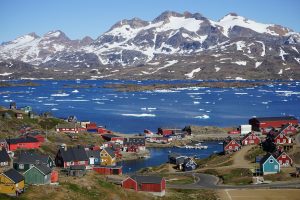
Image by Bernd Hildebrandt from Pixabay
Here is a breakdown of the crisis.
The Basics: Sovereignty and Strategy
First, it is important to understand what Greenland is. It is not a sovereign nation. It is an autonomous territory within the Kingdom of Denmark. While Greenlanders manage their own domestic affairs, Denmark controls their foreign policy and defense.
So, why does the U.S. want it?
1. Defense: The U.S. sees Greenland as the anchor of North American security and a core node in its proposed “Golden Dome” missile defense system. While Pituffik Space Base already provides Arctic early-warning coverage, broader access to the Island improves the coverage. Greenland also straddles the GIUK Gap, critical for tracking and constraining Russian naval access to the Atlantic.
2. Resources: Greenland is home to some of the world’s largest untapped deposits of Rare Earth Elements (REEs), including Neodymium (Nd), Praseodymium (Pr) and Lithium (Li) – essential for EVs, wind turbines, and advanced military hardware. While the U.S. could pursue these via the “business route” – think private mining deals – China can compete or outbid in the same market. Direct control reduces exposure to foreign bidders, shifting local politics, and revoked contracts.
3. New Trade Routes: As Arctic ice retreats, seasonal sea passages such as the Northern Sea Route and Northwest Passage are becoming increasingly navigable, shortening the distance between Asia and Europe. This has spurred interest from powers like China. For the United States, control of Greenland represents a countermove to this expansion.
The Money Trail
To understand why Greenland stays with Denmark, you have to follow the money.
Currently, Greenland’s economy cannot survive on its own. It relies on an annual subsidy from Denmark known as the “Block Grant.” Denmark sends Greenland roughly $600 million every year – about $11,000 per person on the island (population about 57,000). It pays for their free healthcare, schools, and social services.
The Only Legal Path: A Referendum
Crucially, the U.S. cannot simply write a check to Denmark and take the keys.
Under the 2009 Self-Government Act, there is only one legal mechanism for change: A Referendum.
The people of Greenland must vote “Yes” to independence. This is the initial, non-negotiable step.
There is a problem, though.
If that vote were held today, it would fail. 85% of Greenlanders reportedly oppose joining the U.S.
Since the U.S. cannot force the vote, it must buy it. The strategy is to make the incentives so overwhelming that Greenlanders change their minds.
According to Reuters, U.S. officials have discussed direct cash payments to Greenlanders – potentially $10,000 to $100,000 per person – as part of a broader inducement package. The U.S. had previously contemplated not just matching the Danish $600 million grant, but considerably exceeding it.
So where do the tariffs come in?
The tariffs are the pressure point. Denmark is highly exposed to U.S. trade outside the E.U., and escalating tariffs (10% initially, rising to 25%) would strain public finances. The implicit U.S. strategy is to make continued subsidies to Greenland politically and fiscally painful for Copenhagen. If the Danish block grant weakens, Greenlanders may be forced to consider the American offer as the only viable economic backstop.
How This Plays Out: Possible Scenarios
Given the intense pressure of the new tariffs, here are the three most likely ways this standoff could play out over the next year.
Scenario 1: Greenland Chooses U.S. Alignment
The economic pain of tariffs becomes too much for Denmark. Copenhagen privately tells Greenland it can no longer afford to backstop them. Greenland exercises its right to vote for independence – but immediately signs a “Compact of Free Association” (COFA) with the U.S.
This is the model used by Pacific nations like Palau. Greenland gets to call itself a “sovereign nation,” but the U.S. provides all funding (replacing the Danish grant) and gains exclusive, permanent military control.
Scenario 2: Stalemate And Pain
Europe refuses to cave and responds with targeted retaliation against U.S. technology and services, while Washington keeps tariffs in place but grants selective exemptions to prevent a full-blown trade war. The result is sustained economic friction without resolution. Diplomatic relations freeze, Greenland is quietly treated as a disputed zone, and foreign investment stalls as uncertainty rises. The standoff drags into the 2026 U.S. midterms, with Greenland bearing the economic cost of a conflict neither side is willing to fully escalate or resolve.
Scenario 3: U.S. Uses Force
Diplomacy collapses. The U.S. cites an “imminent threat” from foreign adversaries (Russia/China) in Greenland and escalates via gray-zone tactics: potential restrictions on shipments or special forces deployments to “secure” key sites for safety reasons. This creates a de facto seizure without outright invasion, forcing Denmark into an untenable position and risking severe damage to the NATO alliance. Although Trump has historically refused to rule out force, the current focus remains on economic pressure via tariffs.
The current tariff strategy reflects classic economic leverage, but it faces hard limits: Greenland’s self-determination is legally non-negotiable. Whatever the outcome, the decision will ultimately be made in Nuuk – not imposed from Washington or Copenhagen.
Global events impact global markets. The Trefis High Quality (HQ) Portfolio, with a collection of 30 stocks, has a track record of comfortably outperforming its benchmark that includes all three – the S&P 500, S&P mid-cap, and Russell 2000 indices. Why is that? As a group, HQ Portfolio stocks provided better returns with less risk versus the benchmark index; less of a roller-coaster ride, as evident in HQ Portfolio performance metrics.
Invest with Trefis Market-Beating Portfolios
See all Trefis Price Estimates