
Apple Stock: Alpha Engine Or Portfolio Diversifier?
Apple (AAPL) stock has climbed 5% over the past five trading sessions and is now up 13% over the last month, driven by a broader rally in the Nasdaq-100, strong Q2 earnings, a fresh $100 billion share repurchase authorization, and growing optimism around generative AI integration across its devices.

Apple remains one of the market’s most closely watched mega-cap stocks, but beyond the recent rally, investors should look deeper into the underlying drivers of its longer-term performance and whether AAPL meaningfully improves portfolio diversification and risk-adjusted returns. For high-net-worth investors focused on sophisticated asset allocation, the key question is not just whether the stock can keep rising but whether it actually adds diversification benefits within a broader portfolio.
Let’s look past the daily noise and examine its core behavior against major asset classes.
Behavior vs. Other Asset Classes
True diversification means finding assets that don’t move in lockstep with the broader market. As the table below shows, AAPL offers an interesting profile. With a high correlation to the S&P 500 of 75.6% in the last 5 years, it moves largely in tandem with the broader market, meaning its value lies more in potential outperformance (alpha) rather than pure diversification.

The Momentum Factor: Capturing the Upside
A diversifier is only useful if it brings return potential. To evaluate this, we look at ‘upside capture’ – how much of the market’s gains a stock captures when the market is rising. Currently, AAPL features a moderate upside capture ratio of 97.6. It captures a reasonable portion of the market’s gains, though investors shouldn’t expect it to fully outpace a strong bull run.
Is the Fundamental Health There?
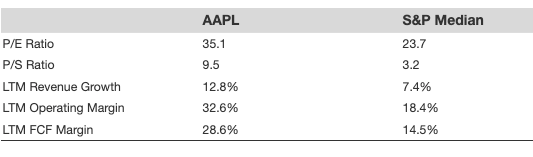
A non-correlated asset is risky if the underlying business is deteriorating. Crucially, this asset is backed by exceptional fundamental health. The company is delivering both rapid revenue growth and robust operating margins, a rare ‘gold standard’ combination.
It currently trades at a premium to the broader market median, meaning investors are actively paying up for its specific return profile and expected future cash flows.
Here is a quick look at AAPL’s fundamental health. While the table below compares it against the S&P 500 median, it further helps to also understand AAPL’s standing against direct peers.
The Bottom Line
Ultimately, given its high correlation to the broader market, AAPL acts primarily as a directional equity play rather than a true structural diversifier, meaning its value lies in alpha generation. Coupled with its exceptional fundamental health – boasting both strong top-line growth and robust margins – it stands out as a highly resilient satellite allocation.
If this specific risk profile doesn’t align with your mandate, it is worth exploring alternative allocations and better bets.
Sophisticated Portfolios Require Strategic Allocation
Finding a true diversifier means looking beyond basic asset classes. When a stock like AAPL exhibits certain market correlation alongside actionable price behavior, it warrants a closer look as a strategic satellite position. However, true wealth preservation requires a holistic view of how every asset interacts.