
Lennar (LEN)
Market Price (10/19/2026): $76.89 | Market Cap: $18.3 BilInvestor Relations Sector: Consumer Discretionary | Industry: Homebuilding
Lennar (LEN)
Market Price (10/19/2026): $76.89Market Cap: $18.3 BilSector: Consumer DiscretionaryIndustry: Homebuilding
Investment Highlights Why It Matters Detailed financial logic regarding cash flow yields vs trend-riding momentum.
Attractive yieldTotal YieldTotal Yield = Earnings Yield + Dividend Yield, Earnings Yield = Net Income / Market Cap Dividend Yield = Total Dividends / Market Cap is 9.8%, Dividend Yield is 2.7%, ERPEquity Risk Premium (ERP) = Total Yield - Risk Free Rate, Reflects the premium above risk free assets offered by the investment. is 4.4% Stock buyback supportStock Buyback 3Y Total is 5.4 Bil Low stock price volatilityVol 12M is 38% Megatrend and thematic driversMegatrends include Smart Buildings & Proptech, and Sustainable & Green Buildings. Themes include IoT for Buildings, Energy Efficient Building Materials, Show more. | Weak multi-year price returns2Y Excs Rtn is -87%, 3Y Excs Rtn is -104% | Weak revenue growthRev Chg LTMRevenue Change % Last Twelve Months (LTM) is -8.0%, Rev Chg 3Y AvgRevenue Change % averaged over trailing 3 years is -1.2%, Rev Chg QQuarterly Revenue Change % is -8.7% Key risksLEN key risks include [1] significant margin compression and eroding profitability driven by the need to offer increased sales incentives and price reductions. |
| Attractive yieldTotal YieldTotal Yield = Earnings Yield + Dividend Yield, Earnings Yield = Net Income / Market Cap Dividend Yield = Total Dividends / Market Cap is 9.8%, Dividend Yield is 2.7%, ERPEquity Risk Premium (ERP) = Total Yield - Risk Free Rate, Reflects the premium above risk free assets offered by the investment. is 4.4% |
| Stock buyback supportStock Buyback 3Y Total is 5.4 Bil |
| Low stock price volatilityVol 12M is 38% |
| Megatrend and thematic driversMegatrends include Smart Buildings & Proptech, and Sustainable & Green Buildings. Themes include IoT for Buildings, Energy Efficient Building Materials, Show more. |
| Weak multi-year price returns2Y Excs Rtn is -87%, 3Y Excs Rtn is -104% |
| Weak revenue growthRev Chg LTMRevenue Change % Last Twelve Months (LTM) is -8.0%, Rev Chg 3Y AvgRevenue Change % averaged over trailing 3 years is -1.2%, Rev Chg QQuarterly Revenue Change % is -8.7% |
| Key risksLEN key risks include [1] significant margin compression and eroding profitability driven by the need to offer increased sales incentives and price reductions. |
Qualitative Assessment
AI Analysis | Feedback
Lennar (LEN) stock has lost about 15% since 6/30/2026 because of the following key factors:
1. Fiscal Q3 2026 Earnings and Revenue Miss Undermined Investor Confidence.
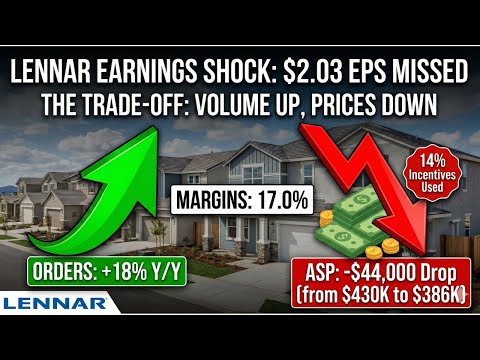
Lennar reported diluted earnings per share of $1.19 in fiscal Q3 2026, ended August 31, 2026, a significant decline from $2.29 in fiscal Q3 2025. The adjusted EPS of $1.23 fell short of the consensus estimate of $1.29. Total revenues for the quarter were $8.0 billion, missing the forecast of $8.31 billion and representing an 8.7% year-over-year decrease. Home sales revenue specifically decreased 6% to $7.7 billion, driven by a 3% drop in the average sales price to $372,000 and a 3% reduction in home deliveries to 20,840 homes. New orders also decreased 9% year-over-year to 20,879 homes.
2. Deteriorating Profitability and Margin Compression Impacted Financial Outlook.
The company experienced a notable decline in profitability, with its homebuilding gross margin falling to 15.5% for the first nine months of fiscal 2026, down from 18% in the prior year. While the fiscal Q3 2026 homebuilding gross margin improved sequentially to 15.8% from 15.6% in the previous quarter, it remained under pressure. This compression was primarily attributed to lower revenue per square foot and higher land costs, necessitating increased reliance on pricing adjustments and incentives, which were 12% of the gross price in fiscal Q3 2026. Additionally, operating earnings for the Financial Services segment decreased to $129 million in fiscal Q3 2026 from $177 million in fiscal Q3 2025, mainly due to lower profit per locked loan and reduced lock volume in the mortgage business, excluding one-time items.
Show more
Lennar (LEN) stock has lost about 15% since 6/30/2026 because of the following key factors:
1. Fiscal Q3 2026 Earnings and Revenue Miss Undermined Investor Confidence.
Lennar reported diluted earnings per share of $1.19 in fiscal Q3 2026, ended August 31, 2026, a significant decline from $2.29 in fiscal Q3 2025. The adjusted EPS of $1.23 fell short of the consensus estimate of $1.29. Total revenues for the quarter were $8.0 billion, missing the forecast of $8.31 billion and representing an 8.7% year-over-year decrease. Home sales revenue specifically decreased 6% to $7.7 billion, driven by a 3% drop in the average sales price to $372,000 and a 3% reduction in home deliveries to 20,840 homes. New orders also decreased 9% year-over-year to 20,879 homes.
2. Deteriorating Profitability and Margin Compression Impacted Financial Outlook.
The company experienced a notable decline in profitability, with its homebuilding gross margin falling to 15.5% for the first nine months of fiscal 2026, down from 18% in the prior year. While the fiscal Q3 2026 homebuilding gross margin improved sequentially to 15.8% from 15.6% in the previous quarter, it remained under pressure. This compression was primarily attributed to lower revenue per square foot and higher land costs, necessitating increased reliance on pricing adjustments and incentives, which were 12% of the gross price in fiscal Q3 2026. Additionally, operating earnings for the Financial Services segment decreased to $129 million in fiscal Q3 2026 from $177 million in fiscal Q3 2025, mainly due to lower profit per locked loan and reduced lock volume in the mortgage business, excluding one-time items.
3. Elevated Mortgage Rates and Persistent Affordability Constraints Created Macroeconomic Headwinds.
A significant macroeconomic factor contributing to the stock's decline was the continued surge in mortgage rates. The 30-year fixed-rate mortgage averaged 7.28% as of October 1, 2026, an increase from 7.03% the prior week and 6.34% a year earlier. These high borrowing costs severely limited homebuyers' purchasing power, with approximately 50% of Lennar's community visitors unable to qualify for a home purchase without further price or incentive adjustments. Although nominal U.S. home prices saw a modest 1.9% year-over-year increase in July 2026, real home values declined for the 14th consecutive month when adjusted for 3.4% inflation. This challenging environment, characterized by high rates and affordability issues, intensified competition from the resale market and put downward pressure on home sales volumes and average selling prices.
4. Negative Analyst Revisions and Price Target Reductions Signaled Cautious Market Outlook.
Analyst sentiment for Lennar turned increasingly negative, leading to multiple downward revisions in earnings estimates and price targets during the period. Keefe, Bruyette & Woods, for instance, cut its price target from $85.00 to $75.00 and assigned an "underperform" rating in September 2026. Morgan Stanley initiated coverage with an "underweight" rating and a $65.00 price objective, citing concerns about margins. BTIG Research reiterated a "sell" rating with a $63.00 target price in September 2026. Raymond James also reiterated an "Underperform" rating, noting that Lennar's strategy to maintain production volumes at the expense of near-term margins made its earnings outlook highly sensitive to mortgage rates and consumer confidence. This collective bearish outlook contributed to the stock's decline, with the consensus rating from analysts trending towards "Reduce" or "Sell" and a consensus target price around $79.86 as of October 2026.
Show less
Stock Movement Drivers
Fundamental Drivers
The -13.8% change in LEN stock from 6/30/2026 to 10/18/2026 was primarily driven by a -17.1% change in the company's Net Income Margin (%).| (LTM values as of) | 6302026 | 10182026 | Change |
|---|---|---|---|
| Stock Price ($) | 89.37 | 77.08 | -13.8% |
| Change Contribution By: | |||
| Total Revenues ($ Mil) | 32,737 | 31,973 | -2.3% |
| Net Income Margin (%) | 4.9% | 4.1% | -17.1% |
| P/E Multiple | 13.3 | 14.0 | 5.2% |
| Shares Outstanding (Mil) | 241 | 238 | 1.3% |
| Cumulative Contribution | -13.8% |
Market Drivers
6/30/2026 to 10/18/2026| Return | Correlation | |
|---|---|---|
| LEN | -13.8% | |
| Market (SPY) | 2.2% | 34.2% |
| Sector (XLY) | -4.1% | 42.4% |
Fundamental Drivers
The -9.7% change in LEN stock from 3/31/2026 to 10/18/2026 was primarily driven by a -32.7% change in the company's Net Income Margin (%).| (LTM values as of) | 3312026 | 10182026 | Change |
|---|---|---|---|
| Stock Price ($) | 85.32 | 77.08 | -9.7% |
| Change Contribution By: | |||
| Total Revenues ($ Mil) | 34,187 | 31,973 | -6.5% |
| Net Income Margin (%) | 6.1% | 4.1% | -32.7% |
| P/E Multiple | 10.4 | 14.0 | 35.2% |
| Shares Outstanding (Mil) | 252 | 238 | 6.1% |
| Cumulative Contribution | -9.7% |
Market Drivers
3/31/2026 to 10/18/2026| Return | Correlation | |
|---|---|---|
| LEN | -9.7% | |
| Market (SPY) | 17.7% | 38.6% |
| Sector (XLY) | 3.4% | 47.7% |
Fundamental Drivers
The -37.2% change in LEN stock from 9/30/2025 to 10/18/2026 was primarily driven by a -55.5% change in the company's Net Income Margin (%).| (LTM values as of) | 9302025 | 10182026 | Change |
|---|---|---|---|
| Stock Price ($) | 122.75 | 77.08 | -37.2% |
| Change Contribution By: | |||
| Total Revenues ($ Mil) | 35,372 | 31,973 | -9.6% |
| Net Income Margin (%) | 9.2% | 4.1% | -55.5% |
| P/E Multiple | 9.8 | 14.0 | 42.7% |
| Shares Outstanding (Mil) | 260 | 238 | 9.5% |
| Cumulative Contribution | -37.2% |
Market Drivers
9/30/2025 to 10/18/2026| Return | Correlation | |
|---|---|---|
| LEN | -37.2% | |
| Market (SPY) | 15.5% | 32.1% |
| Sector (XLY) | -5.6% | 43.0% |
Fundamental Drivers
The -27.4% change in LEN stock from 9/30/2023 to 10/18/2026 was primarily driven by a -64.9% change in the company's Net Income Margin (%).| (LTM values as of) | 9302023 | 10182026 | Change |
|---|---|---|---|
| Stock Price ($) | 106.20 | 77.08 | -27.4% |
| Change Contribution By: | |||
| Total Revenues ($ Mil) | 33,440 | 31,973 | -4.4% |
| Net Income Margin (%) | 11.7% | 4.1% | -64.9% |
| P/E Multiple | 7.7 | 14.0 | 81.8% |
| Shares Outstanding (Mil) | 283 | 238 | 19.0% |
| Cumulative Contribution | -27.4% |
Market Drivers
9/30/2023 to 10/18/2026| Return | Correlation | |
|---|---|---|
| LEN | -27.4% | |
| Market (SPY) | 84.7% | 35.8% |
| Sector (XLY) | 42.9% | 44.4% |
Price Returns Compared
| 2021 | 2022 | 2023 | 2024 | 2025 | 2026 | Total [1] | |
|---|---|---|---|---|---|---|---|
| Returns | |||||||
| LEN Return | 54% | -21% | 67% | -7% | -23% | -23% | 12% |
| Peers Return | 51% | -22% | 90% | 6% | -0% | -6% | 120% |
| S&P 500 Return | 27% | -19% | 24% | 23% | 16% | 14% | 108% |
Monthly Win Rates [3] | |||||||
| LEN Win Rate | 75% | 42% | 58% | 67% | 33% | 50% | |
| Peers Win Rate | 75% | 42% | 65% | 57% | 45% | 42% | |
| S&P 500 Win Rate | 75% | 42% | 67% | 75% | 67% | 50% | |
Max Drawdowns [4] | |||||||
| LEN Max Drawdown | -16% | -44% | -22% | -29% | -28% | -39% | |
| Peers Max Drawdown | -21% | -42% | -21% | -26% | -25% | -26% | |
| S&P 500 Max Drawdown | -5% | -25% | -10% | -8% | -19% | -9% | |
[1] Cumulative total returns since the beginning of 2021
[2] Peers: DHI, PHM, NVR, TOL, MTH. See LEN Returns vs. Peers.
[3] Win Rate = % of calendar months in which monthly returns were positive
[4] Max drawdown represents maximum peak-to-trough decline within a year
[5] 2026 data is for the year up to 10/16/2026 (YTD)
How Low Can It Go
| Event | LEN | S&P 500 |
|---|---|---|
| 2025 US Tariff Shock | ||
| % Loss | -15.0% | -18.8% |
| % Gain to Breakeven | 17.7% | 23.1% |
| Time to Breakeven | 111 days | 79 days |
| Summer-Fall 2023 Five Percent Yield Shock | ||
| % Loss | -18.9% | -9.5% |
| % Gain to Breakeven | 23.3% | 10.5% |
| Time to Breakeven | 20 days | 24 days |
| 2022 Inflation Shock & Fed Tightening | ||
| % Loss | -41.8% | -24.5% |
| % Gain to Breakeven | 71.9% | 32.4% |
| Time to Breakeven | 308 days | 427 days |
| 2020 COVID-19 Crash | ||
| % Loss | -58.3% | -33.7% |
| % Gain to Breakeven | 140.0% | 50.9% |
| Time to Breakeven | 121 days | 140 days |
| Q4 2018 Fed Policy Error / Growth Scare | ||
| % Loss | -17.6% | -19.2% |
| % Gain to Breakeven | 21.4% | 23.8% |
| Time to Breakeven | 16 days | 105 days |
| 2015-2016 China Devaluation / Global Growth Scare | ||
| % Loss | -29.8% | -12.2% |
| % Gain to Breakeven | 42.4% | 13.9% |
| Time to Breakeven | 488 days | 62 days |
In The Past
Lennar's stock fell -15.0% during the 2025 US Tariff Shock. Such a loss loss requires a 17.7% gain to breakeven.
Preserve Wealth
Limiting losses and compounding gains is essential to preserving wealth.
Asset Allocation
Actively managed asset allocation strategies protect wealth. Learn more.
| Event | LEN | S&P 500 |
|---|---|---|
| 2022 Inflation Shock & Fed Tightening | ||
| % Loss | -41.8% | -24.5% |
| % Gain to Breakeven | 71.9% | 32.4% |
| Time to Breakeven | 308 days | 427 days |
| 2020 COVID-19 Crash | ||
| % Loss | -58.3% | -33.7% |
| % Gain to Breakeven | 140.0% | 50.9% |
| Time to Breakeven | 121 days | 140 days |
| 2015-2016 China Devaluation / Global Growth Scare | ||
| % Loss | -29.8% | -12.2% |
| % Gain to Breakeven | 42.4% | 13.9% |
| Time to Breakeven | 488 days | 62 days |
| 2013 Taper Tantrum | ||
| % Loss | -21.8% | -0.2% |
| % Gain to Breakeven | 27.9% | 0.2% |
| Time to Breakeven | 154 days | 1 days |
| 2011 US Debt Ceiling Crisis & European Contagion | ||
| % Loss | -31.7% | -17.9% |
| % Gain to Breakeven | 46.3% | 21.8% |
| Time to Breakeven | 105 days | 123 days |
| 2010 Eurozone Sovereign Debt Crisis / Flash Crash | ||
| % Loss | -32.3% | -15.4% |
| % Gain to Breakeven | 47.6% | 18.2% |
| Time to Breakeven | 189 days | 125 days |
| 2008-2009 Global Financial Crisis | ||
| % Loss | -79.2% | -53.4% |
| % Gain to Breakeven | 379.9% | 114.4% |
| Time to Breakeven | 299 days | 1085 days |
| Summer 2007 Credit Crunch | ||
| % Loss | -28.3% | -8.6% |
| % Gain to Breakeven | 39.5% | 9.5% |
| Time to Breakeven | 1800 days | 47 days |
In The Past
Lennar's stock fell -15.0% during the 2025 US Tariff Shock. Such a loss loss requires a 17.7% gain to breakeven.
Preserve Wealth
Limiting losses and compounding gains is essential to preserving wealth.
Asset Allocation
Actively managed asset allocation strategies protect wealth. Learn more.
About Lennar (LEN)
Lennar Corporation (LEN) is a leading homebuilder operating primarily under the Lennar brand across the United States. Its core business focuses on the construction and sale of various single-family homes, including both attached and detached properties. The company is also actively involved in the purchase, development, and sale of residential land, which forms the foundation for its housing projects.
Beyond its primary homebuilding activities, Lennar offers an integrated suite of financial services to support homebuyers, including residential mortgage financing, title insurance, and closing services. The company further diversifies its operations through a multifamily segment, which involves the development, construction, and management of rental properties, and engages in fund investment activities. It also originates and sells securitization commercial mortgage loans.
Lennar serves a broad spectrum of the U.S. housing market, catering to diverse customer needs. Its primary customers include first-time homebuyers, individuals looking to move up to a larger home, active adult communities, and the luxury home segment. The company operates through distinct geographic segments across the East, Central, Texas, and West regions of the United States, highlighting its widespread national presence.
AI Analysis | Feedback
The General Motors of new home construction.
AI Analysis | Feedback
- Homebuilding: Construction and sale of single-family attached and detached homes.
- Residential Land Development and Sales: Purchase, development, and sale of residential land.
- Multifamily Rental Property Development and Management: Development, construction, and management of multifamily rental properties.
- Residential Mortgage Financing: Providing residential mortgage loans for home buyers.
- Title Insurance and Closing Services: Offering title insurance and closing services for real estate transactions.
- Commercial Mortgage Loan Origination and Securitization: Originating and selling securitized commercial mortgage loans.
- Fund Investment Activity: Engaging in various fund investment activities.
AI Analysis | Feedback
Lennar Corporation (LEN) primarily sells its homes and services to individual homebuyers.
The categories of customers it serves include:
- First-time homebuyers
- Move-up homebuyers
- Active adult homebuyers
AI Analysis | Feedback
AI Analysis | Feedback
Stuart Miller is the son of co-founder Leonard Miller, who took Lennar public in 1971. He began working at Lennar Corporation in the 1980s. Miller became the Chief Executive Officer of Lennar in 1997. He assumed the role of Executive Chairman in April 2018. From 1997 until 2005, he served as Chairman of the Board of LNR Property Corporation, a commercial real estate entity that was spun off from Lennar and later sold in February 2005.
Diane Bessette, Chief Financial Officer
Diane Bessette joined Lennar Corporation in 1995. During her tenure, she held various senior leadership positions, including Corporate Controller from 1997 to 2008. She was named Vice President in 2000 and served as Treasurer from February 2008 until April 2024. Bessette was appointed Chief Financial Officer in April 2018.
Katherine Lee Martin, Chief Legal Officer and Secretary
Katherine Lee Martin serves as Lennar's Chief Legal Officer and Secretary. She is part of a leadership team composed of innovative leaders and industry experts.
Fred Rothman, Chief Operating Officer
Fred Rothman is the Chief Operating Officer of Lennar Corporation. He has also held roles such as President of Eastern Homebuilding Operations and Regional President at Lennar.
Bruce Gross, Chief Executive Officer, Lennar Financial Services
Bruce Gross is the Chief Executive Officer of Lennar Financial Services, which provides mortgage financing, title insurance, and homeowners insurance. He previously served as Vice President and Chief Financial Officer of Lennar. Since joining Lennar in 1997, Gross has been instrumental in the company's strategic and operating initiatives, including multiple acquisitions, contributing significantly to Lennar's growth. Before joining Lennar, he helped launch Pacific Greystone Corporation and supported its growth through an initial public offering and its subsequent acquisition by Lennar.
AI Analysis | Feedback
The key risks to Lennar's business are primarily driven by macroeconomic factors impacting the housing market and internal operational pressures.
- Interest Rate Sensitivity and Housing Affordability: High mortgage rates significantly dampen new-home demand and overall affordability, directly impacting Lennar's home sales and its financial services segment. A sustained period of elevated rates could further curtail sales volumes and reduce profitability, as evidenced by Lennar's recent performance lagging the S&P 500 due to higher mortgage rates squeezing demand. Higher interest rates also increase Lennar's costs for financing construction projects and land acquisition.
- Cyclical Downturns and Economic Uncertainty: The homebuilding industry is inherently cyclical and highly sensitive to broader economic conditions, employment levels, and consumer sentiment. A significant economic slowdown, a spike in unemployment, or geopolitical uncertainty could lead to reduced consumer confidence, increased home sale cancellations, and decreased demand for new homes.
- Margin Pressure from Costs and Incentives: Lennar faces ongoing pressure on its gross margins due to various factors. These include the use of buyer incentives and mortgage-rate buy-downs to stimulate sales in a challenging market, which can erode profitability. Additionally, rising material costs, labor shortages, and increasing land costs can inflate construction expenses and delay deliveries, further compressing margins.
AI Analysis | Feedback
The emergence of advanced construction technologies, such as large-scale 3D printing for homes and highly automated modular building systems, presents a clear emerging threat to traditional homebuilders like Lennar. These technologies promise to significantly reduce construction time, labor costs, and material waste, potentially enabling faster, more affordable, and more sustainable housing production. If these methods achieve widespread adoption and scalability, they could disrupt established construction practices and create a competitive disadvantage for companies relying primarily on conventional stick-built construction methods.
AI Analysis | Feedback
Lennar Corporation operates as a homebuilder and provides financial services, primarily in the United States. Its main addressable markets in the U.S. include residential construction, mortgage financing, and title insurance.
- Residential Construction Market (U.S.): The U.S. residential construction market size is estimated at USD 1.41 trillion in 2026, with projections to reach USD 1.76 trillion by 2031, growing at a compound annual growth rate (CAGR) of 4.53% between 2026 and 2031. For context, residential construction represented 54.3% of the total U.S. construction market in 2025, which was valued at USD 2.2 trillion.
- Mortgage Financing Market (U.S.): The total single-family mortgage origination volume in the U.S. is expected to reach $2.2 trillion in 2026, up from an estimated $2.0 trillion in 2025.
- Title Insurance Market (U.S.): The market size of the Title Insurance in the U.S. is estimated at $17.1 billion in 2025. The industry generated $4.5 billion in title insurance premiums during the second quarter of 2025.
AI Analysis | Feedback
Lennar (LEN) is expected to drive future revenue growth over the next 2-3 years through several key strategies aimed at navigating the current housing market and leveraging operational strengths:
- Increased Home Deliveries and Volume Focus: Lennar has communicated a clear objective to increase its volume of home deliveries. For instance, the company is targeting approximately 85,000 home deliveries in 2026. This focus on consistent and high-volume production is a direct driver of revenue growth, as more units sold translate to higher top-line figures.
- Enhanced Operational Efficiency and Cost Management: The company is prioritizing operational improvements, including reducing direct construction costs and improving cycle times for home construction. These efficiencies, such as an 11% year-over-year reduction in cycle time for single-family detached homes to an all-time low of 122 days in Q1 2026, allow Lennar to maintain competitiveness and offer homes at more attractive price points, thereby stimulating demand and supporting revenue growth.
- Leveraging an Asset-Light Land Strategy: Lennar continues to expand its "asset-light" approach to land acquisition through off-balance sheet land banking relationships. This strategy reduces capital intensity and risk, improves inventory turnover (from 1.5% to 1.7% year-over-year in Q1 2025 and 2.2x to 2.5x quarter-over-quarter in Q1 2026), and enables the company to adapt more quickly to market conditions, supporting sustained homebuilding volume and revenue.
- Technology-Driven Sales and Customer Engagement: Investments in technology are improving customer engagement quality scores (up 7%) and increasing the efficiency of the sales process, including an 11% quarter-over-quarter increase in kept sales appointments. This digital transformation aims to convert online interest into actual home sales more effectively, directly contributing to revenue generation.
- Focus on Affordability and Meeting Market Demand: Recognizing challenges like elevated interest rates and affordability pressures, Lennar is adapting its offerings to meet market demand by focusing on delivering homes at prices and with incentives that buyers can afford. This includes refining products and optimizing "Everything's Included" packages, which helps maintain sales pace and volume in a challenging environment.
AI Analysis | Feedback
Share Repurchases
- In January 2024, Lennar's Board of Directors authorized an expansion of its stock repurchase program, allowing for up to $5 billion in buybacks of Class A or Class B common stock with no set expiration date.
- Lennar repurchased $2.256 billion in shares during fiscal year 2024.
- In fiscal year 2025, the company repurchased $1.7 billion of its common stock.
Inbound Investments
- In March 2021, Lennar announced the formation of the Upward America Venture, which was initially capitalized with a total equity commitment of $1.25 billion. This venture, led by Centerbridge alongside Allianz Real Estate and other institutional investors, focuses on acquiring single-family homes for rent.
Outbound Investments
- In November 2024, Lennar entered into a definitive agreement to acquire Rausch Coleman Homes' homebuilding operations for $1 billion, expanding its market presence and contributing to its 2025 growth targets; the acquisition was completed in February 2025.
- Lennar made strategic technology investments in unconsolidated entities, totaling $239.3 million in fiscal 2024 and $127.5 million in fiscal 2023.
- In February 2025, Lennar completed the spin-off of Millrose Properties, Inc., an entity focused on land acquisition, development, and management, which is expected to have an asset base of $6.0-$8.0 billion.
Capital Expenditures
- From fiscal year 2021 to 2025, Lennar's capital expenditures averaged $116.5 million annually.
- Capital expenditures for Lennar peaked in fiscal year 2025 at $188.6 million.
- The primary focus of these capital expenditures is on Lennar's homebuilding operations, including the construction and sale of single-family homes and the development of residential land.
Peer Outperformance in Homebuilding
| Ticker | Name | Rev Growth 3Y Avg | P/E | 1Y | 3Y | 5Y | 5Y Gap |
|---|---|---|---|---|---|---|---|
| LEN | Lennar | -1.2% | 14.0x | -37.4% | -22.4% | -16.3% | — |
| PHM | PulteGroup | -0.5% | 11.3x | -8.0% | 65.7% | 141.1% | +157pp |
| TOL | Toll Brothers | 0.2% | 10.5x | -0.8% | 97.1% | 135.2% | +151pp |
| MHO | M/I Homes | 0.3% | 10.1x | -9.6% | 64.7% | 106.5% | +123pp |
| IBP | Installed Building Products | 2.5% | 19.7x | -26.8% | 75.6% | 79.9% | +96pp |
| DHI | D.R. Horton | -1.0% | 12.9x | -8.2% | 42.0% | 66.0% | +82pp |
| Industry | Names | 1Y med | 3Y med | 5Y med | Top 3 by 5Y |
|---|---|---|---|---|---|
| Education Services | 14 | -19.9% | 82.6% | 91.0% | CVSA 247% · PRDO 235% · LRN 148% |
| Homebuilding ← | 18 | -8.6% | 40.7% | 41.3% | GRBK 181% · PHM 141% · TOL 135% |
| Specialty Stores | 7 | 15.0% | 42.6% | 15.9% | ASO 49% · DKS 31% · FIVE 16% |
| Hotels, Resorts & Cruise Lines | 21 | 11.2% | 50.2% | 13.8% | RCL 234% · MAR 154% · HLT 143% |
| Home Furnishings | 3 | -5.6% | 52.0% | 1.3% | SGI 44% · MHK -36% |
| Home Improvement Retail | 5 | -18.8% | 10.0% | -1.9% | HD -1% · LOW -2% · FND -64% |
| Automotive Retail | 17 | -13.1% | 10.3% | -8.4% | MUSA 233% · PAG 129% · ORLY 110% |
| Specialized Consumer Services | 10 | -13.0% | 23.6% | -13.2% | HRB 134% · FTDR 84% · SCI 42% |
| Footwear | 9 | 72.1% | 45.8% | -14.0% | DECK 40% · SHOO 18% · CROX -14% |
| Distributors | 4 | -9.2% | -15.4% | -15.9% | ARMK 122% · GPC 22% · LKQ -54% |
| Restaurants | 36 | -5.2% | -5.8% | -18.6% | EAT 322% · CAKE 200% · TXRH 102% |
| Household Appliances | 17 | -2.4% | 27.5% | -35.8% | |
| Apparel Retail | 26 | 5.1% | 7.7% | -38.4% | ANF 290% · TJX 145% · ROST 128% |
| Leisure Facilities | 12 | 10.8% | -5.8% | -41.3% | LTH 149% · OSW 117% · PLNT -37% |
| Computer & Electronics Retail | 3 | 16.2% | 54.2% | -42.4% | BBY 1% · GME -42% |
| Leisure Products | 14 | -18.3% | -17.0% | -44.9% | GOLF 78% · HAS 30% · MAT -14% |
| Automotive Parts & Equipment | 39 | -12.1% | -13.5% | -46.4% | MOD 1144% · GTX 253% · BWA 54% |
| Apparel, Accessories & Luxury Goods | 29 | 1.3% | 15.1% | -46.9% | RL 256% · TPR 254% · KTB 74% |
| Broadline Retail | 13 | 9.6% | 29.3% | -48.2% | EBAY 77% · AMZN 45% · OLLI 40% |
| Casinos & Gaming | 20 | -11.3% | -25.9% | -50.9% | MCRI 86% · BYD 10% · RRR 9% |
| Automobile Manufacturers | 8 | -73.4% | -53.6% | -77.7% | GM 54% · TSLA 22% · F 9% |
| Other Specialty Retail | 17 | -34.0% | -32.7% | -77.8% | ULTA 46% · TSCO -11% · BBWI -66% |
| Consumer Electronics | 11 | -27.6% | -33.4% | -78.3% | GRMN 98% · SONO -47% |
Latest Trefis Analyses
Research & Analysis
Invest in Strategies
Wealth Management
Peer Comparisons
| Peers to compare with: |
Financials
| Median | |
|---|---|
| Name | |
| Mkt Price | 124.27 |
| Mkt Cap | 17.1 |
| Rev LTM | 13,583 |
| Op Inc LTM | 1,644 |
| FCF LTM | 1,068 |
| FCF 3Y Avg | 1,282 |
| CFO LTM | 1,129 |
| CFO 3Y Avg | 1,371 |
Growth & Margins
| Median | |
|---|---|
| Name | |
| Rev Chg LTM | -7.7% |
| Rev Chg 3Y Avg | -1.1% |
| Rev Chg Q | -9.6% |
| QoQ Delta Rev Chg LTM | -2.5% |
| Op Inc Chg LTM | -25.6% |
| Op Inc Chg 3Y Avg | -12.2% |
| Op Mgn LTM | 12.6% |
| Op Mgn 3Y Avg | 15.2% |
| QoQ Delta Op Mgn LTM | -0.8% |
| CFO/Rev LTM | 10.0% |
| CFO/Rev 3Y Avg | 8.5% |
| FCF/Rev LTM | 9.4% |
| FCF/Rev 3Y Avg | 7.9% |
Valuation
| Median | |
|---|---|
| Name | |
| Mkt Cap | 17.1 |
| P/S | 1.2 |
| P/Op Inc | 10.1 |
| P/EBIT | 9.6 |
| P/E | 12.4 |
| P/CFO | 12.5 |
| Total Yield | 9.8% |
| Dividend Yield | 1.1% |
| FCF Yield 3Y Avg | 5.8% |
| D/E | 0.2 |
| Net D/E | 0.1 |
Returns
| Median | |
|---|---|
| Name | |
| 1M Rtn | -0.9% |
| 3M Rtn | -9.1% |
| 6M Rtn | -10.7% |
| 12M Rtn | -10.8% |
| 3Y Rtn | 28.1% |
| 1M Excs Rtn | -3.8% |
| 3M Excs Rtn | -10.7% |
| 6M Excs Rtn | -18.2% |
| 12M Excs Rtn | -25.7% |
| 3Y Excs Rtn | -55.9% |
Comparison Analyses
Segment Financials
Revenue by Segment| $ Mil | 2025 | 2024 | 2023 | 2022 | 2021 |
|---|---|---|---|---|---|
| Homebuilding | 32,267 | 33,906 | 32,661 | 31,951 | 25,545 |
| Financial Services | 1,198 | 1,109 | 977 | 810 | 899 |
| Multifamily | 681 | 412 | 573 | 866 | 665 |
| Lennar Other | 41 | 14 | 22 | 44 | 21 |
| Total | 34,187 | 35,441 | 34,233 | 33,671 | 27,131 |
| $ Mil | 2024 | 2023 | 2022 | 2021 | 2020 |
|---|---|---|---|---|---|
| Homebuilding | 5,342 | 5,528 | 6,777 | 5,032 | 2,989 |
| Financial Services | 481 | ||||
| Lennar Other | -10 | ||||
| Multifamily | 23 | ||||
| Total | 5,342 | 5,528 | 6,777 | 5,032 | 3,482 |
| $ Mil | 2025 | 2024 | 2023 | 2022 | 2021 |
|---|---|---|---|---|---|
| Homebuilding | 29,253 | 35,594 | 33,628 | 32,684 | 27,468 |
| Financial Services | 3,377 | 3,517 | 3,567 | 3,254 | 2,964 |
| Multifamily | 902 | 1,307 | 1,382 | 1,257 | 1,312 |
| Lennar Other | 898 | 895 | 658 | 789 | 1,464 |
| Total | 34,430 | 41,313 | 39,234 | 37,984 | 33,208 |
Price Behavior
| Market Price | $77.08 | |
| Market Cap ($ Bil) | 18.3 | |
| First Trading Date | 11/05/1987 | |
| Distance from 52W High | -40.8% | |
| 50 Days | 200 Days | |
| DMA Price | $81.41 | $91.47 |
| DMA Trend | down | down |
| Distance from DMA | -5.3% | -15.7% |
| 3M | 1YR | |
| Volatility | 39.4% | 38.3% |
| Downside Capture | 151.45 | 149.83 |
| Upside Capture | 92.91 | 73.48 |
| Correlation (S&P 500) | 31.2% | 35.3% |
| 1M | 2M | 3M | 6M | 1Y | 3Y | |
|---|---|---|---|---|---|---|
| Beta | 1.92 | 1.81 | 1.41 | 1.28 | 0.98 | 0.83 |
| Up Beta | 1.01 | 1.62 | 0.33 | 1.11 | 1.21 | 0.84 |
| Down Beta | 4.18 | 2.85 | 1.77 | 1.38 | 0.90 | 0.52 |
| Up Capture | 163% | 169% | 144% | 104% | 47% | 56% |
| Bmk +ve Days | 6 | 16 | 27 | 66 | 132 | 424 |
| Stock +ve Days | 11 | 21 | 31 | 64 | 119 | 376 |
| Down Capture | 217% | 196% | 198% | 157% | 119% | 104% |
| Bmk -ve Days | 16 | 26 | 37 | 60 | 120 | 328 |
| Stock -ve Days | 11 | 21 | 33 | 62 | 133 | 374 |
[1] Upside and downside betas calculated using positive and negative benchmark daily returns respectively
Based On 1-Year Data
| Annualized Return | Annualized Volatility | Sharpe Ratio | Correlation with LEN | |
|---|---|---|---|---|
| LEN | -35.7% | 38.3% | -1.08 | - |
| Sector ETF (XLY) | -3.6% | 19.2% | -0.32 | 44.8% |
| Equity (SPY) | 15.8% | 12.7% | 0.86 | 34.5% |
| Gold (GLD) | -1.4% | 29.4% | -0.05 | 18.2% |
| Commodities (DBC) | 52.4% | 20.7% | 1.92 | -27.5% |
| Real Estate (VNQ) | 4.8% | 13.7% | 0.09 | 44.2% |
| Bitcoin (BTCUSD) | -26.5% | 43.6% | -0.59 | 2.8% |
Smart multi-asset allocation framework can stack odds in your favor. Learn How
Based On 5-Year Data
| Annualized Return | Annualized Volatility | Sharpe Ratio | Correlation with LEN | |
|---|---|---|---|---|
| LEN | -2.2% | 35.4% | 0.01 | - |
| Sector ETF (XLY) | 5.1% | 24.1% | 0.17 | 54.3% |
| Equity (SPY) | 13.2% | 17.1% | 0.59 | 50.0% |
| Gold (GLD) | 18.4% | 18.9% | 0.79 | 12.2% |
| Commodities (DBC) | 9.9% | 19.5% | 0.39 | -4.3% |
| Real Estate (VNQ) | 1.6% | 18.8% | -0.02 | 56.3% |
| Bitcoin (BTCUSD) | 8.6% | 51.8% | 0.34 | 21.5% |
Smart multi-asset allocation framework can stack odds in your favor. Learn How
Based On 10-Year Data
| Annualized Return | Annualized Volatility | Sharpe Ratio | Correlation with LEN | |
|---|---|---|---|---|
| LEN | 7.6% | 37.8% | 0.31 | - |
| Sector ETF (XLY) | 12.0% | 22.2% | 0.49 | 55.9% |
| Equity (SPY) | 15.2% | 17.9% | 0.72 | 52.7% |
| Gold (GLD) | 12.3% | 16.4% | 0.61 | 12.8% |
| Commodities (DBC) | 8.3% | 18.1% | 0.37 | 10.2% |
| Real Estate (VNQ) | 5.2% | 20.7% | 0.21 | 55.7% |
| Bitcoin (BTCUSD) | 63.1% | 66.2% | 1.03 | 13.8% |
Smart multi-asset allocation framework can stack odds in your favor. Learn How
Returns Analyses
Earnings Returns History
Updated 10/19/2026| Forward Returns | |||
|---|---|---|---|
| Earnings Date | 1D Returns | 5D Returns | 21D Returns |
| 9/16/2026 | 1.7% | 4.0% | -0.2% |
| 6/11/2026 | -4.9% | -5.5% | -11.3% |
| 3/12/2026 | 2.6% | 1.3% | -3.0% |
| 12/16/2025 | -1.8% | -10.6% | 2.1% |
| 9/19/2025 | -4.2% | -6.7% | -4.9% |
| 6/17/2025 | -4.5% | 2.0% | 0.5% |
| 3/20/2025 | -0.2% | -2.0% | -12.9% |
| 12/18/2024 | -3.7% | -8.9% | -12.1% |
| ... | |||
| SUMMARY STATS | |||
| # Positive | 12 | 11 | 11 |
| # Negative | 12 | 13 | 13 |
| Median Positive | 2.3% | 4.0% | 5.3% |
| Median Negative | -3.9% | -4.1% | -4.9% |
| Max Positive | 13.8% | 8.8% | 25.6% |
| Max Negative | -7.6% | -10.6% | -13.3% |
| Forward Returns | |||
|---|---|---|---|
| Earnings Date | 1D Returns | 5D Returns | 21D Returns |
| 9/16/2026 | 1.7% | 4.0% | -0.2% |
| 6/11/2026 | -4.9% | -5.5% | -11.3% |
| 3/12/2026 | 2.6% | 1.3% | -3.0% |
| 12/16/2025 | -1.8% | -10.6% | 2.1% |
| 9/19/2025 | -4.2% | -6.7% | -4.9% |
| 6/17/2025 | -4.5% | 2.0% | 0.5% |
| 3/20/2025 | -0.2% | -2.0% | -12.9% |
| 12/18/2024 | -3.7% | -8.9% | -12.1% |
| 9/19/2024 | -5.3% | -4.9% | -1.6% |
| 6/17/2024 | -5.0% | -4.7% | 9.0% |
| 3/13/2024 | -7.6% | -1.1% | -3.4% |
| 12/14/2023 | 6.6% | 1.1% | 3.7% |
| 9/14/2023 | -2.5% | -3.9% | -6.8% |
| 6/14/2023 | 4.4% | 5.7% | 14.0% |
| 3/14/2023 | -0.6% | 2.7% | 3.0% |
| 12/14/2022 | 0.3% | -1.8% | 9.1% |
| 9/21/2022 | 2.0% | 2.1% | -5.5% |
| 6/21/2022 | 3.1% | 6.2% | 25.6% |
| 3/16/2022 | 0.9% | -4.1% | -13.3% |
| 12/15/2021 | 1.7% | -2.2% | -2.3% |
| 9/20/2021 | -2.9% | -1.3% | -0.9% |
| 6/16/2021 | 3.6% | 6.2% | 5.3% |
| 3/16/2021 | 13.8% | 7.4% | 16.0% |
| 12/16/2020 | 0.6% | 8.8% | 3.7% |
| SUMMARY STATS | |||
| # Positive | 12 | 11 | 11 |
| # Negative | 12 | 13 | 13 |
| Median Positive | 2.3% | 4.0% | 5.3% |
| Median Negative | -3.9% | -4.1% | -4.9% |
| Max Positive | 13.8% | 8.8% | 25.6% |
| Max Negative | -7.6% | -10.6% | -13.3% |
SEC Filings
Expand for More| Report Date | Filing Date | Filing |
|---|---|---|
| 08/31/2026 | 10/02/2026 | 10-Q |
| 05/31/2026 | 06/29/2026 | 10-Q |
| 02/28/2026 | 04/09/2026 | 10-Q |
| 11/30/2025 | 01/28/2026 | 10-K |
| 08/31/2025 | 10/03/2025 | 10-Q |
| 05/31/2025 | 07/01/2025 | 10-Q |
| 02/28/2025 | 04/04/2025 | 10-Q |
| 11/30/2024 | 01/23/2025 | 10-K |
| 08/31/2024 | 10/02/2024 | 10-Q |
| 05/31/2024 | 06/28/2024 | 10-Q |
| 02/29/2024 | 03/29/2024 | 10-Q |
| 11/30/2023 | 01/26/2024 | 10-K |
| 08/31/2023 | 09/29/2023 | 10-Q |
| 05/31/2023 | 06/30/2023 | 10-Q |
| 02/28/2023 | 04/04/2023 | 10-Q |
| 11/30/2022 | 01/26/2023 | 10-K |
| Report Date | Filing Date | Filing |
|---|---|---|
| 08/31/2026 | 10/02/2026 | 10-Q |
| 05/31/2026 | 06/29/2026 | 10-Q |
| 02/28/2026 | 04/09/2026 | 10-Q |
| 11/30/2025 | 01/28/2026 | 10-K |
| 08/31/2025 | 10/03/2025 | 10-Q |
| 05/31/2025 | 07/01/2025 | 10-Q |
| 02/28/2025 | 04/04/2025 | 10-Q |
| 11/30/2024 | 01/23/2025 | 10-K |
| 08/31/2024 | 10/02/2024 | 10-Q |
| 05/31/2024 | 06/28/2024 | 10-Q |
| 02/29/2024 | 03/29/2024 | 10-Q |
| 11/30/2023 | 01/26/2024 | 10-K |
| 08/31/2023 | 09/29/2023 | 10-Q |
| 05/31/2023 | 06/30/2023 | 10-Q |
| 02/28/2023 | 04/04/2023 | 10-Q |
| 11/30/2022 | 01/26/2023 | 10-K |
| 08/31/2022 | 10/04/2022 | 10-Q |
| 05/31/2022 | 07/01/2022 | 10-Q |
| 02/28/2022 | 04/01/2022 | 10-Q |
| 11/30/2021 | 01/28/2022 | 10-K |
| 08/31/2021 | 10/01/2021 | 10-Q |
| 05/31/2021 | 07/02/2021 | 10-Q |
| 02/28/2021 | 04/01/2021 | 10-Q |
| 11/30/2020 | 01/22/2021 | 10-K |
| 08/31/2020 | 10/01/2020 | 10-Q |
| 05/31/2020 | 07/06/2020 | 10-Q |
| 02/29/2020 | 04/07/2020 | 10-Q |
| 11/30/2019 | 01/27/2020 | 10-K |
Recent Forward Guidance
Updated 9/17/2026Latest: Q3 2026 Earnings Reported 9/16/2026
| Forward Guidance | Guidance Change | |||||||
|---|---|---|---|---|---|---|---|---|
| Metric | Source | Low | Mid | High | % Chg | % Delta | Change | Prior |
| Q4 2026 New Orders | Reported | 19500 | 20000 | 20500 | -7.0% | Lower New | Guidance: 21500 for Q3 2026 | |
| Q4 2026 Deliveries | Reported | 22000 | 22500 | 23000 | 7.1% | Higher New | Guidance: 21000 for Q3 2026 | |
| Q4 2026 Financial Services Operating Earnings | Reported | 90.00 Mil | 92.50 Mil | 95.00 Mil | -5.1% | Lower New | Guidance: 97.50 Mil for Q3 2026 | |
| Q4 2026 Average Sales Price | Reported | 0.37 Mil | 0.38 Mil | 0.38 Mil | -0.7% | Lower New | Guidance: 0.38 Mil for Q3 2026 | |
| Q4 2026 Gross Margin % on Home Sales | Reported | 15.5% | 15.75% | 16.0% | -0.2% | Lower New | Guidance: 16.0% for Q3 2026 | |
| Q4 2026 SG&A % of Home Sales | Reported | 8.7% | 8.85% | 9.0% | -0.0% | Lower New | Guidance: 8.9% for Q3 2026 | |
| 2026 Target Deliveries | Reported | 80000 | 80500 | 81000 | -2.4% | Lowered | Guidance: 82500 for 2026 | |
Prior: Q2 2026 Earnings Reported 6/11/2026
| Forward Guidance | Guidance Change | |||||||
|---|---|---|---|---|---|---|---|---|
| Metric | Source | Low | Mid | High | % Chg | % Delta | Change | Prior |
| Q3 2026 New Orders | Reported | 21000 | 21500 | 22000 | 0 | Affirmed | Guidance: 21500 for Q2 2026 | |
| Q3 2026 Deliveries | Reported | 20500 | 21000 | 21500 | 2.4% | Higher New | Guidance: 20500 for Q2 2026 | |
| Q3 2026 Financial Services Operating Earnings | Reported | 95.00 Mil | 97.50 Mil | 100.00 Mil | -7.1% | Lower New | Guidance: 105.00 Mil for Q2 2026 | |
| Q3 2026 Average Sales Price | Reported | 0.38 Mil | 0.38 Mil | 0.38 Mil | 1.3% | Higher New | Guidance: 0.37 Mil for Q2 2026 | |
| Q3 2026 Gross Margin % on Home Sales | Reported | 16.0% | 0.2% | Higher New | Guidance: 15.75% for Q2 2026 | |||
| Q3 2026 SG&A % of Home Sales | Reported | 8.8% | 8.9% | 9.0% | -0.1% | Lower New | Guidance: 9.0% for Q2 2026 | |
| 2026 Deliveries | Reported | 82000 | 82500 | 83000 | Lowered | |||
Q1 2026 Earnings Reported 3/12/2026
| Forward Guidance | Guidance Change | |||||||
|---|---|---|---|---|---|---|---|---|
| Metric | Source | Low | Mid | High | % Chg | % Delta | Change | Prior |
| Q2 2026 New Orders | Reported | 21000 | 21500 | 22000 | 16.2% | Higher New | Guidance: 18500 for Q1 2026 | |
| Q2 2026 Deliveries | Reported | 20000 | 20500 | 21000 | 17.1% | Higher New | Guidance: 17500 for Q1 2026 | |
| Q2 2026 Financial Services Operating Earnings | Reported | 100.00 Mil | 105.00 Mil | 110.00 Mil | -2.3% | Lower New | Guidance: 107.50 Mil for Q1 2026 | |
| Q2 2026 Average Sales Price | Reported | 0.37 Mil | 0.37 Mil | 0.38 Mil | 0.7% | Higher New | Guidance: 0.37 Mil for Q1 2026 | |
| Q2 2026 Gross Margin % on Home Sales | Reported | 15.5% | 15.75% | 16.0% | 0.2% | Higher New | Guidance: 15.5% for Q1 2026 | |
| Q2 2026 SG&A % of Home Sales | Reported | 8.9% | 9.0% | 9.1% | -0.5% | Lower New | Guidance: 9.5% for Q1 2026 | |
Q4 2025 Earnings Reported 12/16/2025
| Forward Guidance | Guidance Change | |||||||
|---|---|---|---|---|---|---|---|---|
| Metric | Source | Low | Mid | High | % Chg | % Delta | Change | Prior |
| Q1 2026 Deliveries | Reported | 17000 | 17500 | 18000 | -22.2% | Lower New | Actual: 22500 for Q4 2025 | |
| Q1 2026 New Orders | Reported | 18000 | 18500 | 19000 | -9.8% | Lower New | Actual: 20500 for Q4 2025 | |
| Q1 2026 Financial Services Operating Earnings | Reported | 105.00 Mil | 107.50 Mil | 110.00 Mil | -18.9% | Lower New | Actual: 132.50 Mil for Q4 2025 | |
| Q1 2026 Average Sales Price | Reported | 0.36 Mil | 0.37 Mil | 0.38 Mil | -3.9% | Lower New | Actual: 0.39 Mil for Q4 2025 | |
| Q1 2026 S,G&A % of Home Sales | Reported | 9.5% | 1.6% | Higher New | Actual: 7.9% for Q4 2025 | |||
| Q1 2026 Gross Margin % on Home Sales | Reported | 15.0% | 15.5% | 16.0% | -2.0% | Lower New | Actual: 17.5% for Q4 2025 | |
| 2026 Deliveries | Reported | 85000 | ||||||
Insider Activity
Updated 10/8/2026| # | Owner | Title | Holding | Action | Filing Date | Price | Shares | Transacted Value | Value of Held Shares | Form |
|---|---|---|---|---|---|---|---|---|---|---|
| 1 | Berkshire, Hathaway Inc | See footnote | Buy | 10052026 | 79.45 | 1,697,919 | 134,893,412 | 2,259,297,945 | Form | |
| 2 | Berkshire, Hathaway Inc | See footnote | Buy | 10052026 | 78.22 | 10,176 | 796,015 | 44,433,866 | Form | |
| 3 | Berkshire, Hathaway Inc | See footnote | Buy | 10052026 | 80.15 | 705,690 | 56,563,927 | 2,143,329,973 | Form | |
| 4 | Berkshire, Hathaway Inc | See footnote | Buy | 10052026 | 78.54 | 4,852 | 381,079 | 43,814,034 | Form | |
| 5 | Berkshire, Hathaway Inc | See footnote | Buy | 9302026 | 81.59 | 638,813 | 52,120,753 | 2,124,149,633 | Form |
| # | Owner | Title | Holding | Action | Filing Date | Price | Shares | Transacted Value | Value of Held Shares | Form |
|---|---|---|---|---|---|---|---|---|---|---|
| 1 | Berkshire, Hathaway Inc | See footnote | Buy | 10052026 | 79.45 | 1,697,919 | 134,893,412 | 2,259,297,945 | Form | |
| 2 | Berkshire, Hathaway Inc | See footnote | Buy | 10052026 | 78.22 | 10,176 | 796,015 | 44,433,866 | Form | |
| 3 | Berkshire, Hathaway Inc | See footnote | Buy | 10052026 | 80.15 | 705,690 | 56,563,927 | 2,143,329,973 | Form | |
| 4 | Berkshire, Hathaway Inc | See footnote | Buy | 10052026 | 78.54 | 4,852 | 381,079 | 43,814,034 | Form | |
| 5 | Berkshire, Hathaway Inc | See footnote | Buy | 9302026 | 81.59 | 638,813 | 52,120,753 | 2,124,149,633 | Form | |
| 6 | Berkshire, Hathaway Inc | See footnote | Buy | 9302026 | 79.98 | 4,008 | 320,560 | 44,228,940 | Form | |
| 7 | Berkshire, Hathaway Inc | See footnote | Buy | 9302026 | 81.95 | 12,289 | 1,007,084 | 2,081,171,305 | Form | |
| 8 | Berkshire, Hathaway Inc | See footnote | Buy | 9302026 | 80.00 | 100 | 8,000 | 43,919,360 | Form | |
| 9 | Berkshire, Hathaway Inc | See footnote | Buy | 9302026 | 81.96 | 5,200 | 426,192 | 2,080,418,055 | Form | |
| 10 | Berkshire, Hathaway Inc | See footnote | Buy | 9252026 | 81.15 | 485,102 | 39,364,958 | 2,059,379,628 | Form | |
| 11 | Berkshire, Hathaway Inc | See footnote | Buy | 9252026 | 79.53 | 7,022 | 558,460 | 43,653,381 | Form | |
| 12 | Berkshire, Hathaway Inc | See footnote | Buy | 9252026 | 80.90 | 640,930 | 51,853,995 | 2,013,953,388 | Form | |
| 13 | Berkshire, Hathaway Inc | See footnote | Buy | 9252026 | 79.54 | 12,390 | 985,472 | 43,099,069 | Form | |
| 14 | Berkshire, Hathaway Inc | See footnote | Buy | 9252026 | 81.65 | 532,993 | 43,518,878 | 1,980,184,128 | Form | |
| 15 | Berkshire, Hathaway Inc | See footnote | Buy | 9252026 | 79.99 | 1,263 | 101,027 | 42,353,105 | Form | |
| 16 | Berkshire, Hathaway Inc | See footnote | Buy | 9212026 | 77.79 | 644,084 | 50,100,626 | 1,845,011,223 | Form | |
| 17 | Berkshire, Hathaway Inc | See footnote | Buy | 9212026 | 76.44 | 23,034 | 1,760,661 | 40,375,588 | Form | |
| 18 | Berkshire, Hathaway Inc | See footnote | Buy | 9212026 | 76.52 | 1,346,675 | 103,043,629 | 1,765,633,365 | Form | |
| 19 | Berkshire, Hathaway Inc | See footnote | Buy | 9212026 | 74.91 | 34,722 | 2,600,918 | 37,841,699 | Form | |
| 20 | Berkshire, Hathaway Inc | See footnote | Buy | 9212026 | 79.02 | 677,749 | 53,552,463 | 1,716,869,610 | Form | |
| 21 | Berkshire, Hathaway Inc | See footnote | Buy | 9212026 | 77.43 | 17,265 | 1,336,854 | 36,428,485 | Form |
Investor Activity (13F)
Updated Oct 19, 2026Active managers (13F portfolio over $250M, at least 3 holdings) with a position over $5M that is either over 10% of their portfolio or held in a concentrated book of 50 or fewer total positions. Index/ETF, sovereign, bank, community-bank and charitable/donor-advised filers are excluded.
| Active Manager | Value | % of Portfolio | Total Positions | QoQ | Filing |
|---|---|---|---|---|---|
| Greenhaven Associates Inc | $953.9 Mil | 15.7% | 27 | ADD +5.1% | 13F |
| Sophron Capital Management L.P. | $17.7 Mil | 5.2% | 41 | ADD +476.4% | 13F |
| Brave Warrior Advisors, LLC | $209.3 Mil | 5.2% | 36 | Hold | 13F |
| GoodHaven Capital Management, LLC | $13.7 Mil | 4.8% | 24 | ADD +8.2% | 13F |
| Smead Capital Management, Inc. | $137.7 Mil | 3.0% | 32 | TRIM -13.0% | 13F |
| Prescott General Partners LLC | $28.0 Mil | 2.1% | 10 | ADD +1515.0% | 13F |
| Horiko Capital Management LLC | $7.6 Mil | 1.8% | 20 | Hold | 13F |
| Magnolia Group, LLC | $9.1 Mil | 1.7% | 12 | ADD +53.1% | 13F |
| First Washington CORP | $5.5 Mil | 1.6% | 50 | Hold | 13F |
| Deltroit Asset Management (UK) LLP | $7.7 Mil | 1.3% | 39 | ADD +329.5% | 13F |
| Active Manager | Value | % of Portfolio | Total Positions | QoQ | Filing |
|---|---|---|---|---|---|
| Prescott General Partners LLC | $28.0 Mil | 2.1% | 10 | ADD +1515.0% | 13F |
| Sophron Capital Management L.P. | $17.7 Mil | 5.2% | 41 | ADD +476.4% | 13F |
| Deltroit Asset Management (UK) LLP | $7.7 Mil | 1.3% | 39 | ADD +329.5% | 13F |
| Magnolia Group, LLC | $9.1 Mil | 1.7% | 12 | ADD +53.1% | 13F |
| GoodHaven Capital Management, LLC | $13.7 Mil | 4.8% | 24 | ADD +8.2% | 13F |
| Greenhaven Associates Inc | $953.9 Mil | 15.7% | 27 | ADD +5.1% | 13F |
| Active Manager | Value | % of Portfolio | Total Positions | QoQ | Filing |
|---|---|---|---|---|---|
| Greenhaven Associates Inc | $953.9 Mil | 15.7% | 27 | ADD +5.1% | 13F |
| Brave Warrior Advisors, LLC | $209.3 Mil | 5.2% | 36 | Hold | 13F |
| Smead Capital Management, Inc. | $137.7 Mil | 3.0% | 32 | TRIM -13.0% | 13F |
| Prescott General Partners LLC | $28.0 Mil | 2.1% | 10 | ADD +1515.0% | 13F |
| Sophron Capital Management L.P. | $17.7 Mil | 5.2% | 41 | ADD +476.4% | 13F |
| GoodHaven Capital Management, LLC | $13.7 Mil | 4.8% | 24 | ADD +8.2% | 13F |
| Magnolia Group, LLC | $9.1 Mil | 1.7% | 12 | ADD +53.1% | 13F |
| Deltroit Asset Management (UK) LLP | $7.7 Mil | 1.3% | 39 | ADD +329.5% | 13F |
| Horiko Capital Management LLC | $7.6 Mil | 1.8% | 20 | Hold | 13F |
| First Washington CORP | $5.5 Mil | 1.6% | 50 | Hold | 13F |
LEN Trade Sentinel
Neutral / Watch
CONVICTION RATIONALE
Lennar is deliberately sacrificing profitability to maintain sales volume and clear high-cost land inventory. While new orders are declining, forward guidance for gross margins of 15.5% to 16.0% suggests a bottoming process. The investment case hinges on management's ability to execute this planned recovery amid continued market weakness.
STOCK ARCHETYPE
Project-Based / Unit SalesNumber of Home Deliveries × Average Sales Price (ASP) Gross Margin % on Home Sales, which is currently being suppressed by the company's strategic choice to prioritize volume over price.
INVESTMENT THESIS
Evidence suggests a planned trough, with management working through high-cost land to position for a future recovery.
- Management guides Q4 2026 gross margin to a 15.5% to 16.0% range.
- The company is working through land acquired in different market conditions.
- Construction cycle time reached a record low of 116 days, improving efficiency.
- The basic share count has been reduced by 15.9% over the last three years.
PRIMARY RISK
Persistently high mortgage rates could suppress demand further, forcing Lennar to extend its high-incentive, low-margin strategy indefinitely. New orders already fell 7.5% year-over-year in Q3 despite incentives, and the cancellation rate is 15%, indicating demand is fragile and could break under more pressure.
- Sales incentives on deliveries were 12% of revenue in Q3 2026.
- The cancellation rate on new orders was 15% in Q3 2026.
- Mortgage rates rose to approximately 7% during the third quarter.
- Full-year 2026 delivery guidance was lowered.
| KPI | Status | Rationale |
|---|---|---|
| New Orders | 20,879 homes in Q3 2026 - Decelerating | New orders missed management's guidance, falling below the low-end forecast of 21 thousand homes. Management attributed the weakness to a market that has "gotten more difficult" due to higher interest rates, moderating consumer confidence, and increased competition from the resale market. |
| Home Deliveries | 20,840 homes in Q3 2026 - Decelerating | Home deliveries fell within the company's guidance range of 20,500 to 21,500 homes. The year-over-year decline reflects the broader market slowdown, while the sequential increase is in line with the company's historical pattern of higher deliveries in the second half of its fiscal year. |
| Construction Cycle Time | 116 days (Q3 2026) | Measures the efficiency of the construction process from start to completion. A lower cycle time indicates better operational efficiency, faster inventory turns, and quicker cash conversion. |
| Cancellation Rate | 15% (Q3 2026) | The percentage of sales contracts that are cancelled. A higher rate can signal weakening consumer confidence, affordability issues, or inability to secure financing, posing a risk to backlog conversion. |
Strategic Trough vs. Structural Decline
BULL VIEW
Management is skillfully navigating a cyclical downturn by clearing expensive inventory. The land-light model and operational efficiencies like record 116-day cycle times provide flexibility to emerge stronger when affordability improves.
CORE TENSION
Can guided Q4 margin recovery to 15.5% offset the YoY drop in new orders?
PREVAILING SENTIMENT
Forward guidance provides a clear, dated path for margin recovery. However, recent misses on new order guidance suggest demand remains the primary point of weakness.
BEAR VIEW
The strategy is failing. New orders are falling despite heavy incentives, and margins are far below peers. This signals a permanent reset of profitability, not a temporary dip, as competition from resale inventory intensifies.
| Timeline | Event & Metric To Watch |
|---|---|
October 22, 2026 | Quarterly Dividend Payment Watch: A quarterly cash dividend of $0.50 per share will be paid to shareholders of record as of October 7, 2026. |
12/7/2026 | Weakness in Peer Reports Watch: Peer commentary on incentive levels, cancellation rates, and order trends, particularly in shared markets like Florida and Texas. |
12/14/2026 | Negative Q1 Margin Guidance Watch: Q1 2027 gross margin guidance falling below the 15.5% floor set for Q4 2026. |
12/14/2026 | Company Q4 Earnings Report Watch: Lennar is scheduled to report its next quarterly earnings. |
Q4 2026 | Q4 New Orders Guidance Watch: Company guidance for Q4 2026 new orders is a midpoint of 20,000, a change of -7.0%. |
Q4 2026 | Q4 Deliveries Guidance Watch: Company guidance for Q4 2026 deliveries is a midpoint of 22,500, a change of 7.1%. |
Q4 2026 | Q4 Gross Margin Guidance Watch: Company guidance for Q4 2026 gross margin on home sales was lowered. |
1/18/2027 | Peer D.R. Horton Earnings Watch: Peer D.R. Horton is scheduled to report earnings. |
1/26/2027 | Peers NVR and Meritage Earnings Watch: Peers NVR and Meritage Homes are scheduled to report earnings. |
No set date | Rising Interest Rate Environment Watch: Further increases in the 10-year U.S. Treasury yield, which influences mortgage rates, and hawkish Federal Reserve commentary. |
| Date | Event | Stock Impact |
|---|---|---|
2026-09-23 | Company Declares Quarterly Dividend Details: On September 23, Lennar's board declared a quarterly cash dividend of $0.50 per share, payable on October 22, 2026. | -1.9% $83.06 -> $81.47 |
2026-09-16 | Q3 Earnings Miss and Guidance Cut Details: On September 16, the company reported disappointing Q3 earnings and lowered its guidance for Q4 new orders, deliveries, sales price, and gross margin, as well as its full-year 2026 delivery target. | -0.5% $80.07 -> $79.70 |
2026-09-15 | Federal Reserve Hikes Interest Rates Details: In mid-September, the Federal Reserve raised its benchmark interest rate for the first time since July 2023, a move expected to deepen the housing freeze. | -2.0% $79.99 -> $78.36 |
2026-09-08 | Stock Drops Amid Volatility Details: On September 8, shares fell 3.8% to $80.37, with news reports highlighting significant recent stock volatility. | -3.4% $83.58 -> $80.76 |
2026-08-06 | Stock Declines Amid Market Concerns Details: On August 6, shares fell 3.5% to $84.82 amid broader market concerns and questions about the stock's valuation. | +0.3% $87.88 -> $88.18 |
2026-07-13 | News Highlights Rising Mortgage Rates Details: A news report on July 13 noted that mortgage rates were heading higher, making homes less affordable and creating bad news for homebuilders. | -0.7% $84.27 -> $83.71 |
2026-06-12 | Q2 Earnings and Outlook Cut Details: On June 12, the company reported its Q2 2026 earnings and cut its full-year outlook, citing slipping margins and new orders. The stock saw a -5.0% reaction. | -5.5% $94.39 -> $89.22 |
Position Sizing
4% - 6%
NORMAL POSITION
Sizing is volatility-based: LEN trades at roughly 35% annualized realized (three-month) volatility versus about 11% for the S&P 500 (3.2x the market). A 4% - 6% position keeps a single-name swing of that size within a diversified portfolio's risk budget.
Diversification Alternatives
DHI - D.R. Horton
Affordability LeaderD.R. Horton serves a similar affordability-focused market but with vastly superior gross margins of 22.6%, suggesting a more resilient cost structure and higher profitability through the cycle.
PHM - a business partner
Premium Cyclical Playa business partner focuses on build-to-order for move-up buyers who value choice, leading to the highest gross margins in the peer group at 25.2% and exposure to a less price-sensitive customer.
Lennar is a high-volume home manufacturer sacrificing near-term margin to maintain production, convert its expensive land bank to cash, and gain market share during a housing downturn.
In a difficult housing market defined by high interest rates and affordability constraints, Lennar has deliberately chosen to prioritize sales volume over price. Management is using incentives and price adjustments to maintain a consistent production pace, which they believe drives down construction costs and allows them to work through land that was acquired when market conditions were better. This 'price to market' strategy results in significantly lower margins than peers but is designed to generate cash flow and position the company with a more favorably priced land basis for when the market recovers.
News of stabilizing or falling mortgage rates, continued improvement in cycle times and construction costs, and new orders holding steady or growing despite the challenging macro environment.
A sharp drop in new orders, a significant increase in cancellation rates, rising construction costs that can't be offset, or an inability to reduce sales incentives as the land basis improves.
Short-term stock price fluctuations based on general market sentiment or minor misses/beats on quarterly EPS that don't alter the core strategy of volume over price.
Repricing Catalyst
An inflection point where the company has worked through its higher-cost land, allowing it to reduce incentives and demonstrate a clear path to margin recovery, or a significant drop in mortgage rates that unleashes pent-up housing demand.
Homebuilding
$32.3B TTM (94% of Total)What It Is
Constructs and sells single-family attached and detached homes to first-time, move-up, active adult, and luxury homebuyers across various U.S. markets.
Who Pays & How
Individual homebuyers pay for the homes. They choose Lennar for its product offerings across different price points, its 'Everything's Included' approach which bundles features, and its ability to offer financing incentives like rate buydowns to improve affordability.
Competition
Financial Services
$1.2B TTM (4% of Total)What It Is
Provides mortgage financing, title insurance, and closing services primarily to buyers of Lennar homes. It also originates and securitizes commercial mortgage loans.
Who Pays & How
Homebuyers pay for mortgage and title services. A high percentage (84% in FY2025) of Lennar homebuyers who need financing use this segment, driven by the convenience and integration with the home purchase, including targeted financing programs and rate buydowns.
Competition
Multifamily
$681M TTM (2% of Total)What It Is
Develops, constructs, and manages multifamily rental communities, often through joint ventures and funds, with the intention of retaining them as income-generating assets.
Who Pays & How
The segment generates revenue from the development and sale of properties and management fees. It competes for tenants with other apartment operators and for capital from investment partners.
Competition
Lennar Other
$41M TTM (0% of Total)What It Is
This segment includes strategic investments in technology companies related to the homebuilding and financial services industries, as well as retained fund investments.
Who Pays & How
This segment's results are primarily driven by the performance and mark-to-market valuation of its strategic investments.
Competition
Lennar — Investor Video Playlist



Industry Resources
| Consumer Discretionary Resources |
| Retail Dive |
| Business of Fashion (BoF) |
| WWD (Women's Wear Daily) |
| National Retail Federation (NRF) |
| McKinsey & Company - Consumer |
| Mintel Consumer Trends |
| Homebuilding Resources |
| Builder Online |
| Professional Builder |
| HousingWire |
External Quote Links
| Y Finance | Barrons |
| TradingView | Morningstar |
| SeekingAlpha | ValueLine |
| Motley Fool | Robinhood |
| CNBC | Etrade |
| MarketWatch | Unusual Whales |
| YCharts | Perplexity Finance |
| FinViz |
Prefer one of these to Trefis? Tell us why.