
Abercrombie & Fitch (ANF)
Market Price (10/18/2026): $152.98 | Market Cap: $6.7 BilSector: Consumer Discretionary | Industry: Apparel Retail
Abercrombie & Fitch (ANF)
Market Price (10/18/2026): $152.98Market Cap: $6.7 BilSector: Consumer DiscretionaryIndustry: Apparel Retail
Investment Highlights Why It Matters Detailed financial logic regarding cash flow yields vs trend-riding momentum.
Attractive yieldTotal YieldTotal Yield = Earnings Yield + Dividend Yield, Earnings Yield = Net Income / Market Cap Dividend Yield = Total Dividends / Market Cap is 8.0%, FCF Yield is 8.4% Attractive cash flow generationCFO/Rev LTMCash Flow from Operations / Revenue (Sales), Last Twelve Months (LTM) is 15%, FCF/Rev LTMFree Cash Flow / Revenue (Sales), Last Twelve Months (LTM) is 11% Stock buyback supportStock Buyback 3Y Total is 1.1 Bil Megatrend and thematic driversMegatrends include E-commerce & Digital Retail, and Experience Economy & Premiumization. Themes include Direct-to-Consumer Brands, and Experiential Retail. | Trading close to highsDist 52W High is 0.0% Weak multi-year price returns2Y Excs Rtn is -32% Meaningful short interestShort Interest % of Basic SharesShort Interest % of Basic Shares = (Short Interest Quantity) / (Basic Shares Outstanding). A high fraction of short interest can indicate potential risk of a short squeeze. is 10% | Stock price has recently run up significantly12M Rtn12 month market price return is 124% Valuation getting more expensiveP/S 6M Chg %Price/Sales change over 6 months. Declining P/S indicates valuation has become less expensive. is 64% Key risksANF key risks include [1] managing brand relevance as evidenced by a 5% sales decline in its core Abercrombie brand and [2] navigating a projected $50 million net impact from trade tariffs. |
| Attractive yieldTotal YieldTotal Yield = Earnings Yield + Dividend Yield, Earnings Yield = Net Income / Market Cap Dividend Yield = Total Dividends / Market Cap is 8.0%, FCF Yield is 8.4% |
| Attractive cash flow generationCFO/Rev LTMCash Flow from Operations / Revenue (Sales), Last Twelve Months (LTM) is 15%, FCF/Rev LTMFree Cash Flow / Revenue (Sales), Last Twelve Months (LTM) is 11% |
| Stock buyback supportStock Buyback 3Y Total is 1.1 Bil |
| Megatrend and thematic driversMegatrends include E-commerce & Digital Retail, and Experience Economy & Premiumization. Themes include Direct-to-Consumer Brands, and Experiential Retail. |
| Trading close to highsDist 52W High is 0.0% |
| Weak multi-year price returns2Y Excs Rtn is -32% |
| Meaningful short interestShort Interest % of Basic SharesShort Interest % of Basic Shares = (Short Interest Quantity) / (Basic Shares Outstanding). A high fraction of short interest can indicate potential risk of a short squeeze. is 10% |
| Stock price has recently run up significantly12M Rtn12 month market price return is 124% |
| Valuation getting more expensiveP/S 6M Chg %Price/Sales change over 6 months. Declining P/S indicates valuation has become less expensive. is 64% |
| Key risksANF key risks include [1] managing brand relevance as evidenced by a 5% sales decline in its core Abercrombie brand and [2] navigating a projected $50 million net impact from trade tariffs. |
Qualitative Assessment
AI Analysis | Feedback
Abercrombie & Fitch (ANF) stock has gained about 70% since 6/30/2026 because of the following key factors:
1. Exceptional Fiscal Q2 2026 Financial Performance.
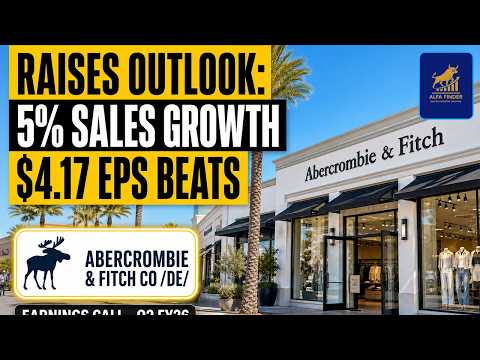
Abercrombie & Fitch reported record net sales of $1.3 billion for fiscal Q2 2026, which ended August 1, 2026, marking its 15th consecutive quarter of growth and a 5% increase year-over-year. The company's diluted earnings per share (EPS) of $4.17 significantly surpassed analysts' consensus estimates of $1.99 by 109.55%. Operating margin reached 20%, partly bolstered by approximately $100 million in refunds of International Emergency Economic Powers Act (IEEPA) tariffs.
2. Robust Full-Year and Q3 Fiscal 2026 Outlook, Coupled with Shareholder Returns.
Following strong results, Abercrombie & Fitch updated its full-year outlook, projecting net sales growth of around 5% and net income per diluted share between $13.10 and $13.60. For fiscal Q3 2026, the company anticipates net sales growth of 5% to 6% and net income per diluted share of $2.90 to $3.20. Additionally, the company repurchased $177 million in shares during fiscal Q2 2026, contributing to year-to-date repurchases of $282 million, which represents a 7% reduction in shares outstanding from the beginning of the year.
Show more
Abercrombie & Fitch (ANF) stock has gained about 70% since 6/30/2026 because of the following key factors:
1. Exceptional Fiscal Q2 2026 Financial Performance.
Abercrombie & Fitch reported record net sales of $1.3 billion for fiscal Q2 2026, which ended August 1, 2026, marking its 15th consecutive quarter of growth and a 5% increase year-over-year. The company's diluted earnings per share (EPS) of $4.17 significantly surpassed analysts' consensus estimates of $1.99 by 109.55%. Operating margin reached 20%, partly bolstered by approximately $100 million in refunds of International Emergency Economic Powers Act (IEEPA) tariffs.
2. Robust Full-Year and Q3 Fiscal 2026 Outlook, Coupled with Shareholder Returns.
Following strong results, Abercrombie & Fitch updated its full-year outlook, projecting net sales growth of around 5% and net income per diluted share between $13.10 and $13.60. For fiscal Q3 2026, the company anticipates net sales growth of 5% to 6% and net income per diluted share of $2.90 to $3.20. Additionally, the company repurchased $177 million in shares during fiscal Q2 2026, contributing to year-to-date repurchases of $282 million, which represents a 7% reduction in shares outstanding from the beginning of the year.
3. Sustained Brand Momentum and Effective Strategic Initiatives.
The company demonstrated consistent sales growth across its Abercrombie brands (up 8%) and Hollister brands (up 2%), with both achieving their best-ever second-quarter sales. Strategic initiatives included the launch of the Fall 2026 "Denim Made Iconic" campaign featuring 120 new styles, and expanded partnerships with the NFL, Dallas Cowboys, and Barry's for its activewear brand YPB.
4. Positive Analyst Sentiment and Price Target Reiterations.
Investment firms reiterated their positive outlooks, with BTIG Research maintaining a "buy" rating and a $175.00 price target on October 9, 2026. Jefferies also upheld its "buy" rating on the same date, citing strong brand momentum, firmer pricing, and disciplined discounting as factors supporting continued sales and margin growth.
Show less
Stock Movement Drivers
Fundamental Drivers
The 70.3% change in ANF stock from 6/30/2026 to 10/17/2026 was primarily driven by a 52.6% change in the company's P/E Multiple.| (LTM values as of) | 6302026 | 10172026 | Change |
|---|---|---|---|
| Stock Price ($) | 90.01 | 153.26 | 70.3% |
| Change Contribution By: | |||
| Total Revenues ($ Mil) | 5,283 | 5,341 | 1.1% |
| Net Income Margin (%) | 9.3% | 10.0% | 7.4% |
| P/E Multiple | 8.2 | 12.5 | 52.6% |
| Shares Outstanding (Mil) | 45 | 44 | 2.7% |
| Cumulative Contribution | 70.3% |
Market Drivers
6/30/2026 to 10/17/2026| Return | Correlation | |
|---|---|---|
| ANF | 70.3% | |
| Market (SPY) | 2.2% | 16.5% |
| Sector (XLY) | -4.1% | 22.3% |
Fundamental Drivers
The 67.7% change in ANF stock from 3/31/2026 to 10/17/2026 was primarily driven by a 52.0% change in the company's P/E Multiple.| (LTM values as of) | 3312026 | 10172026 | Change |
|---|---|---|---|
| Stock Price ($) | 91.37 | 153.26 | 67.7% |
| Change Contribution By: | |||
| Total Revenues ($ Mil) | 5,266 | 5,341 | 1.4% |
| Net Income Margin (%) | 9.6% | 10.0% | 4.3% |
| P/E Multiple | 8.2 | 12.5 | 52.0% |
| Shares Outstanding (Mil) | 46 | 44 | 4.3% |
| Cumulative Contribution | 67.7% |
Market Drivers
3/31/2026 to 10/17/2026| Return | Correlation | |
|---|---|---|
| ANF | 67.7% | |
| Market (SPY) | 17.7% | 16.8% |
| Sector (XLY) | 3.4% | 29.6% |
Fundamental Drivers
The 79.1% change in ANF stock from 9/30/2025 to 10/17/2026 was primarily driven by a 66.4% change in the company's P/E Multiple.| (LTM values as of) | 9302025 | 10172026 | Change |
|---|---|---|---|
| Stock Price ($) | 85.55 | 153.26 | 79.1% |
| Change Contribution By: | |||
| Total Revenues ($ Mil) | 5,100 | 5,341 | 4.7% |
| Net Income Margin (%) | 10.6% | 10.0% | -5.4% |
| P/E Multiple | 7.5 | 12.5 | 66.4% |
| Shares Outstanding (Mil) | 48 | 44 | 8.6% |
| Cumulative Contribution | 79.1% |
Market Drivers
9/30/2025 to 10/17/2026| Return | Correlation | |
|---|---|---|
| ANF | 79.1% | |
| Market (SPY) | 15.5% | 19.9% |
| Sector (XLY) | -5.6% | 29.8% |
Fundamental Drivers
The 171.9% change in ANF stock from 9/30/2023 to 10/17/2026 was primarily driven by a 252.7% change in the company's Net Income Margin (%).| (LTM values as of) | 9302023 | 10172026 | Change |
|---|---|---|---|
| Stock Price ($) | 56.37 | 153.26 | 171.9% |
| Change Contribution By: | |||
| Total Revenues ($ Mil) | 3,851 | 5,341 | 38.7% |
| Net Income Margin (%) | 2.8% | 10.0% | 252.7% |
| P/E Multiple | 25.9 | 12.5 | -51.7% |
| Shares Outstanding (Mil) | 50 | 44 | 15.0% |
| Cumulative Contribution | 171.9% |
Market Drivers
9/30/2023 to 10/17/2026| Return | Correlation | |
|---|---|---|
| ANF | 171.9% | |
| Market (SPY) | 84.7% | 32.7% |
| Sector (XLY) | 42.9% | 35.7% |
Price Returns Compared
| 2021 | 2022 | 2023 | 2024 | 2025 | 2026 | Total [1] | |
|---|---|---|---|---|---|---|---|
| Returns | |||||||
| ANF Return | 71% | -34% | 285% | 69% | -16% | 21% | 647% |
| Peers Return | 17% | -24% | 55% | 12% | 15% | -5% | 67% |
| S&P 500 Return | 27% | -19% | 24% | 23% | 16% | 14% | 108% |
Monthly Win Rates [3] | |||||||
| ANF Win Rate | 67% | 50% | 83% | 50% | 42% | 50% | |
| Peers Win Rate | 50% | 32% | 62% | 52% | 55% | 54% | |
| S&P 500 Win Rate | 75% | 42% | 67% | 75% | 67% | 50% | |
Max Drawdowns [4] | |||||||
| ANF Max Drawdown | -31% | -65% | -30% | -32% | -59% | -46% | |
| Peers Max Drawdown | -29% | -47% | -22% | -34% | -43% | -36% | |
| S&P 500 Max Drawdown | -5% | -25% | -10% | -8% | -19% | -9% | |
[1] Cumulative total returns since the beginning of 2021
[2] Peers: AEO, URBN, LULU, RL, PVH. See ANF Returns vs. Peers.
[3] Win Rate = % of calendar months in which monthly returns were positive
[4] Max drawdown represents maximum peak-to-trough decline within a year
[5] 2026 data is for the year up to 10/16/2026 (YTD)
How Low Can It Go
| Event | ANF | S&P 500 |
|---|---|---|
| 2025 US Tariff Shock | ||
| % Loss | -36.3% | -18.8% |
| % Gain to Breakeven | 57.0% | 23.1% |
| Time to Breakeven | 246 days | 79 days |
| 2023 SVB Regional Banking Crisis | ||
| % Loss | -29.7% | -6.7% |
| % Gain to Breakeven | 42.2% | 7.1% |
| Time to Breakeven | 26 days | 31 days |
| 2022 Inflation Shock & Fed Tightening | ||
| % Loss | -58.9% | -24.5% |
| % Gain to Breakeven | 143.1% | 32.4% |
| Time to Breakeven | 286 days | 427 days |
| 2020 COVID-19 Crash | ||
| % Loss | -52.0% | -33.7% |
| % Gain to Breakeven | 108.4% | 50.9% |
| Time to Breakeven | 189 days | 140 days |
| Q4 2018 Fed Policy Error / Growth Scare | ||
| % Loss | -22.1% | -19.2% |
| % Gain to Breakeven | 28.3% | 23.8% |
| Time to Breakeven | 9 days | 105 days |
| 2016-2017 Trump Reflation Bond Selloff | ||
| % Loss | -31.2% | -3.7% |
| % Gain to Breakeven | 45.3% | 3.9% |
| Time to Breakeven | 226 days | 6 days |
In The Past
Abercrombie & Fitch's stock fell -36.3% during the 2025 US Tariff Shock. Such a loss loss requires a 57.0% gain to breakeven.
Preserve Wealth
Limiting losses and compounding gains is essential to preserving wealth.
Asset Allocation
Actively managed asset allocation strategies protect wealth. Learn more.
| Event | ANF | S&P 500 |
|---|---|---|
| 2025 US Tariff Shock | ||
| % Loss | -36.3% | -18.8% |
| % Gain to Breakeven | 57.0% | 23.1% |
| Time to Breakeven | 246 days | 79 days |
| 2023 SVB Regional Banking Crisis | ||
| % Loss | -29.7% | -6.7% |
| % Gain to Breakeven | 42.2% | 7.1% |
| Time to Breakeven | 26 days | 31 days |
| 2022 Inflation Shock & Fed Tightening | ||
| % Loss | -58.9% | -24.5% |
| % Gain to Breakeven | 143.1% | 32.4% |
| Time to Breakeven | 286 days | 427 days |
| 2020 COVID-19 Crash | ||
| % Loss | -52.0% | -33.7% |
| % Gain to Breakeven | 108.4% | 50.9% |
| Time to Breakeven | 189 days | 140 days |
| Q4 2018 Fed Policy Error / Growth Scare | ||
| % Loss | -22.1% | -19.2% |
| % Gain to Breakeven | 28.3% | 23.8% |
| Time to Breakeven | 9 days | 105 days |
| 2016-2017 Trump Reflation Bond Selloff | ||
| % Loss | -31.2% | -3.7% |
| % Gain to Breakeven | 45.3% | 3.9% |
| Time to Breakeven | 226 days | 6 days |
| 2014-2016 Oil Price Collapse | ||
| % Loss | -59.7% | -6.8% |
| % Gain to Breakeven | 148.0% | 7.3% |
| Time to Breakeven | 2028 days | 15 days |
| 2013 Taper Tantrum | ||
| % Loss | -34.3% | -0.2% |
| % Gain to Breakeven | 52.3% | 0.2% |
| Time to Breakeven | 2668 days | 1 days |
| 2011 US Debt Ceiling Crisis & European Contagion | ||
| % Loss | -26.9% | -17.9% |
| % Gain to Breakeven | 36.9% | 21.8% |
| Time to Breakeven | 4427 days | 123 days |
| 2010 Eurozone Sovereign Debt Crisis / Flash Crash | ||
| % Loss | -38.3% | -15.4% |
| % Gain to Breakeven | 62.2% | 18.2% |
| Time to Breakeven | 154 days | 125 days |
| 2008-2009 Global Financial Crisis | ||
| % Loss | -82.7% | -53.4% |
| % Gain to Breakeven | 478.7% | 114.4% |
| Time to Breakeven | 5429 days | 1085 days |
In The Past
Abercrombie & Fitch's stock fell -36.3% during the 2025 US Tariff Shock. Such a loss loss requires a 57.0% gain to breakeven.
Preserve Wealth
Limiting losses and compounding gains is essential to preserving wealth.
Asset Allocation
Actively managed asset allocation strategies protect wealth. Learn more.
About Abercrombie & Fitch (ANF)
Abercrombie & Fitch Co. (ANF) is a global specialty retailer primarily focused on apparel, personal care products, and accessories. The company operates through two main segments, Hollister and Abercrombie, which encompass a portfolio of distinct brands. It manages an extensive international retail presence with stores across North America, Europe, Asia, and the Middle East, complemented by significant e-commerce operations.
The core business involves designing, sourcing, and marketing a diverse range of clothing and related products for men, women, and children. Key brands include Hollister, Abercrombie & Fitch, abercrombie kids, Gilly Hicks, and Social Tourist. These brands cater to specific fashion tastes and demographics, offering casual wear, intimates, and other lifestyle items, distributed through company-owned stores, its online platforms, and various third-party wholesale, franchise, and licensing arrangements.
ANF's primary customer base consists of children, teens, and young adults seeking contemporary and casual fashion. The company serves these customers across a broad international market, leveraging its multi-channel distribution strategy to reach consumers globally and maintain its brand presence in the competitive retail landscape.
```AI Analysis | Feedback
1. Like Gap Inc., but focused on trendy casual apparel for teens and young adults.
2. Similar to American Eagle Outfitters, operating multiple brands for young, fashion-conscious consumers.
AI Analysis | Feedback
- Apparel: Clothing items offered for men, women, and children under various brands.
- Personal care products: Items such as fragrances and body care products.
- Accessories: Supplemental fashion items that complement apparel.
AI Analysis | Feedback
Abercrombie & Fitch (ANF) primarily sells its products directly to individual consumers through its retail stores and e-commerce platforms. Based on its brand portfolio and product offerings, the company serves the following categories of customers:
- Teenagers and Young Adults: This category represents a significant portion of customers for brands like Abercrombie & Fitch, Hollister, and Social Tourist, which offer casual apparel and accessories tailored to current trends and lifestyles for this demographic.
- Children: The "abercrombie kids" brand specifically targets younger customers, offering a range of clothing and accessories for children.
- Consumers seeking intimates and loungewear: The Gilly Hicks brand focuses on intimates, loungewear, and sleepwear, primarily appealing to women and young women looking for comfortable and stylish options in these categories.
AI Analysis | Feedback
AI Analysis | Feedback
Fran Horowitz, Chief Executive Officer
Fran Horowitz has served as Chief Executive Officer and a director on the Board of Abercrombie & Fitch Co. since February 2017. Her previous roles at the company include President and Chief Merchandising Officer for all brands (December 2015 to February 2017), a member of the Office of the Chairman (December 2014 to February 2017), and Brand President of Hollister (October 2014 to December 2015).
Robert Ball, Executive Vice President, Chief Financial Officer
Robert Ball was appointed Chief Financial Officer of Abercrombie & Fitch Co., effective November 20, 2024. Before this promotion, he was the Senior Vice President of Corporate Finance, Investor Relations, and Treasury. Ball has nearly 22 years of experience with Abercrombie & Fitch Co., having held various finance leadership positions including CFO of the Abercrombie & Fitch and abercrombie kids brands. He began his career as a financial advisor at Merrill Lynch.
Scott Lipesky, Executive Vice President, Chief Operating Officer
Scott Lipesky was promoted to Executive Vice President, Chief Operating Officer in May 2023. Prior to this, he served as the company's Chief Financial Officer from 2017 to 2023. Lipesky has been recognized for his instrumental role in evolving A&F Co.'s finance and strategy functions.
Samir Desai, Executive Vice President, Chief Digital and Technology Officer
Samir Desai has held the position of Executive Vice President, Chief Digital and Technology Officer at Abercrombie & Fitch Co. since July 2021, a newly created role. He is responsible for leading the company's digital transformation strategy, including optimizing user experience, leveraging consumer data and analytics, and enhancing digital experiences across all brands. Before joining Abercrombie & Fitch Co., Mr. Desai was the Chief Technology Officer at Equinox, where he developed and executed the company's data strategy, launched a direct-to-consumer digital media business, and created omnichannel customer experiences. His career started as director of information technology at Intertex Apparel Group.
Greg Henchel, Executive Vice President, General Counsel and Corporate Secretary
Greg Henchel has been Executive Vice President, General Counsel and Corporate Secretary of Abercrombie & Fitch Co. since October 2018, and Executive Vice President since October 2021. He joined A&F from HSN, Inc., where he served as Chief Legal Officer for the multi-channel retailer. Before his tenure at HSN, Henchel was General Counsel at Tween Brands, Inc. Earlier in his career, he served as Assistant General Counsel at Cardinal Health, Inc. and began as a litigation associate at Jones Day.
AI Analysis | Feedback
Key Risks to Abercrombie & Fitch (ANF)
- Macroeconomic Uncertainty and Impact on Consumer Spending: Abercrombie & Fitch's performance is highly dependent on consumer discretionary spending. Fluctuations in global economic conditions, such as inflation, unemployment rates, interest rates, and overall consumer confidence, can directly affect consumer purchasing habits and reduce demand for apparel and accessories. This macroeconomic uncertainty poses a significant threat to the company's sales and profitability.
- Supply Chain Disruptions and Geopolitical Risks: The company relies heavily on foreign manufacturers for its merchandise, exposing it to risks associated with international trade. Potential disruptions in the global supply chain, including trade restrictions, tariffs, increased freight costs, and geopolitical conflicts (such as the uncertainty from ongoing hostilities in Ukraine), can lead to delays in merchandise deliveries, higher operational costs, and impact overall operational efficiency and financial performance.
- Intense Competition and Rapidly Changing Fashion Trends: The apparel retail industry is highly competitive and characterized by constantly evolving fashion trends and consumer preferences. Abercrombie & Fitch must continually anticipate and respond to these changes to maintain customer engagement and demand for its brands. Failure to adapt quickly to new trends or intense promotional activity from competitors can lead to reduced sales, pressure on pricing, inventory obsolescence, and erosion of market share and profitability.
AI Analysis | Feedback
AI Analysis | Feedback
Abercrombie & Fitch (ANF) operates in the apparel, personal care products, and accessories markets.
Addressable Markets:
Apparel
- The global apparel market was valued at approximately $1.84 trillion in 2025.
- In the U.S., the apparel market size was estimated at $365.70 billion in 2025.
- The Asia Pacific region dominated the global apparel industry with a revenue share of 40.8% in 2025.
- Europe's apparel market accounted for 26.55% of the global revenue in 2025.
- The North American apparel market held a share of 22.5% in 2025.
- The Middle East & Africa apparel market is expected to reach $96.23 billion in 2025.
Personal Care Products
- The global beauty and personal care products market was valued at $552.0 billion in 2025.
- The U.S. beauty and personal care products market size was estimated at $109.56 billion in 2025.
- Asia-Pacific dominated the global beauty and personal care products market, holding over 37.2% of the market share in 2025.
Accessories
- The global fashion accessories market size was valued at $1,143.52 billion in 2025.
- The U.S. fashion accessories market generated a revenue of $222.07 billion in 2024.
- The Asia Pacific region dominated the global fashion accessories market with a valuation of $436.18 billion in 2025.
- North America accounts for more than 35% of global fashion accessories consumption.
- Europe holds the second-largest share of the global fashion accessories market.
AI Analysis | Feedback
AI Analysis | Feedback
Share Repurchases
- Abercrombie & Fitch repurchased $450 million in shares in fiscal 2025, which represented an approximate 11% reduction in shares outstanding at the beginning of the year.
- The company has a $1.3 billion share repurchase program, with $1.1 billion remaining authorized as of Q1 2025.
- Abercrombie & Fitch plans to repurchase approximately $450 million in shares in fiscal 2026, with at least $100 million projected for the upcoming fiscal period.
Capital Expenditures
- Capital expenditures for fiscal 2026 are expected to be in the range of $200 million to $225 million.
- Net cash used for investing activities, primarily reflecting capital expenditures, was $151 million in fiscal 2025. Capital expenditures for the period ending January 31, 2026, amounted to $236.1 million.
- The primary focus of capital expenditures includes continued international and channel expansion, investments in marketing, stores, people, digital capabilities, and opening new stores.

Peer Outperformance in Apparel Retail
| Industry | Names | 1Y med | 3Y med | 5Y med | Top 3 by 5Y |
|---|---|---|---|---|---|
| Education Services | 14 | -19.9% | 80.2% | 87.5% | CVSA 248% · PRDO 232% · LRN 140% |
| Homebuilding | 18 | -8.6% | 37.2% | 44.6% | GRBK 187% · PHM 146% · TOL 140% |
| Specialty Stores | 7 | 15.0% | 41.0% | 17.2% | ASO 51% · DKS 36% · FIVE 17% |
| Hotels, Resorts & Cruise Lines | 21 | 11.2% | 46.8% | 11.2% | RCL 233% · MAR 153% · HLT 142% |
| Home Furnishings | 3 | -5.6% | 48.3% | 1.7% | SGI 50% · MHK -35% |
| Home Improvement Retail | 5 | -18.8% | 8.3% | -0.8% | HD 0% · LOW -1% · FND -63% |
| Automotive Retail | 17 | -13.1% | 9.1% | -8.2% | MUSA 239% · PAG 132% · ORLY 113% |
| Footwear | 9 | 72.1% | 45.1% | -10.2% | DECK 44% · SHOO 19% · CROX -10% |
| Specialized Consumer Services | 10 | -13.0% | 23.7% | -12.1% | HRB 132% · FTDR 85% · SCI 42% |
| Distributors | 4 | -9.2% | -23.5% | -16.0% | ARMK 123% · GPC 22% · LKQ -54% |
| Restaurants | 36 | -5.2% | -6.0% | -18.4% | EAT 329% · CAKE 200% · TXRH 107% |
| Household Appliances | 17 | -2.4% | 25.6% | -36.6% | |
| Apparel Retail ← | 26 | 5.1% | 4.9% | -37.5% | ANF 291% · TJX 146% · ROST 130% |
| Leisure Facilities | 12 | 10.8% | -7.0% | -41.2% | LTH 139% · OSW 119% · PLNT -37% |
| Computer & Electronics Retail | 3 | 16.2% | 52.7% | -41.5% | BBY 3% · GME -41% |
| Leisure Products | 14 | -18.3% | -18.3% | -44.3% | GOLF 80% · HAS 31% · MAT -13% |
| Automotive Parts & Equipment | 39 | -12.1% | -17.7% | -47.1% | MOD 1130% · GTX 253% · BWA 51% |
| Apparel, Accessories & Luxury Goods | 29 | 1.3% | 13.7% | -47.4% | RL 258% · TPR 248% · KTB 77% |
| Broadline Retail | 13 | 9.6% | 27.3% | -48.3% | EBAY 75% · AMZN 47% · OLLI 41% |
| Casinos & Gaming | 20 | -11.3% | -26.0% | -50.5% | MCRI 87% · BYD 11% · RRR 9% |
| Automobile Manufacturers | 8 | -73.4% | -53.2% | -77.1% | GM 51% · TSLA 26% · F 8% |
| Other Specialty Retail | 17 | -34.0% | -34.6% | -77.3% | ULTA 46% · TSCO -8% · BBWI -65% |
| Consumer Electronics | 11 | -27.6% | -33.3% | -78.5% | GRMN 102% · SONO -45% |
Latest Trefis Analyses
Research & Analysis
Invest in Strategies
Wealth Management
Peer Comparisons
| Peers to compare with: |
Financials
| Median | |
|---|---|
| Name | |
| Mkt Price | 91.93 |
| Mkt Cap | 6.7 |
| Rev LTM | 8,355 |
| Op Inc LTM | 732 |
| FCF LTM | 715 |
| FCF 3Y Avg | 675 |
| CFO LTM | 875 |
| CFO 3Y Avg | 844 |
Growth & Margins
| Median | |
|---|---|
| Name | |
| Rev Chg LTM | 4.7% |
| Rev Chg 3Y Avg | 8.0% |
| Rev Chg Q | 4.8% |
| QoQ Delta Rev Chg LTM | 1.1% |
| Op Inc Chg LTM | 11.0% |
| Op Inc Chg 3Y Avg | 21.1% |
| Op Mgn LTM | 13.7% |
| Op Mgn 3Y Avg | 14.2% |
| QoQ Delta Op Mgn LTM | 0.7% |
| CFO/Rev LTM | 15.3% |
| CFO/Rev 3Y Avg | 13.8% |
| FCF/Rev LTM | 10.6% |
| FCF/Rev 3Y Avg | 9.7% |
Valuation
| Median | |
|---|---|
| Name | |
| Mkt Cap | 6.7 |
| P/S | 1.0 |
| P/Op Inc | 5.6 |
| P/EBIT | 8.8 |
| P/E | 8.9 |
| P/CFO | 5.5 |
| Total Yield | 8.0% |
| Dividend Yield | 0.2% |
| FCF Yield 3Y Avg | 7.8% |
| D/E | 0.2 |
| Net D/E | 0.1 |
Returns
| Median | |
|---|---|
| Name | |
| 1M Rtn | 15.1% |
| 3M Rtn | 7.6% |
| 6M Rtn | -3.1% |
| 12M Rtn | 21.0% |
| 3Y Rtn | 78.0% |
| 1M Excs Rtn | 12.8% |
| 3M Excs Rtn | 1.8% |
| 6M Excs Rtn | -12.6% |
| 12M Excs Rtn | 4.6% |
| 3Y Excs Rtn | 3.5% |
Comparison Analyses
Segment Financials
Revenue by Segment| $ Mil | 2026 | 2025 | 2024 | 2023 | 2022 |
|---|---|---|---|---|---|
| Single Segment | 5,266 | 4,949 | 4,281 | 3,698 | 3,713 |
| Total | 5,266 | 4,949 | 4,281 | 3,698 | 3,713 |
| $ Mil | 2015 | 2014 | 2013 | 2012 |
|---|---|---|---|---|
| Direct-to-Consumer Operations | 270 | 295 | 269 | 254 |
| U.S. Stores | 261 | 195 | 432 | 390 |
| International Stores | 204 | 249 | 351 | 261 |
| Other | -622 | -658 | -678 | -716 |
| Total | 114 | 81 | 374 | 190 |
| $ Mil | 2015 | 2014 | 2013 | 2012 |
|---|---|---|---|---|
| Other | 1,390 | 1,509 | 1,497 | 1,636 |
| International Stores | 616 | 805 | 840 | 660 |
| U.S. Stores | 349 | 414 | 587 | 681 |
| Direct-to-Consumer Operations | 150 | 122 | 63 | 71 |
| Total | 2,505 | 2,851 | 2,987 | 3,048 |
Price Behavior
| Market Price | $153.26 | |
| Market Cap ($ Bil) | 6.7 | |
| First Trading Date | 09/26/1996 | |
| Distance from 52W High | 0.0% | |
| 50 Days | 200 Days | |
| DMA Price | $133.45 | $102.54 |
| DMA Trend | up | up |
| Distance from DMA | 14.8% | 49.5% |
| 3M | 1YR | |
| Volatility | 84.5% | 71.3% |
| Downside Capture | -161.62 | 40.23 |
| Upside Capture | 111.65 | 117.93 |
| Correlation (S&P 500) | 12.9% | 19.7% |
| 1M | 2M | 3M | 6M | 1Y | 3Y | |
|---|---|---|---|---|---|---|
| Beta | 1.47 | 1.56 | 1.28 | 0.95 | 1.11 | 1.33 |
| Up Beta | 2.10 | -3.58 | -3.83 | -0.68 | 0.59 | 1.37 |
| Down Beta | 3.19 | 4.42 | 3.38 | 2.24 | 1.68 | 1.50 |
| Up Capture | 80% | 391% | 384% | 151% | 131% | 190% |
| Bmk +ve Days | 6 | 16 | 27 | 66 | 132 | 424 |
| Stock +ve Days | 10 | 20 | 31 | 63 | 127 | 380 |
| Down Capture | 212% | 101% | 104% | 85% | 84% | 104% |
| Bmk -ve Days | 16 | 26 | 37 | 60 | 120 | 328 |
| Stock -ve Days | 12 | 22 | 33 | 63 | 125 | 371 |
[1] Upside and downside betas calculated using positive and negative benchmark daily returns respectively
Based On 1-Year Data
| Annualized Return | Annualized Volatility | Sharpe Ratio | Correlation with ANF | |
|---|---|---|---|---|
| ANF | 116.2% | 71.3% | 1.34 | - |
| Sector ETF (XLY) | -3.6% | 19.2% | -0.32 | 30.0% |
| Equity (SPY) | 15.8% | 12.7% | 0.86 | 19.6% |
| Gold (GLD) | -1.4% | 29.4% | -0.05 | -4.7% |
| Commodities (DBC) | 52.4% | 20.7% | 1.92 | -22.7% |
| Real Estate (VNQ) | 4.8% | 13.7% | 0.09 | 14.3% |
| Bitcoin (BTCUSD) | -26.5% | 43.6% | -0.59 | 6.7% |
Smart multi-asset allocation framework can stack odds in your favor. Learn How
Based On 5-Year Data
| Annualized Return | Annualized Volatility | Sharpe Ratio | Correlation with ANF | |
|---|---|---|---|---|
| ANF | 31.6% | 62.8% | 0.68 | - |
| Sector ETF (XLY) | 5.1% | 24.1% | 0.17 | 40.6% |
| Equity (SPY) | 13.2% | 17.1% | 0.59 | 36.7% |
| Gold (GLD) | 18.4% | 18.9% | 0.79 | -2.2% |
| Commodities (DBC) | 9.9% | 19.5% | 0.39 | -0.8% |
| Real Estate (VNQ) | 1.6% | 18.8% | -0.02 | 21.8% |
| Bitcoin (BTCUSD) | 8.6% | 51.8% | 0.34 | 14.6% |
Smart multi-asset allocation framework can stack odds in your favor. Learn How
Based On 10-Year Data
| Annualized Return | Annualized Volatility | Sharpe Ratio | Correlation with ANF | |
|---|---|---|---|---|
| ANF | 27.7% | 61.9% | 0.65 | - |
| Sector ETF (XLY) | 12.0% | 22.2% | 0.49 | 41.6% |
| Equity (SPY) | 15.2% | 17.9% | 0.72 | 37.6% |
| Gold (GLD) | 12.3% | 16.4% | 0.61 | -5.3% |
| Commodities (DBC) | 8.3% | 18.1% | 0.37 | 9.2% |
| Real Estate (VNQ) | 5.2% | 20.7% | 0.21 | 29.3% |
| Bitcoin (BTCUSD) | 63.1% | 66.2% | 1.03 | 9.7% |
Smart multi-asset allocation framework can stack odds in your favor. Learn How
Returns Analyses
Earnings Returns History
Updated 9/29/2026| Forward Returns | |||
|---|---|---|---|
| Earnings Date | 1D Returns | 5D Returns | 21D Returns |
| 8/26/2026 | 35.7% | 29.2% | 23.3% |
| 5/27/2026 | 8.9% | 2.2% | 19.5% |
| 3/4/2026 | -3.6% | -12.5% | -5.0% |
| 11/26/2025 | 7.1% | -0.3% | 32.3% |
| 8/28/2025 | -3.1% | -1.2% | -12.2% |
| 5/29/2025 | -5.5% | -4.2% | -0.2% |
| 3/6/2025 | 2.9% | -9.2% | -12.3% |
| 11/27/2024 | 0.8% | 0.9% | 4.1% |
| ... | |||
| SUMMARY STATS | |||
| # Positive | 10 | 8 | 12 |
| # Negative | 14 | 16 | 12 |
| Median Positive | 3.3% | 5.4% | 14.0% |
| Median Negative | -2.9% | -7.0% | -6.9% |
| Max Positive | 35.7% | 29.2% | 32.3% |
| Max Negative | -9.5% | -12.5% | -15.1% |
| Forward Returns | |||
|---|---|---|---|
| Earnings Date | 1D Returns | 5D Returns | 21D Returns |
| 8/26/2026 | 35.7% | 29.2% | 23.3% |
| 5/27/2026 | 8.9% | 2.2% | 19.5% |
| 3/4/2026 | -3.6% | -12.5% | -5.0% |
| 11/26/2025 | 7.1% | -0.3% | 32.3% |
| 8/28/2025 | -3.1% | -1.2% | -12.2% |
| 5/29/2025 | -5.5% | -4.2% | -0.2% |
| 3/6/2025 | 2.9% | -9.2% | -12.3% |
| 11/27/2024 | 0.8% | 0.9% | 4.1% |
| 8/29/2024 | 3.8% | -7.9% | -1.6% |
| 5/30/2024 | -3.1% | -1.5% | 3.4% |
| 3/7/2024 | -7.2% | -1.9% | -6.5% |
| 11/22/2023 | 0.7% | 4.2% | 27.2% |
| 8/24/2023 | -0.6% | 6.5% | 2.6% |
| 5/25/2023 | 4.9% | 11.3% | 31.2% |
| 3/2/2023 | 0.6% | -4.6% | -2.1% |
| 11/23/2022 | -0.9% | -0.4% | -7.2% |
| 8/29/2022 | -1.8% | 1.6% | 8.5% |
| 5/25/2022 | -1.7% | -8.2% | -15.1% |
| 3/3/2022 | -9.5% | -8.4% | -0.6% |
| 11/24/2021 | -3.1% | -10.0% | -11.6% |
| 8/27/2021 | -2.0% | -6.7% | 8.5% |
| 5/27/2021 | -2.7% | -10.0% | 3.4% |
| 3/3/2021 | 1.8% | 18.7% | 26.4% |
| 11/25/2020 | -1.0% | -7.4% | -10.6% |
| SUMMARY STATS | |||
| # Positive | 10 | 8 | 12 |
| # Negative | 14 | 16 | 12 |
| Median Positive | 3.3% | 5.4% | 14.0% |
| Median Negative | -2.9% | -7.0% | -6.9% |
| Max Positive | 35.7% | 29.2% | 32.3% |
| Max Negative | -9.5% | -12.5% | -15.1% |
SEC Filings
Expand for More| Report Date | Filing Date | Filing |
|---|---|---|
| 07/31/2026 | 09/04/2026 | 10-Q |
| 04/30/2026 | 06/05/2026 | 10-Q |
| 01/31/2026 | 03/26/2026 | 10-K |
| 10/31/2025 | 12/05/2025 | 10-Q |
| 07/31/2025 | 09/05/2025 | 10-Q |
| 04/30/2025 | 06/06/2025 | 10-Q |
| 01/31/2025 | 03/31/2025 | 10-K |
| 10/31/2024 | 12/06/2024 | 10-Q |
| 07/31/2024 | 09/06/2024 | 10-Q |
| 04/30/2024 | 06/07/2024 | 10-Q |
| 01/31/2024 | 04/01/2024 | 10-K |
| 10/31/2023 | 12/04/2023 | 10-Q |
| 07/31/2023 | 09/01/2023 | 10-Q |
| 04/30/2023 | 06/06/2023 | 10-Q |
| 01/31/2023 | 03/27/2023 | 10-K |
| 10/31/2022 | 12/06/2022 | 10-Q |
| Report Date | Filing Date | Filing |
|---|---|---|
| 07/31/2026 | 09/04/2026 | 10-Q |
| 04/30/2026 | 06/05/2026 | 10-Q |
| 01/31/2026 | 03/26/2026 | 10-K |
| 10/31/2025 | 12/05/2025 | 10-Q |
| 07/31/2025 | 09/05/2025 | 10-Q |
| 04/30/2025 | 06/06/2025 | 10-Q |
| 01/31/2025 | 03/31/2025 | 10-K |
| 10/31/2024 | 12/06/2024 | 10-Q |
| 07/31/2024 | 09/06/2024 | 10-Q |
| 04/30/2024 | 06/07/2024 | 10-Q |
| 01/31/2024 | 04/01/2024 | 10-K |
| 10/31/2023 | 12/04/2023 | 10-Q |
| 07/31/2023 | 09/01/2023 | 10-Q |
| 04/30/2023 | 06/06/2023 | 10-Q |
| 01/31/2023 | 03/27/2023 | 10-K |
| 10/31/2022 | 12/06/2022 | 10-Q |
| 07/31/2022 | 09/07/2022 | 10-Q |
| 04/30/2022 | 06/08/2022 | 10-Q |
| 01/31/2022 | 03/28/2022 | 10-K |
| 10/31/2021 | 12/06/2021 | 10-Q |
| 07/31/2021 | 09/08/2021 | 10-Q |
| 04/30/2021 | 06/09/2021 | 10-Q |
| 01/31/2021 | 03/29/2021 | 10-K |
| 10/31/2020 | 12/07/2020 | 10-Q |
| 07/31/2020 | 09/08/2020 | 10-Q |
| 04/30/2020 | 06/10/2020 | 10-Q |
| 01/31/2020 | 03/31/2020 | 10-K |
| 10/31/2019 | 12/11/2019 | 10-Q |
Recent Forward Guidance
Updated 10/4/2026Latest: Q2 2026 Earnings Reported 8/26/2026
| Forward Guidance | Guidance Change | |||||||
|---|---|---|---|---|---|---|---|---|
| Metric | Source | Low | Mid | High | % Chg | % Delta | Change | Prior |
| Q3 2026 Net Sales Growth | Reported | 5.0% | 5.5% | 6.0% | 2.5% | Higher New | Guidance: 3.0% for Q2 2026 | |
| Q3 2026 Operating Margin | Reported | 13.0% | 13.5% | 14.0% | 3.5% | Higher New | Guidance: 10.0% for Q2 2026 | |
| Q3 2026 Net Income per diluted share | Reported | 2.9 | 3.05 | 3.2 | 60.5% | Higher New | Guidance: 1.9 for Q2 2026 | |
| Q3 2026 Share repurchases | Reported | 100.00 Mil | -33.3% | Lower New | Guidance: 150.00 Mil for Q2 2026 | |||
| 2026 Net Sales Growth | Reported | 5.0% | 1.0% | Raised | Guidance: 4.0% for 2026 | |||
| 2026 Operating Margin | Reported | 14.5% | 14.75% | 15.0% | 2.5% | Raised | Guidance: 12.25% for 2026 | |
| 2026 Net Income per diluted share | Reported | 13.1 | 13.35 | 13.6 | 25.9% | Raised | Guidance: 10.6 for 2026 | |
| 2026 Share repurchases | Reported | 500.00 Mil | 11.1% | Raised | Guidance: 450.00 Mil for 2026 | |||
Prior: Q1 2026 Earnings Reported 5/27/2026
| Forward Guidance | Guidance Change | |||||||
|---|---|---|---|---|---|---|---|---|
| Metric | Source | Low | Mid | High | % Chg | % Delta | Change | Prior |
| Q2 2026 Net sales growth | Reported | 2.0% | 3.0% | 4.0% | 50.0% | 1.0% | Higher New | Guidance: 2.0% for Q1 2026 |
| Q2 2026 Operating margin | Reported | 10.0% | 42.9% | 3.0% | Higher New | Guidance: 7.0% for Q1 2026 | ||
| Q2 2026 Net income per diluted share | Reported | 1.8 | 1.9 | 2 | 52.0% | Higher New | Guidance: 1.25 for Q1 2026 | |
| Q2 2026 Share repurchases | Reported | 150.00 Mil | 50.0% | Higher New | Guidance: 100.00 Mil for Q1 2026 | |||
| 2026 Net sales growth | Reported | 3.0% | 4.0% | 5.0% | 0.0% | 0.0% | Affirmed | Guidance: 4.0% for 2026 |
| 2026 Operating margin | Reported | 12.0% | 12.25% | 12.5% | 0.0% | 0.0% | Affirmed | Guidance: 12.25% for 2026 |
| 2026 Net income per diluted share | Reported | 10.2 | 10.6 | 11 | 0.0% | Affirmed | Guidance: 10.6 for 2026 | |
| 2026 Capital expenditures | Reported | 225.00 Mil | 5.9% | Raised | Guidance: 212.50 Mil for 2026 | |||
| 2026 Share repurchases | Reported | 450.00 Mil | 0.0% | Affirmed | Guidance: 450.00 Mil for 2026 | |||
Q4 2025 Earnings Reported 3/4/2026
| Forward Guidance | Guidance Change | |||||||
|---|---|---|---|---|---|---|---|---|
| Metric | Source | Low | Mid | High | % Chg | % Delta | Change | Prior |
| Q1 2026 Net sales growth | Reported | 1.0% | 2.0% | 3.0% | -3.0% | Lower New | Actual: 5.0% for Q4 2025 | |
| Q1 2026 Operating margin | Reported | 7.0% | -7.0% | Lower New | Actual: 14.0% for Q4 2025 | |||
| Q1 2026 Net income per diluted share | Reported | 1.2 | 1.25 | 1.3 | -64.8% | Lower New | Actual: 3.55 for Q4 2025 | |
| Q1 2026 Share repurchases | Reported | 100.00 Mil | ||||||
| 2026 Net sales growth | Reported | 3.0% | 4.0% | 5.0% | -2.5% | Lower New | Actual: 6.5% for 2025 | |
| 2026 Operating margin | Reported | 12.0% | 12.25% | 12.5% | -1.0% | Lower New | Actual: 13.25% for 2025 | |
| 2026 Net income per diluted share | Reported | 10.2 | 10.6 | 11 | 2.4% | Higher New | Actual: 10.35 for 2025 | |
| 2026 Capital expenditures | Reported | 200.00 Mil | 212.50 Mil | 225.00 Mil | -5.6% | Lower New | Actual: 225.00 Mil for 2025 | |
| 2026 Share repurchases | Reported | 450.00 Mil | 0 | Same New | Actual: 450.00 Mil for 2025 | |||
Q3 2025 Earnings Reported 11/26/2025
| Forward Guidance | Guidance Change | |||||||
|---|---|---|---|---|---|---|---|---|
| Metric | Source | Low | Mid | High | % Chg | % Delta | Change | Prior |
| Q4 2025 Net sales growth | Reported | 4.0% | 5.0% | 6.0% | -16.7% | -1.0% | Lower New | Guidance: 6.0% for Q3 2025 |
| Q4 2025 Operating margin | Reported | 14.0% | 2.5% | Higher New | Guidance: 11.5% for Q3 2025 | |||
| Q4 2025 Net income per diluted share | Reported | 3.4 | 3.55 | 3.7 | 65.1% | Higher New | Guidance: 2.15 for Q3 2025 | |
| 2025 Net sales growth | Reported | 6.0% | 6.5% | 7.0% | 0.5% | Raised | Guidance: 6.0% for 2025 | |
| 2025 Operating margin | Reported | 13.0% | 13.25% | 13.5% | 0.0% | Affirmed | Guidance: 13.25% for 2025 | |
| 2025 Net income per diluted share | Reported | 10.2 | 10.35 | 10.5 | 1.0% | Raised | Guidance: 10.25 for 2025 | |
| 2025 Capital expenditures | Reported | 225.00 Mil | 0.0% | Affirmed | Guidance: 225.00 Mil for 2025 | |||
| 2025 Share repurchases | Reported | 450.00 Mil | 12.5% | Raised | Guidance: 400.00 Mil for 2025 | |||
Insider Activity
Updated 9/9/2026| # | Owner | Title | Holding | Action | Filing Date | Price | Shares | Transacted Value | Value of Held Shares | Form |
|---|---|---|---|---|---|---|---|---|---|---|
| 1 | Lipesky, Scott D | EVP and COO | Direct | Sell | 9092026 | 146.82 | 2,000 | 293,640 | 21,367,302 | Form |
| 2 | Rust, Jay | EVP, Chief HR Officer | Direct | Sell | 9012026 | 147.50 | 5,000 | 737,500 | 2,308,522 | Form |
| 3 | Robinson, Kenneth B | Direct | Sell | 9012026 | 149.69 | 800 | 119,752 | 1,073,128 | Form | |
| 4 | Lipesky, Scott D | EVP and COO | Direct | Sell | 9012026 | 149.00 | 5,000 | 745,000 | 21,982,566 | Form |
| 5 | Henchel, Gregory J | EVP, Chief Legal Off & Secy | Direct | Sell | 9012026 | 146.65 | 30,000 | 4,399,500 | 4,939,319 | Form |
| # | Owner | Title | Holding | Action | Filing Date | Price | Shares | Transacted Value | Value of Held Shares | Form |
|---|---|---|---|---|---|---|---|---|---|---|
| 1 | Lipesky, Scott D | EVP and COO | Direct | Sell | 9092026 | 146.82 | 2,000 | 293,640 | 21,367,302 | Form |
| 2 | Rust, Jay | EVP, Chief HR Officer | Direct | Sell | 9012026 | 147.50 | 5,000 | 737,500 | 2,308,522 | Form |
| 3 | Robinson, Kenneth B | Direct | Sell | 9012026 | 149.69 | 800 | 119,752 | 1,073,128 | Form | |
| 4 | Lipesky, Scott D | EVP and COO | Direct | Sell | 9012026 | 149.00 | 5,000 | 745,000 | 21,982,566 | Form |
| 5 | Henchel, Gregory J | EVP, Chief Legal Off & Secy | Direct | Sell | 9012026 | 146.65 | 30,000 | 4,399,500 | 4,939,319 | Form |
| 6 | Lipesky, Scott D | EVP and COO | Direct | Sell | 8112026 | 115.00 | 10,000 | 1,150,000 | 17,541,410 | Form |
| 7 | Lipesky, Scott D | EVP and COO | Direct | Sell | 8062026 | 110.00 | 10,000 | 1,100,000 | 17,878,740 | Form |
| 8 | Lipesky, Scott D | EVP and COO | Direct | Sell | 7292026 | 105.00 | 10,000 | 1,050,000 | 18,116,070 | Form |
| 9 | Lipesky, Scott D | EVP and COO | Direct | Sell | 7202026 | 100.00 | 10,000 | 1,000,000 | 18,253,400 | Form |
| 10 | Horowitz, Fran | Chief Executive Officer | Direct | Sell | 2092026 | 100.00 | 29,769 | 2,976,900 | 30,850,300 | Form |
| 11 | Horowitz, Fran | Chief Executive Officer | Direct | Sell | 2062026 | 102.00 | 17,031 | 1,737,200 | 34,504,499 | Form |
| 12 | Horowitz, Fran | Chief Executive Officer | Direct | Sell | 2062026 | 103.66 | 50,000 | 5,182,968 | 36,830,481 | Form |
| 13 | Horowitz, Fran | Chief Executive Officer | Direct | Sell | 2042026 | 101.34 | 50,000 | 5,066,958 | 41,073,066 | Form |
| 14 | Horowitz, Fran | Chief Executive Officer | Direct | Sell | 2042026 | 101.12 | 50,000 | 5,055,808 | 46,038,491 | Form |
| 15 | Horowitz, Fran | Chief Executive Officer | Direct | Sell | 1262026 | 95.40 | 100,000 | 9,539,584 | 48,203,803 | Form |
| 16 | Horowitz, Fran | Chief Executive Officer | Direct | Sell | 1262026 | 98.53 | 103,200 | 10,168,763 | 59,643,243 | Form |
| 17 | Robinson, Kenneth B | Direct | Sell | 9082025 | 94.60 | 1,392 | 131,683 | 556,248 | Form | |
| 18 | Rust, Jay | EVP Human Resources | Direct | Sell | 9032025 | 93.15 | 1,500 | 139,725 | 619,261 | Form |
| 19 | Goldman, James A | Direct | Sell | 9032025 | 96.18 | 5,072 | 487,825 | 727,602 | Form | |
| 20 | Anderson, Kerrii B | Direct | Sell | 9032025 | 95.12 | 4,292 | 408,234 | 3,534,291 | Form |
Investor Activity (13F)
Updated Oct 18, 2026Active managers (13F portfolio over $250M, at least 3 holdings) with a position over $5M that is either over 10% of their portfolio or held in a concentrated book of 50 or fewer total positions. Index/ETF, sovereign, bank, community-bank and charitable/donor-advised filers are excluded.
| Active Manager |
|---|
Abercrombie & Fitch — Investor Video Playlist


Industry Resources
| Consumer Discretionary Resources |
| Retail Dive |
| Business of Fashion (BoF) |
| WWD (Women's Wear Daily) |
| National Retail Federation (NRF) |
| McKinsey & Company - Consumer |
| Mintel Consumer Trends |
| Apparel Retail Resources |
| Apparel News |
| Just Style |
| Sourcing Journal |
External Quote Links
| Y Finance | Barrons |
| TradingView | Morningstar |
| SeekingAlpha | ValueLine |
| Motley Fool | Robinhood |
| CNBC | Etrade |
| MarketWatch | Unusual Whales |
| YCharts | Perplexity Finance |
| FinViz |
Prefer one of these to Trefis? Tell us why.