
How Oracle Stock Rises To $300
Can Oracle (NYSE: ORCL) stock reach $300 in the coming years? We think there is a real possibility. How? Consider this: just about a year ago, Oracle stock was trading at $135, surged to 52-week high levels of $346, and currently trades at $163 per share after correcting from higher levels. Looking at the valuations, Oracle’s valuation is 22.6x based on trailing earnings and 21.9x estimated forward earnings. Is this pricey? Not really, considering the company is converting its backlog into revenue alongside data center buildouts.
That being said, Oracle’s stock performance has experienced varied returns over the last three years, consistently outpacing the broader market. Returns for the stock were 27.36% in 2023, 63.03% in 2024, and 18.52% in 2025. In contrast, the S&P 500 returned 24.23% in 2023, 23.31% in 2024, and 16.39% in 2025.
Why is that? Oracle provided higher returns as the market accounted for its infrastructure expansion to support workloads. In the scenario below, we use Oracle revenues, profit margins, and valuation multiples to demonstrate a potential path to a $330 stock price.
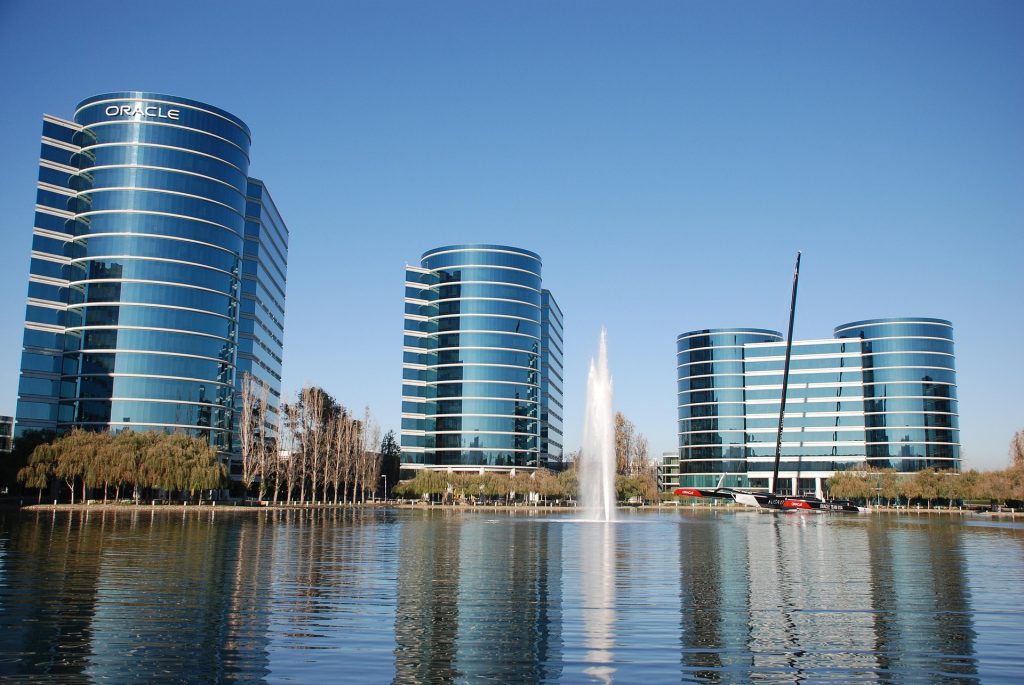
Image by JJ from Pixabay
Capacity Buildouts Will Drive Revenue Growth
Oracle revenues expanded from $49.95 billion in fiscal 2023 to $64.08 billion over the trailing twelve months. The momentum is poised to continue. Oracle is likely to see sales expand to $67.2 billion in the current fiscal year. Specifically, Oracle Cloud Infrastructure (OCI) is rapidly capturing generative AI training workloads. If Oracle maintains this OCI backlog conversion and data center expansion rate, sales could rise to $88.1 billion by 2027 and reach $108.0 billion by fiscal 2028. See how Oracle’s growth and margins compare with its peers, including CRM and IBM.
Scale Will Support Earnings Despite Margin Pressure
Oracle is navigating a critical transition period. Its adjusted net income margins, which stood at 28.4% in fiscal 2023, improved to 32.7% over the trailing twelve months. Given the massive capital expenditures required to secure GPU clusters and build out data centers, the company’s margins are expected to take a near-term hit.
However, as the company converts its backlog into revenue, economies of scale will apply. While we do not expect a meaningful rise in the margins by 2028, the absolute volume of revenue expansion will translate into bottom-line growth. This trajectory projects adjusted earnings to rise to over $11 per share by 2028.
Oracle Valuation
Now, if expected earnings reach $11 by 2028, the P/E multiple will contract from about 23x currently to levels of about 14x, assuming the stock price stays the same. Right? But that is exactly what Oracle investors are betting will not happen. With the initial investment for capacity buildouts out of the way and the backlog translating into real revenues, a scenario where the multiple expands looks more likely. Why is that?
While supply chain bottlenecks for data center hardware remain a primary execution risk, as capital expenditures normalize and the backlog converts to revenue, investors will likely assign a premium to Oracle’s future. A rebound to the stock’s three-year average multiple of 30x would translate into a stock price of $330. This effectively means an earnings expansion paired with a return to historical multiples would drive a more than 2x rise from current levels. This makes the growth of Oracle stock to $300 levels by 2028 a real possibility.
Oracle’s aggressive data center buildouts and accelerating backlog conversion make it a compelling tech pick. For investors weighing the broader cloud infrastructure race, see our recent analysis – Is Microsoft Stock A Smarter Buy Than Google After Its Massive 250% Rally? – highlights similar AI-driven momentum. However, picking the right winners across the sector still carries risk. If you want to deploy high-conviction, data-backed strategies across your entire portfolio without managing the day-to-day execution yourself, we can help. Our Trefis High Quality Portfolio (HQ) strategy has outperformed its market benchmark (a combination of the S&P 500, S&P mid-cap, and Russell 2000) to produce over 105% returns since inception.