
How Low Can Shopify Stock Go?

Shopify (NASDAQ: SHOP) provides the e-commerce infrastructure for a diverse merchant base, including brands such as Skullcandy, Daily Harvest, and Carrier. Despite this established market position, the stock has faced significant selling pressure recently, declining 38% year-to-date and reaching a 52-week low of $97 in May 2026.
Historical data indicate that market shocks are an inherent risk for high-growth assets. Across 10 major crises, Shopify has sustained an average drawdown of -34%, compared to a -14% average decline for the S&P 500. This heightened volatility is typically a function of Shopify’s high-multiple valuation structure rather than fundamental deterioration. During systemic de-risking phases, high-growth cloud platforms often experience accelerated capital outflows, a trend frequently observed in peers such as MercadoLibre (MELI).
Analyzing Shopify’s quantitative performance during past market contractions provides a framework for identifying a potential valuation floor and distinguishing between cyclical volatility and a structural retreat.

Image by StockSnap from Pixabay
- How Western Digital Became An AI Landlord
- Is Micron Stock’s Record-Breaking Run A Cyclical Peak Or A New AI Reality?
- What A Patient Holder Is Really Paying For Broadcom Stock
- Visa Stock And The Number Behind The Worry
- Texas Instruments Stock And The Industrial Recovery Hiding In Plain Sight
- PLTR Stock: What Does Its Valuation Imply?
How Does It Handle Rate & Valuation Shock?
The 2022 Inflation Shock set the benchmark for rate-driven volatility as aggressive Fed tightening to combat 9.1% inflation triggered a massive valuation reset. Shopify sustained an 81% drawdown, significantly deeper than the 24% decline in the S&P 500 and the 35% drop in the bond market. This capital rotation favored cash-flow-positive incumbents like Oracle (ORCL) and Microsoft (MSFT) at the expense of high-multiple growth peers. Shopify’s contraction mirrored the sharp de-ratings seen in Salesforce (CRM), Snowflake (SNOW), and Cloudflare (NET), as rising discount rates penalized growth-dependent valuation models.
This trend highlights the resilience of diversified platforms; for example, even during such resets, Booking Stock Delivers Strong Cash Yield – Upside Ahead? because its high-margin business model offers a valuation floor that high-multiple software stocks often lack.
What Happens During Sovereign & Geopolitical Risk?
The 2025 U.S. Tariff Shock exposed Shopify’s deep vulnerability to supply chain disruptions. SHOP stock experienced a -40% drawdown during this period, significantly underperforming the -19% decline for the S&P 500 and the -3.8% dip in the bond market. Because Shopify relies heavily on cross-border trade, these tariffs directly threatened the processing fees that drive its revenue. This geopolitical headwind created synchronized pressure across the industry, forcing competitors like Amazon (AMZN) and eBay (EBAY) to navigate skyrocketing costs of goods for their small business partners.
In these environments, investors are forced to ask How Low Can INTC Really Go In A Market Crash? as they search for absolute price support, which is a challenging exercise for Shopify because its “floor” is often moving in lockstep with the viability of its small business ecosystem.
How It Fares During Growth & Demand Scares?
The 2015-2016 China Devaluation triggered a 44% drop in Shopify as markets priced in a potential global recession. Because independent merchants rely heavily on discretionary spending, their growth typically retracts first during macro slowdowns. This sensitivity is a shared trait among digital commerce enablers like Wix (WIX) and payment processors like PayPal (PYPL), both of which face immediate volume compression when consumer confidence wavers.
Past Market Shock Drawdowns Summarized For SHOP
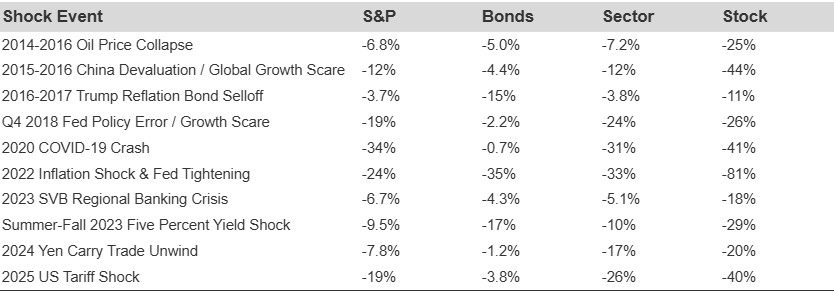
[1] 2014-2016 Oil Price Collapse: OPEC refused to cut output, crashing crude from $100 to $26.
[2] 2015-2016 China Devaluation / Global Growth Scare: Yuan devaluation sparked global recession fears, crushing cyclicals and emerging markets.
[3] 2016-2017 Trump Reflation Bond Selloff: Trump’s election spurred fiscal stimulus hopes, rotating capital from bonds into cyclicals.
[4] Q4 2018 Fed Policy Error / Growth Scare: Powell’s hawkish comments and trade war fears triggered the worst December since 1931.
[5] 2020 COVID-19 Crash: Pandemic lockdowns caused history’s fastest bear market before massive stimulus drove recovery.
[6] 2022 Inflation Shock & Fed Tightening: 9.1% CPI forced aggressive rate hikes, crushing both stocks and bonds simultaneously.
[7] 2023 SVB Regional Banking Crisis: SVB’s rate-driven bond losses triggered a social-media bank run, seized by FDIC.
[8] Summer-Fall 2023 Five Percent Yield Shock: Strong economic data pushed 10-year yields to 5%, compressing yield-sensitive sector valuations.
[9] 2024 Yen Carry Trade Unwind: BOJ rate hike unwound yen carry trades, briefly crashing tech stocks globally.
[10] 2025 US Tariff Shock: 145% China tariffs crashed equities and the dollar on supply chain disruption fears.
So, What Can You Do For Your Investments?
When a Rate and Valuation Risk shock hits, Shopify contracts predictably, often exhibiting significantly more volatility than established, cash-flow-heavy technology incumbents. Recognizing this behavior as a mathematical feature of high-beta e-commerce stocks rather than a structural flaw allows investors to maintain a long-term perspective during inevitable periods of macro-driven turbulence.
To navigate these sharp swings, the Trefis High Quality Portfolio offers a more resilient approach by focusing on durable fundamental compounding across a diversified set of winners. The HQ Portfolio has delivered 105% returns since inception, consistently outperforming its benchmark (a combination of the S&P 500, S&P Mid-Cap, and Russell 2000). Why did HQ outperform? See the full story behind the HQ Portfolio performance metrics. and the five key reasons for its consistent success.