
Rocket Lab Stock’s Strong Flight Hides A Steep Fall
Record contracts paint a bullish picture, but in a market shock, this stock has a history of falling much harder than the averages.
Rocket Lab (RKLB) stock fell 10.8% on June 12th, 2026, a sharp drop that gets your attention. But it’s a deceptively small move compared to the real risk here. The company itself appears to be executing well, building its Electron and HASTE rockets while developing the larger Neutron vehicle. On its latest earnings call, management announced a record quarter, with revenue hitting $200.3 million and the backlog swelling to approximately $2.2 billion. The market is weighing that strength against guidance for lower gross margins, driven by a mix shift toward large-scale government contracts with the Space Development Agency (SDA).
That near-term pressure makes a bigger question urgent for shareholders. Forget a single-day drop; how does this stock behave in a genuine, broad market shock? The historical pattern is clear and severe, and understanding it is the key to deciding if you can truly ride out the volatility.
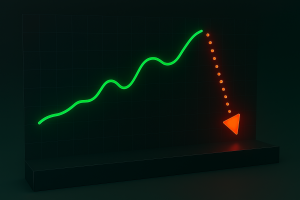
How Steep Are Rocket Lab’s Crash-Time Drops?
- Cash Machine Trading Cheap – EPAM Systems Stock Set to Run?
- Johnson & Johnson Stock Capital Return Hits $85 Bil
- GE Aerospace Stock Pays Out $29 Bil – Investors Take Note
- Years of Rewards: $28 Bil From Nike Stock
- Coinbase Global Stock Pulls Back to Support – Smart Entry?
- TransUnion Stock Delivers Strong Cash Yield – Upside Ahead?
When the market catches a cold, Rocket Lab has historically gotten the flu. Across the five major shocks it has traded through, the stock’s average peak-to-trough drawdown was about 37%, while the S&P 500 fell an average of 13% in the same periods. That amplified downside is the risk you carry. Its single deepest drawdown was 70%, a gut-wrenching fall during the 2022 Inflation Shock & Fed Tightening. The stock has been hit hardest during “Rate & Valuation Shock” environments, which included that 2022 event and the Summer-Fall 2023 Five Percent Yield Shock. In a real storm, this stock’s drops are less like dips and more like dives.
After the Fall: How Rocket Lab Has Come Back
The historical silver lining has been the speed of its rebound. For the shocks it has fully recovered from, the median time to climb back to a pre-shock high was about 4 months. These past episodes read more like sudden air-pockets than lasting structural damage to the stock price. However, the slowest recovery took much longer: about 34 months to reclaim its high after the 2022 Inflation Shock & Fed Tightening. A history of fast recoveries is encouraging, but it is not a promise. The next major market downturn could always be different.
Every Major Shock Rocket Lab Has Traded Through
Peak-to-trough drawdown in each shock, and how long the stock took to reclaim its pre-shock high. Stock vs. the S&P 500, long-duration bonds, and its sector.
| Shock Event | Stock | S&P 500 | Bonds | Sector | Recovery |
|---|---|---|---|---|---|
| 2022 Inflation Shock & Fed Tightening | -70% | -24% | -35% | -20% | ~34 mo |
| 2023 SVB Regional Banking Crisis | -22% | -6.7% | -4.3% | -6.2% | ~4 mo |
| Summer-Fall 2023 Five Percent Yield Shock | -46% | -9.5% | -17% | -12% | ~14 mo |
| 2024 Yen Carry Trade Unwind | -11% | -7.8% | -1.2% | -1.1% | ~1 mo |
| 2025 US Tariff Shock | -37% | -19% | -3.8% | -16% | ~3 mo |
[1] 2022 Inflation Shock & Fed Tightening: 9.1% CPI forced aggressive rate hikes, crushing both stocks and bonds simultaneously.
[2] 2023 SVB Regional Banking Crisis: SVB’s rate-driven bond losses triggered a social-media bank run, seized by FDIC.
[3] Summer-Fall 2023 Five Percent Yield Shock: Strong economic data pushed 10-year yields to 5%, compressing yield-sensitive sector valuations.
[4] 2024 Yen Carry Trade Unwind: BOJ rate hike unwound yen carry trades, briefly crashing tech stocks globally.
[5] 2025 US Tariff Shock: 145% China tariffs crashed equities and the dollar on supply chain disruption fears.
Is This A Sturdier Rocket Lab Now?
The company that endured those past shocks is not the same one that exists today. It is arguably stronger, with record revenue of $200.3 million in the first quarter and a backlog of approximately $2.2 billion providing more visibility than ever. Its operating margin, while still negative, has improved to -33.2% over the trailing twelve months from a 3-year average of -54.6%. Yet, new risks create a similar high-stakes profile. Management has stated that the company’s long-term financial model depends on the successful execution of its new Neutron rocket. Meanwhile, its current growth is partly fueled by lower-margin SDA contracts. The business is more mature, but its valuation is still heavily tied to a high-risk development program, suggesting its amplified-drawdown character likely remains.
What This Means For Your Rocket Lab Position
So, can you ride out a 70% fall? That deepest drawdown, applied to a 10% position in a portfolio, would have cut 7% from your total holdings. On a 20% position, it would have erased 14%. Those are sizable hits that can test anyone’s conviction. The answer isn’t about predicting the next crash, but about acknowledging the potential impact and managing your exposure accordingly. The most important lever you control is disciplined position sizing and genuine diversification. Progress on the Neutron rocket’s first flight remains the key milestone to watch.
That discipline is exactly what the Trefis High Quality (HQ) Portfolio is built to deliver: it pairs the upside of strong businesses with the stability of a 30-stock portfolio, sized and rebalanced with discipline, and has a track record of outpacing the S&P 500, S&P Mid-cap, and Russell 2000. Pairing a concentrated holding with an approach like this is how you keep compounding without a single drawdown derailing the plan.