
Oracle Stock: Is the Panic Overdone?

Oracle Stock (NYSE: ORCL) crashed 6% yesterday as geopolitical jitters hit the market – specifically the U.S.-EU tensions over Greenland that sparked trade war fears. But there’s something more specific to Oracle: bondholders just filed a lawsuit over potential losses from the company’s debt-fueled AI infrastructure buildout. When you’re sitting on over $100 billion in debt to fund data centers, that kind of news stings.
Wait, wasn’t Oracle doing well with AI contracts?
That’s the paradox here. Oracle has $523 billion in cloud contract backlog – massive multi-billion dollar deals that should excite investors. Yet the stock is down 26% over six months and nearly 50% from its September high of $345. The market is basically saying: “We don’t care about your revenue potential if your balance sheet is a house of cards.”
That being said, if you seek an upside with less volatility than holding an individual stock like ORCL, consider the High Quality Portfolio. It has comfortably outperformed its benchmark—a combination of the S&P 500, Russell, and S&P MidCap indexes—and has achieved returns exceeding 105% since its inception. Why is that? As a group, HQ Portfolio stocks provided better returns with less risk versus the benchmark index; less of a roller-coaster ride, as evident in HQ Portfolio performance metrics. Separately, see – What’s Happening With Broadcom stock?
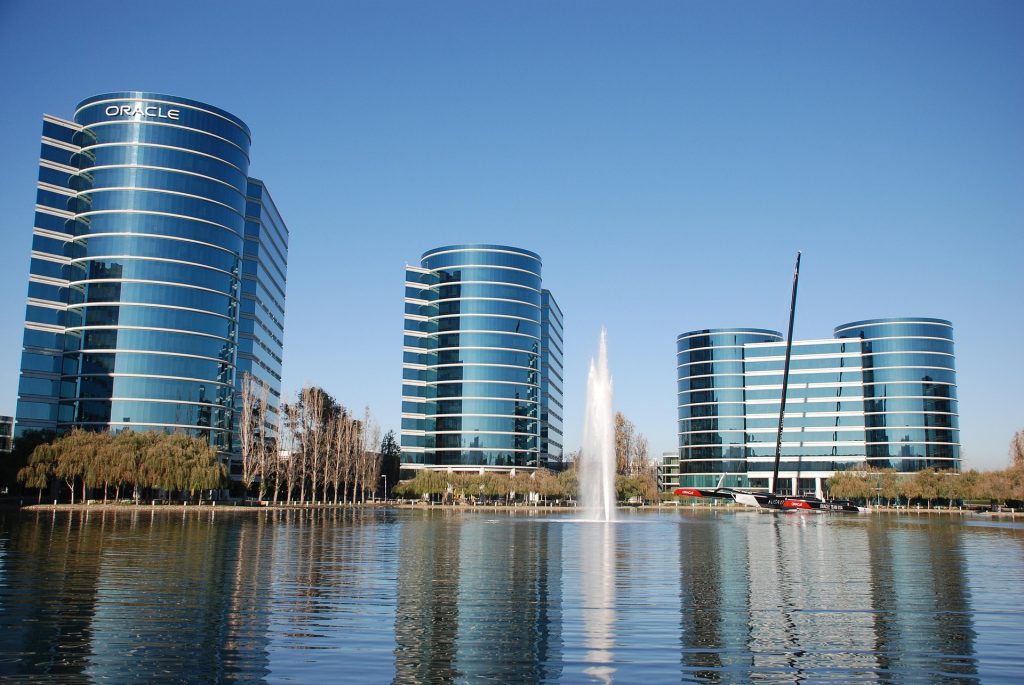
Image by JJ from Pixabay
So is Oracle actually fragile when markets panic?
Here’s where it gets interesting. Looking at Oracle’s behavior during past downturns reveals something unexpected.
During the 2008 financial crisis, Oracle fell 41% while the S&P 500 crashed 57%. Oracle recovered completely within 16 months.
In the 2020 COVID crash, Oracle dropped 29% versus 34% for the broader market and bounced back in less than four months. Even in the smaller 2018 correction, Oracle essentially matched the market’s decline but recovered faster.
But 2022 was different. The 2022 inflation shock broke the pattern. Oracle plunged 41% compared to just 25% for the S&P 500. That’s concerning because it suggests Oracle isn’t always the defensive stalwart its historical record implies. The stock did eventually recover by May 2023 and even rallied to $328 by September 2025, but that 2022 episode matters.
Why would Oracle fall harder during inflation but hold up better during financial panics?
Think about Oracle’s business model. In a liquidity crisis or sudden shock, enterprises keep paying for mission-critical database and cloud infrastructure – they can’t just turn it off. But during an inflation crisis with rising rates, Oracle’s debt load becomes a liability. Higher interest costs, tighter financial conditions, and investor anxiety about leveraged balance sheets all work against them.
What about the fundamentals right now?
Oracle is a $515 billion company generating $61 billion in revenue with 11% growth and a healthy 32% operating margin. The business itself is performing. But here’s the tension: the debt-to-equity ratio sits at 0.24 with a cash-to-assets ratio of just 0.1. The company is trading at a P/E of 33.4 – not cheap, but not outrageous for a tech infrastructure play with double-digit growth.
The real question is whether Oracle can monetize that $523 billion backlog fast enough to justify the capital expenditure and service the debt without squeezing profitability.
Should investors who own Oracle at $180 be worried about further downside?
If Oracle drops another 20-30% to $126, history suggests it would likely recover – assuming this plays out like 2008, 2018, or 2020. But if this is more like 2022 (an environment where high debt and rising costs matter more), then the downside could be steeper and the recovery slower.
So what’s the verdict – is Oracle oversold or justifiably punished?
The pessimism looks overdone. Oracle is down 50% from its peak on concerns that are real but potentially priced in. Analysts see $295 as fair value – a 60%+ upside from current levels. The debt concern isn’t new information; the market has been hammering Oracle for months on exactly this issue.
If you believe enterprises will continue migrating to cloud infrastructure and Oracle can execute on its backlog, the risk-reward here favors buyers. But you need conviction that the debt load is manageable and that we’re not heading into a sustained high-rate environment where leveraged tech infrastructure companies get systematically repriced lower.
Bottom line?
Oracle is more resilient than the market during sudden shocks but vulnerable during prolonged financial stress. At $180, the stock price reflects significant pessimism. The question is whether the lawsuit and debt fears are a temporary panic or a fundamental reevaluation of Oracle’s AI strategy. The backlog suggests growth; the balance sheet suggests risk. Which one wins depends on execution and macro conditions over the next 12-18 months.
Remember, investing in a single stock without comprehensive analysis can be risky. Consider the Trefis Reinforced Value (RV) Portfolio, which has outperformed its all-cap stocks benchmark (combination of the S&P 500, S&P mid-cap, and Russell 2000 benchmark indices) to produce strong returns for investors. Why is that? The quarterly rebalanced mix of large-, mid-, and small-cap RV Portfolio stocks provided a responsive way to make the most of upbeat market conditions while limiting losses when markets head south, as detailed in RV Portfolio performance metrics.
Invest with Trefis Market-Beating Portfolios
See all Trefis Price Estimates