
Dell’s Growth Story Comes With Risk, But Also a Unique Edge

Dell Technologies (DELL) stock has surged 30% in just the last five trading days. And whenever a move like that happens, the instinct for a lot of investors is obvious: chase the momentum before it disappears.
But if you manage money with a longer-term mindset — especially in a diversified portfolio — the more important question is not whether the stock can keep running next week.
It’s whether this thing actually behaves differently enough from the rest of your portfolio to deserve a spot in it.
That’s where Dell becomes more interesting than the headline move suggests.
- How Dell Technologies Stock Gained 120%
- Pay Less, Gain More: DELL Tops Apple Stock
- Five-Year Tally: Dell Technologies Stock Delivers $22 Bil Gain
- Is Dell Stock An Under-Analyzed Capital Compounder Opportunity?
- At 20x Earnings, Dell Still Looks Affordable Thanks to AI
- Stronger Bet Than Apple Stock: DELL Delivers More

Dell Doesn’t Move Exactly Like The Market
Most large tech-related stocks eventually start acting like leveraged versions of the S&P 500. When the market goes up, they go up more. When it falls, they fall harder.
Dell isn’t completely detached from the market, but it’s not perfectly tied to it either.
Over the last five years, Dell’s correlation with the S&P 500 has been about 51%. That’s meaningful because it suggests the stock still has a decent amount of company-specific behavior driving returns rather than simply mirroring index movements.
And compared to traditional diversifiers like gold or real estate, Dell behaves very differently.
Here’s the bigger picture:
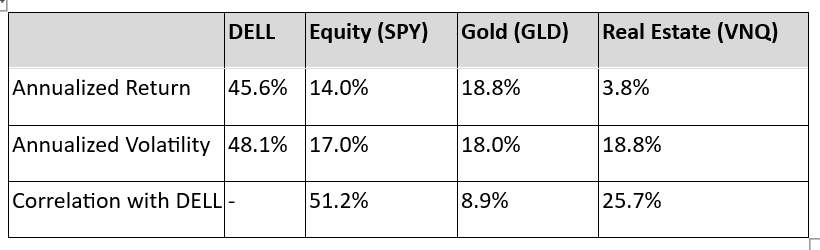
The volatility is obviously high. Dell is not some defensive low-beta hiding place. A nearly 50% annualized volatility number tells you this stock can move aggressively in both directions.
But the returns have also been enormous.
That combination — strong returns with only moderate correlation to broader equities — is exactly why some investors view stocks like Dell as “satellite allocations.” Not core holdings, but strategic additions that can potentially improve overall portfolio behavior.
See also, Why Wheaton Precious Metals Looks Different This Time Around.
The Upside Capture Number Is Wild
One metric that stands out here is Dell’s Upside Capture ratio: 216.1.
That basically means when markets rise, Dell has historically participated in those gains at more than double the market’s pace.
Not every high-volatility stock does that consistently. Some simply swing around randomly. Dell’s recent history suggests there has been real momentum participation underneath the volatility.
And importantly, it hasn’t always moved on the exact same timeline as the broader market.
That’s a subtle but important distinction.
If a stock rallies for its own company-specific reasons — AI infrastructure demand, enterprise hardware cycles, server growth, or operational execution — that can create diversification benefits even inside an equity-heavy portfolio.
The Fundamentals Are Better Than Many People Think
Momentum stories get dangerous when the business underneath starts weakening.
That’s not really the case here.
Dell’s revenue growth has actually been strong. Last twelve months revenue growth sits at 18.8%, which is well above the S&P 500 median of 7.4%.
Its valuation is also interesting.
Dell trades at a P/E ratio of 32.8 versus the S&P median around 23.9. So, yes, investors are paying a premium.
The weak spot is profitability.
Dell’s operating and free cash flow margins are well below the broader market median, which tells you this is still a relatively lower-margin business despite the strong growth profile.
That matters because lower-margin companies can become vulnerable quickly if growth slows.
See how Dell’s financials compare to its peers, HP, Hewlett Packard Enterprise, International Business Machines, Cisco Systems, and Apple.
So What Exactly Is Dell Right Now?
Dell is not a defensive stock.
It’s not a value stock in the traditional sense, either.
And it’s probably not a pure AI infrastructure play, even though AI enthusiasm has clearly helped sentiment.
What it really looks like is a high-beta growth-oriented satellite position that still offers some diversification characteristics because it doesn’t move perfectly in sync with the broader market.
That’s a pretty specific niche.
For investors who already own large amounts of index exposure, Dell may offer a way to add more upside participation without simply duplicating existing portfolio behavior.
Of course, the volatility cuts both ways. A stock that can rally 30% in five days can absolutely reverse just as quickly.
But when you zoom out past the short-term excitement, the more interesting story is that Dell has quietly built a profile that sits somewhere between growth stock, cyclical infrastructure play, and diversification tool.
And that’s probably why the market keeps rewarding it.
Sophisticated Portfolios Require Strategic Allocation
Finding a true diversifier means looking beyond basic asset classes. When a stock like DELL exhibits certain market correlation alongside actionable price behavior, it warrants a closer look as a strategic satellite position. However, true wealth preservation requires a holistic view of how every asset interacts.