
How Will Cintas’ Stock React To Its Upcoming Earnings?
Cintas (NASDAQ: CTAS) stock, a provider of corporate identity uniforms through rental and sales programs, will report fiscal first quarter 2026 results (May year-end) on Wednesday, September 24. Street estimates call for earnings of $1.20 per share on $2.70 billion in revenue, implying 7% EPS growth and 8% sales growth from last year’s $1.12 per share on $2.50 billion. Historically, CTAS stock has risen after earnings 72% of the time—with a median one-day gain of 3.7% and a peak move of 8%.
The company closed FY25 strong, with Q4 revenue of $2.67 billion (+8% YoY) and EPS of $1.09 (+9%), while operating margin improved to 22.4%. Full-year revenue rose 7.7% to $10.34 billion and EPS jumped 16% to $4.40. For FY26, management guided revenue of $11.0–$11.15 billion and EPS of $4.71–$4.85, underscoring steady growth and resilient profitability. Separately check, Rocket Lab: How Low Can RKLB Stock Really Go?
With a market cap near $80 billion, trailing 12-month revenue of $10 billion, $2.4 billion in operating profit, and $1.8 billion in net income, Cintas is firmly profitable. For event-driven traders, the setup is clear: either position ahead of earnings using historical odds, or wait for the release and trade based on how short-term moves correlate with medium-term returns. For those seeking a steadier alternative, the Trefis High Quality portfolio —up 91% since inception—has consistently outperformed the S&P 500. See earnings reaction history of all stocks.

Photo by Mohamed_hassan on Pixabay
Cintas’ Historical Odds Of Positive Post-Earnings Return
- There are 18 earnings data points recorded over the last five years, with 13 positive and 5 negative one-day (1D) returns observed. In summary, positive 1D returns were seen about 72% of the time.
- Notably, this percentage increases to 82% if we consider data for the last 3 years instead of 5.
- Median of the 13 positive returns = 3.7%, and median of the 5 negative returns = -2.6%
Additional data for observed 5-Day (5D) and 21-Day (21D) returns post earnings are summarized along with the statistics in the table below.
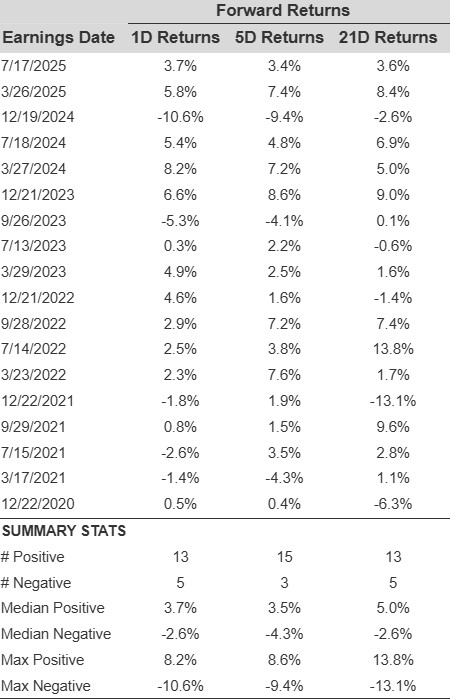
CTAS Correlation Between 1D, 5D and 21D Forward Returns
Correlation Between 1D, 5D, and 21D Historical Returns
A relatively less risky strategy (though not useful if the correlation is low) is to understand the correlation between short-term and medium-term returns post earnings, find a pair that has the highest correlation, and execute the appropriate trade. For example, if 1D and 5D show the highest correlation, a trader can position themselves “long” for the next 5 days if 1D post-earnings return is positive. Here is some correlation data based on 5-year and 3-year (more recent) history. Note that the correlation 1D_5D refers to the correlation between 1D post-earnings returns and subsequent 5D returns.

CTAS Correlation Between 1D, 5D and 21D Historical Returns
Learn more about Trefis RV strategy that has outperformed its all-cap stocks benchmark (combination of all 3, the S&P 500, S&P mid-cap, and Russell 2000), to produce strong returns for investors.
Invest with Trefis Market-Beating Portfolios