
Why Arista Networks May Be More Than Just Another AI Trade

Arista Networks Inc. (NYSE: ANET) has climbed 8.5% in just the last five trading days, which naturally gets momentum traders excited. A move like that in a high-growth tech stock tends to attract attention fast — especially in a market still obsessed with anything tied to AI infrastructure and cloud demand.
But short-term rallies only tell part of the story.
For investors thinking beyond the next few weeks, the more interesting question is whether Arista actually behaves differently enough from the broader market to deserve a role as a strategic portfolio holding.
And surprisingly, the answer may be yes.
- Dell’s Growth Story Comes With Risk, But Also a Unique Edge
- Why Walmart’s Post-Earnings Dip Is A Diversification Play
- AMD Stock At $500: AI Upside, With One Big Caveat
- The SpaceX Halo Effect: What’s Next For Sky-High Redwire Stock?
- How Low Can RGTI Stock Go?
- Intel Stock Has Rallied 6x. What Could Break It?

Arista Isn’t Just Another “Market Stock”
A lot of large-cap tech names eventually become highly correlated with the S&P 500. They rise when the market rises, fall when the market falls, and basically amplify whatever direction indexes are already moving.
Arista shares some of that behavior — but not completely.
Over the last five years, its correlation with the S&P 500 has been about 56.7%. That’s meaningful overlap, but it also means nearly half of the stock’s movement has been driven by company-specific factors rather than broad market momentum alone.
That distinction matters for portfolio construction.
Because if a stock generates returns from unique business drivers — like networking infrastructure demand, hyperscaler spending, or AI data center expansion — it can still provide diversification benefits even while sitting inside an equity-heavy portfolio.
Here’s how the numbers stack up:
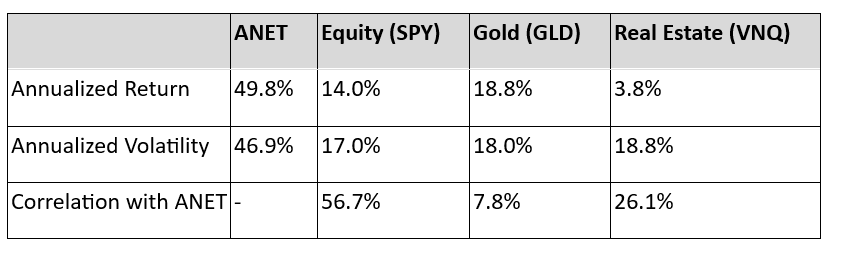
The volatility is obviously elevated. Arista is not a low-risk defensive play. A nearly 47% annualized volatility number tells you the stock can swing hard in either direction.
But the long-term returns have been massive.
And importantly, those returns haven’t simply mirrored the market.
See also, Why Wheaton Precious Metals Looks Different This Time Around.
The Upside Capture Is Extremely Strong
One of the most interesting metrics here is Arista’s Upside Capture ratio: 213.5.
In simple terms, when markets have gone up, Arista has historically captured more than double the upside of the broader market.
That’s not just “good performance.” That’s aggressive participation in bull market momentum.
But unlike some speculative momentum names, Arista’s moves have often been tied to real business execution rather than pure sentiment.
That’s an important difference.
A stock can be volatile and still fundamentally healthy. In Arista’s case, the fundamentals are arguably the biggest reason investors keep rewarding it.
This Is What Elite Fundamentals Actually Look Like
Here’s where the story becomes hard to ignore.
Most companies excel at either growth or profitability. Very few manage both at the same time.
Arista is currently doing exactly that.
Revenue growth over the last twelve months sits at 30.6%, which absolutely crushes the S&P 500 median of 7.4%.
At the same time, operating margins are a staggering 42.8%.
And then there’s free cash flow margin: 54.4%.
Those are exceptional numbers.
This is the kind of financial profile investors are usually willing to pay up for.
And they clearly are.
A P/E above 50 and a price-to-sales ratio of 20 mean the market has already assigned a premium valuation to the business. Investors are effectively betting that Arista’s role in networking infrastructure and AI-related spending remains durable for years.
That premium obviously creates risk if growth slows.
But the current fundamentals justify why the stock trades differently from many other tech names.
See how Arista’s financials compares to its peers, Hewlet Packard Enterprise, Cisco Systems, Dell Technologies, Extreme Networks and Ciena.
So What Exactly Is Arista Right Now?
Arista doesn’t really fit neatly into one category.
It’s not a traditional value stock.
It’s not purely speculative momentum either.
And while AI enthusiasm has absolutely helped sentiment, the business underneath is producing real numbers that support the narrative.
This creates a profile that many portfolio managers look for in a “satellite allocation” — a position designed to add differentiated upside without simply duplicating core index exposure.
Of course, none of this makes the stock low risk. A premium valuation combined with high volatility means Arista can still experience sharp drawdowns when sentiment shifts.
But when you zoom out from the recent 8.5% rally, the more important takeaway is this:
Arista is no longer just a networking company. In many portfolios, it’s becoming a strategic growth asset with its own distinct behavior pattern.
And that’s exactly why investors keep coming back to it.
Sophisticated Portfolios Require Strategic Allocation
Finding a true diversifier means looking beyond basic asset classes. When a stock like ANET exhibits certain market correlations alongside actionable price behavior, it warrants a closer look as a strategic satellite position. However, true wealth preservation requires a holistic view of how every asset interacts.
If you manage substantial assets and are looking for data-driven, cross-asset allocation strategies, consider exploring our Wealth Management Solution tailored specifically to protect and grow your wealth.