
First Hawaiian (FHB)
Market Price (9/30/2026): $24.815 | Market Cap: $3.0 BilSector: Financials | Industry: Regional Banks
First Hawaiian (FHB)
Market Price (9/30/2026): $24.815Market Cap: $3.0 BilSector: FinancialsIndustry: Regional Banks
Investment Highlights Why It Matters Detailed financial logic regarding cash flow yields vs trend-riding momentum.
Attractive yieldTotal YieldTotal Yield = Earnings Yield + Dividend Yield, Earnings Yield = Net Income / Market Cap Dividend Yield = Total Dividends / Market Cap is 14%, Dividend Yield is 4.3%, ERPEquity Risk Premium (ERP) = Total Yield - Risk Free Rate, Reflects the premium above risk free assets offered by the investment. is 9.8%, FCF Yield is 10% Cash is significant % of market capNet D/ENet Debt/Equity. Debt net of cash. Negative indicates net cash. Equity is taken as the Market Capitalization is -93% Attractive cash flow generationCFO/Rev LTMCash Flow from Operations / Revenue (Sales), Last Twelve Months (LTM) is 38%, FCF/Rev LTMFree Cash Flow / Revenue (Sales), Last Twelve Months (LTM) is 36% Low stock price volatilityVol 12M is 24% Capital ratio is >2x the minimum of 6%Tier 1 Capital / Risk Wtd Assets RatioTier 1 Capital / Risk-Weighted Assets is a common measure of financial strength for a bank. It reflects how much equity there is relative to assets where assets are weighted based on riskiness. Low ratios indicate the bank is highly vulnerable to even small changes in the value of their risk assets. is 13% Megatrend and thematic driversMegatrends include Fintech & Digital Payments. Themes include Online Banking & Lending, and Digital Payments. | Weak multi-year price returns2Y Excs Rtn is -16%, 3Y Excs Rtn is -22% | Key risksFHB key risks include [1] sustained weak net interest income growth and profitability compared to its peers, Show more. |
| Attractive yieldTotal YieldTotal Yield = Earnings Yield + Dividend Yield, Earnings Yield = Net Income / Market Cap Dividend Yield = Total Dividends / Market Cap is 14%, Dividend Yield is 4.3%, ERPEquity Risk Premium (ERP) = Total Yield - Risk Free Rate, Reflects the premium above risk free assets offered by the investment. is 9.8%, FCF Yield is 10% |
| Cash is significant % of market capNet D/ENet Debt/Equity. Debt net of cash. Negative indicates net cash. Equity is taken as the Market Capitalization is -93% |
| Attractive cash flow generationCFO/Rev LTMCash Flow from Operations / Revenue (Sales), Last Twelve Months (LTM) is 38%, FCF/Rev LTMFree Cash Flow / Revenue (Sales), Last Twelve Months (LTM) is 36% |
| Low stock price volatilityVol 12M is 24% |
| Capital ratio is >2x the minimum of 6%Tier 1 Capital / Risk Wtd Assets RatioTier 1 Capital / Risk-Weighted Assets is a common measure of financial strength for a bank. It reflects how much equity there is relative to assets where assets are weighted based on riskiness. Low ratios indicate the bank is highly vulnerable to even small changes in the value of their risk assets. is 13% |
| Megatrend and thematic driversMegatrends include Fintech & Digital Payments. Themes include Online Banking & Lending, and Digital Payments. |
| Weak multi-year price returns2Y Excs Rtn is -16%, 3Y Excs Rtn is -22% |
| Key risksFHB key risks include [1] sustained weak net interest income growth and profitability compared to its peers, Show more. |
Qualitative Assessment
AI Analysis | Feedback
First Hawaiian (FHB) stock has lost about 5% since 5/31/2026 because of the following key factors:
1. Muted investor reaction to fiscal Q2 2026 earnings despite beating estimates.
First Hawaiian reported diluted earnings per share of $0.60 for fiscal Q2 2026, surpassing the consensus estimate of $0.58, and revenue of $231.27 million, exceeding forecasts by 1.5%. Net income increased by 8.3% from the prior quarter to $73.4 million. Despite these beats, the stock's reaction was minimal, trading essentially flat in premarket activity on July 24, 2026, suggesting that investors perceived the performance as a continuation of steady execution rather than a significant growth catalyst and noted slow profit growth overall.
2. TriCo Bancshares acquisition at a premium valuation with deferred benefits.
On July 13, 2026, First Hawaiian announced a $2 billion all-stock acquisition of TriCo Bancshares, intended to expand its U.S. mainland presence and achieve 25% cost savings. However, this acquisition is valued at a premium of 1.98 times tangible book value and integration benefits are not expected until early fiscal Q1 2027. This substantial investment with delayed returns may have contributed to investor caution regarding the stock's immediate outlook.
Show more
First Hawaiian (FHB) stock has lost about 5% since 5/31/2026 because of the following key factors:
1. Muted investor reaction to fiscal Q2 2026 earnings despite beating estimates.
First Hawaiian reported diluted earnings per share of $0.60 for fiscal Q2 2026, surpassing the consensus estimate of $0.58, and revenue of $231.27 million, exceeding forecasts by 1.5%. Net income increased by 8.3% from the prior quarter to $73.4 million. Despite these beats, the stock's reaction was minimal, trading essentially flat in premarket activity on July 24, 2026, suggesting that investors perceived the performance as a continuation of steady execution rather than a significant growth catalyst and noted slow profit growth overall.
2. TriCo Bancshares acquisition at a premium valuation with deferred benefits.
On July 13, 2026, First Hawaiian announced a $2 billion all-stock acquisition of TriCo Bancshares, intended to expand its U.S. mainland presence and achieve 25% cost savings. However, this acquisition is valued at a premium of 1.98 times tangible book value and integration benefits are not expected until early fiscal Q1 2027. This substantial investment with delayed returns may have contributed to investor caution regarding the stock's immediate outlook.
3. Contraction in total assets and decline in deposits during fiscal Q2 2026.
First Hawaiian's total assets decreased to $23.65 billion as of June 30, 2026, a 2.5% decline from $24.26 billion at the end of fiscal Q1 2026. This was primarily driven by a $0.71 billion reduction in cash and cash equivalents. Additionally, total deposits declined by $623 million in fiscal Q2 2026, mainly due to expected outflows in public deposits, even though management indicated retail deposits remained flat. This overall contraction in the balance sheet could be viewed negatively by investors.
4. Lagging loan portfolio yield compared to the broader banking industry.
While First Hawaiian's net interest margin expanded to 3.25% in fiscal Q2 2026, its earnings growth and net interest margin are reported to lag those of peers. The total yield from its average loan balance was 5.30% in fiscal Q2 2026, significantly below the FDIC average of 6.59% for the banking industry in the same quarter. This suggests First Hawaiian is generating less revenue from its loan portfolio compared to the industry average, potentially impacting its overall profitability and stock performance.
Show less
Stock Movement Drivers
Fundamental Drivers
The -7.1% change in FHB stock from 5/31/2026 to 9/29/2026 was primarily driven by a -7.8% change in the company's P/E Multiple.| (LTM values as of) | 5312026 | 9292026 | Change |
|---|---|---|---|
| Stock Price ($) | 26.73 | 24.82 | -7.1% |
| Change Contribution By: | |||
| Total Revenues ($ Mil) | 856 | 870 | 1.6% |
| Net Income Margin (%) | 33.3% | 32.7% | -1.5% |
| P/E Multiple | 11.5 | 10.6 | -7.8% |
| Shares Outstanding (Mil) | 122 | 122 | 0.6% |
| Cumulative Contribution | -7.1% |
Market Drivers
5/31/2026 to 9/29/2026| Return | Correlation | |
|---|---|---|
| FHB | -7.1% | |
| Market (SPY) | 1.3% | 16.9% |
| Sector (XLF) | 5.1% | 45.7% |
Fundamental Drivers
The 2.2% change in FHB stock from 2/28/2026 to 9/29/2026 was primarily driven by a 2.7% change in the company's Total Revenues ($ Mil).| (LTM values as of) | 2282026 | 9292026 | Change |
|---|---|---|---|
| Stock Price ($) | 24.29 | 24.82 | 2.2% |
| Change Contribution By: | |||
| Total Revenues ($ Mil) | 847 | 870 | 2.7% |
| Net Income Margin (%) | 32.6% | 32.7% | 0.5% |
| P/E Multiple | 10.8 | 10.6 | -2.2% |
| Shares Outstanding (Mil) | 123 | 122 | 1.4% |
| Cumulative Contribution | 2.2% |
Market Drivers
2/28/2026 to 9/29/2026| Return | Correlation | |
|---|---|---|
| FHB | 2.2% | |
| Market (SPY) | 12.0% | 31.0% |
| Sector (XLF) | 5.9% | 55.5% |
Fundamental Drivers
The -0.4% change in FHB stock from 8/31/2025 to 9/29/2026 was primarily driven by a -16.4% change in the company's P/E Multiple.| (LTM values as of) | 8312025 | 9292026 | Change |
|---|---|---|---|
| Stock Price ($) | 24.93 | 24.82 | -0.4% |
| Change Contribution By: | |||
| Total Revenues ($ Mil) | 794 | 870 | 9.6% |
| Net Income Margin (%) | 31.1% | 32.7% | 5.5% |
| P/E Multiple | 12.7 | 10.6 | -16.4% |
| Shares Outstanding (Mil) | 125 | 122 | 3.0% |
| Cumulative Contribution | -0.4% |
Market Drivers
8/31/2025 to 9/29/2026| Return | Correlation | |
|---|---|---|
| FHB | -0.4% | |
| Market (SPY) | 19.8% | 36.8% |
| Sector (XLF) | 1.6% | 63.8% |
Fundamental Drivers
The 49.4% change in FHB stock from 8/31/2023 to 9/29/2026 was primarily driven by a 38.9% change in the company's P/E Multiple.| (LTM values as of) | 8312023 | 9292026 | Change |
|---|---|---|---|
| Stock Price ($) | 16.62 | 24.82 | 49.4% |
| Change Contribution By: | |||
| Total Revenues ($ Mil) | 820 | 870 | 6.2% |
| Net Income Margin (%) | 33.9% | 32.7% | -3.4% |
| P/E Multiple | 7.6 | 10.6 | 38.9% |
| Shares Outstanding (Mil) | 128 | 122 | 4.9% |
| Cumulative Contribution | 49.4% |
Market Drivers
8/31/2023 to 9/29/2026| Return | Correlation | |
|---|---|---|
| FHB | 49.4% | |
| Market (SPY) | 76.1% | 49.3% |
| Sector (XLF) | 64.7% | 70.1% |
Price Returns Compared
| 2021 | 2022 | 2023 | 2024 | 2025 | 2026 | Total [1] | |
|---|---|---|---|---|---|---|---|
| Returns | |||||||
| FHB Return | 20% | -1% | -8% | 19% | 2% | 2% | 35% |
| Peers Return | 34% | -7% | 1% | 18% | 11% | 12% | 85% |
| S&P 500 Return | 27% | -19% | 24% | 23% | 16% | 12% | 105% |
Monthly Win Rates [3] | |||||||
| FHB Win Rate | 58% | 58% | 50% | 42% | 50% | 33% | |
| Peers Win Rate | 70% | 52% | 42% | 53% | 57% | 47% | |
| S&P 500 Win Rate | 75% | 42% | 67% | 75% | 67% | 44% | |
Max Drawdowns [4] | |||||||
| FHB Max Drawdown | -13% | -29% | -43% | -13% | -24% | -18% | |
| Peers Max Drawdown | -20% | -28% | -44% | -17% | -24% | -17% | |
| S&P 500 Max Drawdown | -5% | -25% | -10% | -8% | -19% | -9% | |
[1] Cumulative total returns since the beginning of 2021
[2] Peers: ASB, ABCB, EBC, BOH, FITB.
[3] Win Rate = % of calendar months in which monthly returns were positive
[4] Max drawdown represents maximum peak-to-trough decline within a year
[5] 2026 data is for the year up to 9/29/2026 (YTD)
How Low Can It Go
| Event | FHB | S&P 500 |
|---|---|---|
| 2025 US Tariff Shock | ||
| % Loss | -23.1% | -18.8% |
| % Gain to Breakeven | 30.0% | 23.1% |
| Time to Breakeven | 273 days | 79 days |
| Summer-Fall 2023 Five Percent Yield Shock | ||
| % Loss | -18.3% | -9.5% |
| % Gain to Breakeven | 22.3% | 10.5% |
| Time to Breakeven | 48 days | 24 days |
| 2023 SVB Regional Banking Crisis | ||
| % Loss | -42.3% | -6.7% |
| % Gain to Breakeven | 73.4% | 7.1% |
| Time to Breakeven | 442 days | 31 days |
| 2022 Inflation Shock & Fed Tightening | ||
| % Loss | -21.6% | -24.5% |
| % Gain to Breakeven | 27.5% | 32.4% |
| Time to Breakeven | 29 days | 427 days |
| 2020 COVID-19 Crash | ||
| % Loss | -50.0% | -33.7% |
| % Gain to Breakeven | 99.9% | 50.9% |
| Time to Breakeven | 322 days | 140 days |
| Q4 2018 Fed Policy Error / Growth Scare | ||
| % Loss | -20.3% | -19.2% |
| % Gain to Breakeven | 25.4% | 23.8% |
| Time to Breakeven | 50 days | 105 days |
In The Past
First Hawaiian's stock fell -23.1% during the 2025 US Tariff Shock. Such a loss loss requires a 30.0% gain to breakeven.
Preserve Wealth
Limiting losses and compounding gains is essential to preserving wealth.
Asset Allocation
Actively managed asset allocation strategies protect wealth. Learn more.
| Event | FHB | S&P 500 |
|---|---|---|
| 2025 US Tariff Shock | ||
| % Loss | -23.1% | -18.8% |
| % Gain to Breakeven | 30.0% | 23.1% |
| Time to Breakeven | 273 days | 79 days |
| 2023 SVB Regional Banking Crisis | ||
| % Loss | -42.3% | -6.7% |
| % Gain to Breakeven | 73.4% | 7.1% |
| Time to Breakeven | 442 days | 31 days |
| 2022 Inflation Shock & Fed Tightening | ||
| % Loss | -21.6% | -24.5% |
| % Gain to Breakeven | 27.5% | 32.4% |
| Time to Breakeven | 29 days | 427 days |
| 2020 COVID-19 Crash | ||
| % Loss | -50.0% | -33.7% |
| % Gain to Breakeven | 99.9% | 50.9% |
| Time to Breakeven | 322 days | 140 days |
| Q4 2018 Fed Policy Error / Growth Scare | ||
| % Loss | -20.3% | -19.2% |
| % Gain to Breakeven | 25.4% | 23.8% |
| Time to Breakeven | 50 days | 105 days |
In The Past
First Hawaiian's stock fell -23.1% during the 2025 US Tariff Shock. Such a loss loss requires a 30.0% gain to breakeven.
Preserve Wealth
Limiting losses and compounding gains is essential to preserving wealth.
Asset Allocation
Actively managed asset allocation strategies protect wealth. Learn more.
About First Hawaiian (FHB)
First Hawaiian, Inc. (FHB) is a bank holding company operating primarily through its subsidiary, First Hawaiian Bank, a full-service financial institution. The company provides a comprehensive range of banking services to both consumer and commercial customers. Its operations are concentrated within Hawaii, Guam, and Saipan, where it maintains a network of 54 branches, making it a key regional financial provider in these Pacific markets.
FHB's core offerings include a variety of deposit products, such as checking and savings accounts. On the lending side, it provides a diverse portfolio including residential and commercial mortgage loans, home equity lines of credit, automobile loans and leases, personal lines of credit and installment loans, and small business loans and leases. Beyond traditional banking, First Hawaiian also offers investment and financial planning services, insurance protection, trust and estate services, private banking, retirement planning, treasury services, and merchant processing to cater to the broader financial needs of its individual and business clients.
AI Analysis | Feedback
It's like Bank of America, but focused exclusively on Hawaii and the Pacific islands.
Think of it as the Wells Fargo of Hawaii, offering a full range of banking services across the islands.
AI Analysis | Feedback
- Deposit Accounts: Offers various accounts like checking, savings, and other deposit products for consumers and businesses.
- Mortgage Lending: Provides residential and commercial mortgage loans, including home equity lines of credit.
- Consumer Lending: Offers a range of personal financing options such as automobile loans and leases, personal lines of credit, installment loans, and credit cards.
- Commercial & Small Business Lending: Facilitates business growth through small business loans and leases, commercial lease, and auto dealer financing.
- Investment & Financial Planning: Delivers individual investment, financial planning, trust and estate services, private banking, and retirement planning.
- Treasury & Merchant Services: Supports businesses with treasury management and merchant processing solutions.
- Insurance Protection: Provides various insurance products for customers.
AI Analysis | Feedback
First Hawaiian, Inc. (FHB) serves a diverse customer base, primarily consisting of a wide array of individuals and businesses across its operating regions. As a bank, its customer relationships are generally not concentrated in a few named entities, but rather across broad categories. Therefore, its major customers can be described by the categories it serves:
-
Individual Consumers
This category includes a broad range of individual customers who utilize the bank's retail banking services. These services encompass checking and savings accounts, residential mortgage loans, home equity lines of credit, automobile loans and leases, personal lines of credit, installment loans, and credit card services. Additionally, individual consumers are served through investment and financial planning, insurance protection, and retirement planning services.
-
Commercial Businesses (Small to Medium-sized Enterprises)
First Hawaiian serves numerous commercial customers, including small and medium-sized businesses. These clients utilize services such as commercial mortgage loans, small business loans and leases, commercial lease and auto dealer financing. They also benefit from treasury and merchant processing services to manage their finances and operations.
-
High-Net-Worth Individuals and Institutional Clients
This category represents customers seeking specialized financial services, including private banking, trust and estate management. These services cater to affluent individuals, families, and potentially some institutional clients requiring sophisticated financial planning and asset management solutions.
AI Analysis | Feedback
- Visa Inc. (V)
- Mastercard Incorporated (MA)
- Fidelity National Information Services (FIS)
- Fiserv, Inc. (FISV)
AI Analysis | Feedback
Robert Harrison, Chairman, President and Chief Executive Officer
Robert Harrison joined First Hawaiian Bank in 1996 and has over 35 years of financial industry experience working for banks in New York and Hawaii. Prior to his current role, he served as Chief Operating Officer of First Hawaiian Bank from December 2009 to January 2012 and as its President from December 2009 to June 2015. He was named Vice Chairman in 2007 and served as the Bank's Chief Risk Officer from 2006 to 2009. He led the bank's initial public stock offering, which transformed First Hawaiian into a publicly traded company after 15 years as a subsidiary of BNP Paribas. He previously served as an Independent Director for Alexander & Baldwin Investments LLC and Alexander & Baldwin, Inc., and as a Vice Chairman for BancWest Corp. (Hawaii).
James Moses, Vice Chairman and Chief Financial Officer, Finance Group
James Moses was appointed as Vice Chairman and Chief Financial Officer, effective January 3, 2023. He brings over 20 years of diverse banking experience to the team. Before joining First Hawaiian, he served as Executive Vice President and CFO of First Bank in St. Louis, Missouri. His previous experience also includes serving as Executive Vice President and CFO of Berkshire Hills Bancorp, and Senior Vice President – Manager, Asset Liability Management at Webster Bank.
Gina Woo Anonuevo, Vice Chair and Chief Administrative Officer
Gina Woo Anonuevo previously served as the Chief Compliance Officer of First Hawaiian Bank and took over as Chief Human Resources Officer effective December 1, 2023.
Alan Arizumi, Vice Chair, Wealth Management Group
Alan Arizumi serves as the Vice Chair of the Wealth Management Group.
Neill Char, Vice Chair, Retail Banking Group
Neill Char holds the position of Vice Chair, Retail Banking Group. He is also listed as Vice Chairman of Commercial & Retail Banking Group.
AI Analysis | Feedback
AI Analysis | Feedback
The emergence and growing adoption of digital-first financial service providers, including neobanks and specialized financial technology (fintech) companies. These competitors leverage technology to offer banking products (e.g., checking accounts, loans, payment processing, investment services) with lower overheads, often more competitive rates, and superior digital user experiences. This trend directly challenges First Hawaiian's traditional branch-heavy business model and its ability to attract and retain customers who increasingly prioritize digital convenience and potentially lower costs or better returns, even in its established island markets.
AI Analysis | Feedback
Here are the addressable market sizes for First Hawaiian (FHB) for its main products and services in its operating regions:
Hawaii
- Retail Banking (encompassing residential mortgages, commercial and industrial mortgages, home equity loans, vehicle loans, and deposit accounts): The market size for the Savings Institutions & Other Depository Credit Intermediation industry in Hawaii is estimated to be $1.1 billion in 2026.
- Total Deposits: Total deposits held at community bank branches in Hawaii were approximately $56.32 billion as of December 13, 2024.
- Small Business Loans: New lending to businesses in Hawaii through loans of $1 million or less totaled $1.1 billion in 2023.
- Commercial Leasing: The Commercial Leasing industry in Hawaii has a market size of $2.0 billion in 2026.
- Residential Mortgage Loans: While a total market size in dollar volume for residential mortgage loans in Hawaii is not explicitly available, the conforming loan limit for 2024 in Hawaii is $1,149,825. The median sale price for homes in Hawaii was approximately $741,000 as of late 2025.
- Auto Loans: Specific market size for auto loans in Hawaii is not explicitly stated. However, new light vehicle registrations in the state are projected to exceed 46,000 units in 2025.
- Wealth Management/Investment & Financial Planning: The Portfolio Management & Investment Advice industry in Hawaii has been growing at an average annual rate of 8.7% from 2020 to 2025. Research indicates that there is more than $917 million in potential client assets available per advisor in Hawaii.
Guam
- Banking Sector (General Scale): While specific market sizes for individual products are not readily available, Bank of Guam, a major competitor, reported total assets of $3.01 billion and total deposits of $2.74 billion as of its latest filing. First Hawaiian Bank is one of the four main commercial banks operating in Guam.
- Residential Mortgage Loans: The conforming residential mortgage loan limit for 2024 in Guam is $1,149,825.
Saipan
Specific addressable market sizes for First Hawaiian's products and services in Saipan (Commonwealth of the Northern Mariana Islands) are not readily available in the provided information.
AI Analysis | Feedback
Expected Drivers of Future Revenue Growth for First Hawaiian (FHB)
First Hawaiian, Inc. (FHB) is anticipated to drive future revenue growth over the next 2-3 years through several key strategies:
- Loan Growth: Management has provided forward guidance for full-year loan growth of 3-4% for 2026, primarily driven by Commercial Real Estate (CRE) and Commercial & Industrial (C&I) segments. The bank has demonstrated growth in total loans and leases in recent quarters.
- Net Interest Margin (NIM) Expansion and Optimization: As net interest income constitutes the largest source of revenue for First Hawaiian, the bank's ability to expand and optimize its net interest margin is crucial. Management expects a full-year NIM of 3.16%–3.18% for 2026, with favorable deposit dynamics contributing to margin improvement.
- Growth in Non-Interest Income via Wealth Management and Trust Services: First Hawaiian has an opportunity to expand its wealth management and trust services, which can attract a broader customer base and deepen existing customer relationships. Management anticipates noninterest income to be approximately $220 million for 2026.
- Strategic Focus on Small Business Lending and Support: The bank is committed to supporting small businesses, particularly in addressing challenges related to accessing funding. This dedicated focus on a key customer segment is expected to drive increased lending and utilization of other banking services.
AI Analysis | Feedback
Share Repurchases
- First Hawaiian authorized a stock repurchase program for up to $75 million during 2021.
- In the fourth quarter of 2024, the company repurchased 1.5 million shares of common stock at a total cost of $40.0 million, completing its 2024 repurchase program.
- During 2025, the company made $100.0 million in buybacks. For example, in the first quarter of 2025, First Hawaiian repurchased 974 thousand shares for $25.0 million, and in the third quarter of 2025, it repurchased 964 thousand shares for $24.0 million.
- As of March 2026, the company was authorized to repurchase an additional $250 million in stock.
Capital Expenditures
- First Hawaiian's capital expenditures were $16 million in 2021, $7.48 million in 2023, $29 million in 2024, and $32 million in 2025.
Peer Outperformance in Regional Banks
| Industry | Names | 1Y med | 3Y med | 5Y med | Top 3 by 5Y |
|---|---|---|---|---|---|
| Reinsurance | 6 | 19.9% | 74.0% | 127.0% | SPNT 168% · RGA 152% · RNR 141% |
| Investment Banking & Brokerage | 13 | -7.8% | 92.4% | 111.3% | IBKR 468% · SNEX 234% · HOOD 176% |
| Diversified Banks | 12 | 25.9% | 126.9% | 104.4% | CM 153% · RY 140% · JPM 132% |
| Life & Health Insurance | 20 | 5.9% | 52.7% | 94.0% | JXN 541% · UNM 309% · FG 191% |
| Multi-Sector Holdings | 4 | 5.6% | 48.6% | 77.5% | JONE 361% · BRK-B 84% · VOYA 71% |
| Property & Casualty Insurance | 42 | 5.9% | 67.7% | 62.2% | ASIC 2635900% · HRTG 410% · UVE 299% |
| Multi-line Insurance | 9 | 4.5% | 68.7% | 59.9% | GNW 146% · L 100% · SLF 90% |
| Regional Banks ← | 263 | 23.5% | 88.6% | 55.2% | ESQ 329% · GCBC 297% · NBN 270% |
| Financial Exchanges & Data | 15 | -4.6% | 15.8% | 34.0% | VIRT 162% · CBOE 126% · CME 68% |
| Diversified Financial Services | 4 | -10.5% | 21.0% | 22.1% | FRHC 171% · EQH 100% · TMS -56% |
| Consumer Finance | 30 | -0.5% | 78.7% | 17.8% | ENVA 386% · EZPW 298% · FCFS 158% |
| Insurance Brokers | 16 | -21.5% | -8.6% | 14.2% | LIFE 273% · ARX 88% · CRD-A 62% |
| Asset Management & Custody Banks | 83 | -10.5% | 15.3% | 6.2% | WT 361% · SII 271% · VCTR 269% |
| Commercial & Residential Mortgage Finance | 13 | -53.8% | 15.3% | 6.1% | FNMA 396% · FMCC 363% · ACT 165% |
| Specialized Finance | 3 | 19.4% | 39.1% | -8.2% | EFC 22% · CACC -8% · HASI -16% |
| Mortgage REITs | 33 | -20.0% | -5.9% | -40.3% | NREF 56% · RITM 37% · DX 27% |
| Transaction & Payment Processing Services | 17 | -1.8% | -7.8% | -41.5% | V 71% · MA 67% · CPAY 50% |
| Diversified Capital Markets | 20 | -35.0% | 18.6% | -58.9% | OPY 191% · LPLA 101% · GOLD 71% |
Latest Trefis Analyses
Research & Analysis
Invest in Strategies
Wealth Management
Peer Comparisons
| Peers to compare with: |
Financials
| Median | |
|---|---|
| Name | |
| Mkt Price | 39.82 |
| Mkt Cap | 5.0 |
| Rev LTM | 1,172 |
| Op Inc LTM | - |
| FCF LTM | 454 |
| FCF 3Y Avg | 345 |
| CFO LTM | 477 |
| CFO 3Y Avg | 363 |
Growth & Margins
| Median | |
|---|---|
| Name | |
| Rev Chg LTM | 19.0% |
| Rev Chg 3Y Avg | 6.3% |
| Rev Chg Q | 18.0% |
| QoQ Delta Rev Chg LTM | 4.3% |
| Op Inc Chg LTM | - |
| Op Inc Chg 3Y Avg | - |
| Op Mgn LTM | - |
| Op Mgn 3Y Avg | - |
| QoQ Delta Op Mgn LTM | - |
| CFO/Rev LTM | 37.5% |
| CFO/Rev 3Y Avg | 39.0% |
| FCF/Rev LTM | 35.3% |
| FCF/Rev 3Y Avg | 35.6% |
Segment Financials
Revenue by Segment| $ Mil | 2025 | 2024 | 2023 | 2022 | 2021 |
|---|---|---|---|---|---|
| Retail Banking | 629 | 598 | 543 | 530 | 477 |
| Commercial Banking | 255 | 279 | 264 | 235 | 236 |
| Corporate/Other | -3 | -69 | 30 | ||
| Treasury and Other | 28 | 2 | |||
| Total | 881 | 809 | 837 | 793 | 715 |
| $ Mil | 2025 | 2024 | 2023 | 2022 | 2021 |
|---|---|---|---|---|---|
| Retail Banking | 251 | 228 | 174 | 180 | 187 |
| Commercial Banking | 130 | 143 | 105 | 96 | 120 |
| Corporate/Other | -104 | -141 | -43 | ||
| Treasury and Other | -10 | -41 | |||
| Total | 276 | 230 | 235 | 266 | 266 |
| $ Mil | 2025 | 2024 | 2023 | 2022 | 2021 |
|---|---|---|---|---|---|
| Retail Banking | 7,186 | 7,138 | 7,252 | 7,360 | 7,148 |
| Commercial Banking | 7,133 | 7,276 | 7,135 | 6,778 | 5,973 |
| Corporate/Other | 6,878 | 6,660 | 7,895 | ||
| Other non-earning assets | 2,758 | 2,754 | 2,646 | 2,708 | |
| Treasury and Other | 7,731 | 11,871 | |||
| Total | 23,955 | 23,828 | 24,926 | 24,577 | 24,992 |
Price Behavior
| Market Price | $24.82 | |
| Market Cap ($ Bil) | 3.0 | |
| First Trading Date | 08/04/2016 | |
| Distance from 52W High | -17.4% | |
| 50 Days | 200 Days | |
| DMA Price | $26.52 | $26.28 |
| DMA Trend | indeterminate | down |
| Distance from DMA | -6.4% | -5.6% |
| 3M | 1YR | |
| Volatility | 19.4% | 23.7% |
| Downside Capture | 114.24 | 77.12 |
| Upside Capture | 14.71 | 67.81 |
| Correlation (SPY) | 30.5% | 37.0% |
| 1M | 2M | 3M | 6M | 1Y | 3Y | |
|---|---|---|---|---|---|---|
| Beta | 0.55 | 0.56 | 0.18 | 0.44 | 0.68 | 0.86 |
| Up Beta | 0.80 | 0.86 | -0.02 | 0.42 | 0.77 | 0.84 |
| Down Beta | -0.31 | -0.08 | 0.01 | 0.15 | 0.54 | 0.90 |
| Up Capture | -13% | -6% | 19% | 47% | 54% | 62% |
| Bmk +ve Days | 10 | 21 | 32 | 68 | 138 | 427 |
| Stock +ve Days | 7 | 14 | 31 | 62 | 121 | 380 |
| Down Capture | 169% | 144% | 47% | 60% | 83% | 95% |
| Bmk -ve Days | 11 | 21 | 32 | 59 | 113 | 324 |
| Stock -ve Days | 14 | 28 | 33 | 65 | 130 | 366 |
[1] Upside and downside betas calculated using positive and negative benchmark daily returns respectively
Based On 1-Year Data
| Annualized Return | Annualized Volatility | Sharpe Ratio | Correlation with FHB | |
|---|---|---|---|---|
| FHB | 2.7% | 23.7% | 0.05 | - |
| Sector ETF (XLF) | 1.5% | 14.8% | -0.12 | 64.2% |
| Equity (SPY) | 16.5% | 13.0% | 0.90 | 37.0% |
| Gold (GLD) | 10.5% | 29.6% | 0.34 | 10.4% |
| Commodities (DBC) | 40.5% | 20.8% | 1.52 | -12.3% |
| Real Estate (VNQ) | 3.2% | 13.6% | -0.02 | 37.2% |
| Bitcoin (BTCUSD) | -24.6% | 44.7% | -0.50 | 19.0% |
Smart multi-asset allocation framework can stack odds in your favor. Learn How
Based On 5-Year Data
| Annualized Return | Annualized Volatility | Sharpe Ratio | Correlation with FHB | |
|---|---|---|---|---|
| FHB | 3.3% | 29.4% | 0.13 | - |
| Sector ETF (XLF) | 10.0% | 18.4% | 0.40 | 70.6% |
| Equity (SPY) | 13.5% | 17.2% | 0.60 | 51.4% |
| Gold (GLD) | 18.2% | 18.9% | 0.78 | 0.7% |
| Commodities (DBC) | 10.6% | 19.6% | 0.42 | 9.5% |
| Real Estate (VNQ) | 0.9% | 18.9% | -0.06 | 48.3% |
| Bitcoin (BTCUSD) | 15.3% | 52.4% | 0.46 | 17.9% |
Smart multi-asset allocation framework can stack odds in your favor. Learn How
Based On 10-Year Data
| Annualized Return | Annualized Volatility | Sharpe Ratio | Correlation with FHB | |
|---|---|---|---|---|
| FHB | 3.4% | 32.3% | 0.17 | - |
| Sector ETF (XLF) | 12.9% | 22.1% | 0.53 | 72.6% |
| Equity (SPY) | 15.4% | 17.9% | 0.73 | 51.8% |
| Gold (GLD) | 11.8% | 16.4% | 0.59 | -5.6% |
| Commodities (DBC) | 8.3% | 18.1% | 0.37 | 16.5% |
| Real Estate (VNQ) | 4.6% | 20.7% | 0.18 | 47.9% |
| Bitcoin (BTCUSD) | 63.5% | 66.2% | 1.03 | 11.2% |
Smart multi-asset allocation framework can stack odds in your favor. Learn How
Returns Analyses
Earnings Returns History
Updated 8/26/2026| Forward Returns | |||
|---|---|---|---|
| Earnings Date | 1D Returns | 5D Returns | 21D Returns |
| 7/24/2026 | -1.9% | -2.5% | -7.3% |
| 4/24/2026 | -2.0% | 1.2% | 2.5% |
| 1/30/2026 | -3.7% | -3.1% | -7.9% |
| 10/24/2025 | 4.7% | 3.0% | 5.1% |
| 7/25/2025 | 0.9% | -3.8% | 2.3% |
| 4/23/2025 | 0.8% | -0.3% | 2.0% |
| 1/31/2025 | 3.1% | 5.2% | 1.4% |
| 10/25/2024 | -0.1% | 3.1% | 17.4% |
| ... | |||
| SUMMARY STATS | |||
| # Positive | 12 | 9 | 15 |
| # Negative | 12 | 15 | 9 |
| Median Positive | 3.1% | 3.4% | 5.1% |
| Median Negative | -1.6% | -3.1% | -7.3% |
| Max Positive | 6.0% | 9.2% | 29.7% |
| Max Negative | -4.2% | -13.7% | -13.6% |
| Forward Returns | |||
|---|---|---|---|
| Earnings Date | 1D Returns | 5D Returns | 21D Returns |
| 7/24/2026 | -1.9% | -2.5% | -7.3% |
| 4/24/2026 | -2.0% | 1.2% | 2.5% |
| 1/30/2026 | -3.7% | -3.1% | -7.9% |
| 10/24/2025 | 4.7% | 3.0% | 5.1% |
| 7/25/2025 | 0.9% | -3.8% | 2.3% |
| 4/23/2025 | 0.8% | -0.3% | 2.0% |
| 1/31/2025 | 3.1% | 5.2% | 1.4% |
| 10/25/2024 | -0.1% | 3.1% | 17.4% |
| 7/26/2024 | 3.9% | -4.0% | -2.3% |
| 4/26/2024 | -0.8% | -1.7% | -5.7% |
| 1/26/2024 | 3.1% | -1.3% | -2.2% |
| 10/27/2023 | -1.8% | 4.1% | 7.0% |
| 7/28/2023 | -2.6% | -7.4% | -13.6% |
| 4/28/2023 | -1.4% | -13.7% | -11.9% |
| 1/27/2023 | 5.1% | 9.2% | 8.4% |
| 10/28/2022 | -1.3% | -3.1% | 2.3% |
| 7/29/2022 | 4.0% | 4.5% | 8.5% |
| 4/22/2022 | -4.2% | -11.1% | -10.1% |
| 1/21/2022 | -0.4% | -2.9% | 1.5% |
| 10/22/2021 | 0.8% | -6.7% | -5.7% |
| 7/23/2021 | 2.3% | 3.4% | 1.4% |
| 4/23/2021 | 0.3% | 3.3% | 5.4% |
| 1/22/2021 | -1.3% | -5.0% | 13.0% |
| 10/23/2020 | 6.0% | -0.2% | 29.7% |
| SUMMARY STATS | |||
| # Positive | 12 | 9 | 15 |
| # Negative | 12 | 15 | 9 |
| Median Positive | 3.1% | 3.4% | 5.1% |
| Median Negative | -1.6% | -3.1% | -7.3% |
| Max Positive | 6.0% | 9.2% | 29.7% |
| Max Negative | -4.2% | -13.7% | -13.6% |
SEC Filings
Expand for More| Report Date | Filing Date | Filing |
|---|---|---|
| 06/30/2026 | 08/03/2026 | 10-Q |
| 03/31/2026 | 05/04/2026 | 10-Q |
| 12/31/2025 | 02/27/2026 | 10-K |
| 09/30/2025 | 11/03/2025 | 10-Q |
| 06/30/2025 | 08/04/2025 | 10-Q |
| 03/31/2025 | 05/05/2025 | 10-Q |
| 12/31/2024 | 02/28/2025 | 10-K |
| 09/30/2024 | 11/04/2024 | 10-Q |
| 06/30/2024 | 08/05/2024 | 10-Q |
| 03/31/2024 | 05/06/2024 | 10-Q |
| 12/31/2023 | 02/28/2024 | 10-K |
| 09/30/2023 | 11/06/2023 | 10-Q |
| 06/30/2023 | 08/07/2023 | 10-Q |
| 03/31/2023 | 05/08/2023 | 10-Q |
| 12/31/2022 | 02/24/2023 | 10-K |
| 09/30/2022 | 11/07/2022 | 10-Q |
| Report Date | Filing Date | Filing |
|---|---|---|
| 06/30/2026 | 08/03/2026 | 10-Q |
| 03/31/2026 | 05/04/2026 | 10-Q |
| 12/31/2025 | 02/27/2026 | 10-K |
| 09/30/2025 | 11/03/2025 | 10-Q |
| 06/30/2025 | 08/04/2025 | 10-Q |
| 03/31/2025 | 05/05/2025 | 10-Q |
| 12/31/2024 | 02/28/2025 | 10-K |
| 09/30/2024 | 11/04/2024 | 10-Q |
| 06/30/2024 | 08/05/2024 | 10-Q |
| 03/31/2024 | 05/06/2024 | 10-Q |
| 12/31/2023 | 02/28/2024 | 10-K |
| 09/30/2023 | 11/06/2023 | 10-Q |
| 06/30/2023 | 08/07/2023 | 10-Q |
| 03/31/2023 | 05/08/2023 | 10-Q |
| 12/31/2022 | 02/24/2023 | 10-K |
| 09/30/2022 | 11/07/2022 | 10-Q |
| 06/30/2022 | 08/08/2022 | 10-Q |
| 03/31/2022 | 05/02/2022 | 10-Q |
| 12/31/2021 | 02/25/2022 | 10-K |
| 09/30/2021 | 11/01/2021 | 10-Q |
| 06/30/2021 | 08/02/2021 | 10-Q |
| 03/31/2021 | 05/04/2021 | 10-Q |
| 12/31/2020 | 02/25/2021 | 10-K |
| 09/30/2020 | 11/02/2020 | 10-Q |
| 06/30/2020 | 08/04/2020 | 10-Q |
| 03/31/2020 | 05/08/2020 | 10-Q |
| 12/31/2019 | 02/28/2020 | 10-K |
| 09/30/2019 | 10/25/2019 | 10-Q |
Insider Activity
Updated 4/26/2026| # | Owner | Title | Holding | Action | Filing Date | Price | Shares | Transacted Value | Value of Held Shares | Form |
|---|---|---|---|---|---|---|---|---|---|---|
| 1 | Wo, Craig Scott | Betty Ching Wo 1985 GST-Exempt Marital Trust | Sell | 2102026 | 26.94 | 500 | Form | |||
| 2 | Wo, Craig Scott | Betty Ching Wo 1985 Marital Trust | Sell | 2102026 | 27.20 | 500 | Form | |||
| 3 | Wo, Craig Scott | Robert Ching Wo Trust 1985 | Sell | 2102026 | 27.22 | 1,000 | Form | |||
| 4 | Arizumi, Alan | VICE CHAIR | Direct | Sell | 12082025 | 25.35 | 36,460 | 924,429 | 951,000 | Form |
| 5 | Arizumi, Alan | VICE CHAIR | Spouse | Sell | 12082025 | 25.34 | 6,566 | 166,365 | 49,712 | Form |
| # | Owner | Title | Holding | Action | Filing Date | Price | Shares | Transacted Value | Value of Held Shares | Form |
|---|---|---|---|---|---|---|---|---|---|---|
| 1 | Wo, Craig Scott | Betty Ching Wo 1985 GST-Exempt Marital Trust | Sell | 2102026 | 26.94 | 500 | Form | |||
| 2 | Wo, Craig Scott | Betty Ching Wo 1985 Marital Trust | Sell | 2102026 | 27.20 | 500 | Form | |||
| 3 | Wo, Craig Scott | Robert Ching Wo Trust 1985 | Sell | 2102026 | 27.22 | 1,000 | Form | |||
| 4 | Arizumi, Alan | VICE CHAIR | Direct | Sell | 12082025 | 25.35 | 36,460 | 924,429 | 951,000 | Form |
| 5 | Arizumi, Alan | VICE CHAIR | Spouse | Sell | 12082025 | 25.34 | 6,566 | 166,365 | 49,712 | Form |
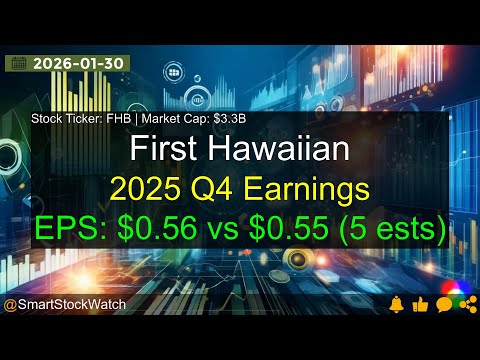
First Hawaiian — Investor Video Playlist




Industry Resources
| Financials Resources |
| Federal Reserve Economic Data |
| Federal Reserve |
| FDIC Data |
| American Banker |
| The Banker |
| Banking Technology |
| Regional Banks Resources |
| Bank Director |
| Independent Banker |
| S&P Global Market Intelligence |
External Quote Links
| Y Finance | Barrons |
| TradingView | Morningstar |
| SeekingAlpha | ValueLine |
| Motley Fool | Robinhood |
| CNBC | Etrade |
| MarketWatch | Unusual Whales |
| YCharts | Perplexity Finance |
| FinViz |
Prefer one of these to Trefis? Tell us why.