
Why Is Tesla Still Worth $1 Trillion?
Tesla (NASDAQ:TSLA) is facing the perfect storm of sorts on many fronts. Sales are plummeting, down 13.5% year-over-year in Q2, after seeing a similar drop in Q1. Profits fell 70% in Q1. The brand has taken a hit with Musk’s political involvement. The company no longer enjoys the regulatory favor we thought it would under the Trump Administration. In fact, the odds are stacked against it, following Elon Musk’s high-profile spat with the President. Chinese EVs are getting much more compelling, making Tesla’s vehicles much less desirable, particularly in international markets. The much hyped Cybertruck pickup for all practical purposes appears to be a dud.
Google is proving that Tesla isn’t the only game in town when it comes to self-driving. The Waymo robotaxi service has a head start over Tesla’s robotaxi and does over 1 million fully autonomous, paid rides each month across Phoenix, San Francisco, and Los Angeles, up from under 50k rides about two years ago with a strong safety track record to boot. In many respects, Waymo actually appears to be ahead of Tesla. So with Tesla falling short on so many fronts, why is the company still valued at close to $1 trillion – more than the next 10 automakers’ market caps combined. There may be a few reasons, although we can’t be sure that they are well-founded. (related While Tesla Talks, Waymo Drives)
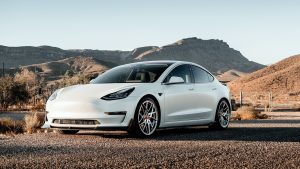
Image by capital street fx from Pixabay
Tesla’s Tough Valuation Math
Tesla’s earnings for the next year, FY’26, are projected at about $2.90 per share, based on consensus estimates. Now, let’s assume for simplicity that these earnings come purely from the company’s automotive business – no contributions from software or renewable energy. (How big is Tesla’s software business?) Even if we apply a generous valuation multiple of 30x to this earnings figure, significantly higher than the low double-digit multiples assigned to traditional automakers like Toyota and Honda, and much higher than the single-digit P/E ratios typical for U.S. majors like Ford or GM, that still implies a stock price of under $100. That would place Tesla’s market cap at roughly $300 billion. In other words, on an automotive-only basis, Tesla would be worth far less than its current market value of close to $1 trillion. So where is the rest of that value coming from? The answer lies in investor belief that Tesla is still well ahead in autonomous driving, robotics, and broader AI applications.
The FSD and Robotics Story
There are a few good reasons for this belief. Take Full Self Driving and robotaxis, for instance. The total price tag of a Waymo vehicle was estimated to be between $150,000 and $200,000 as of 2024. In comparison, Tesla’ mainstream vehicles – such as the Model 3 and Model Y – come with all the FSD hardware pre-installed, starting at less than $50,000. That’s a substantial cost advantage. What’s more, Tesla has millions of vehicles on the road already and Tesla has been considering launching a dedicated robotaxi at under $30,000. The ride-hailing market is already enormous, and we’ve previously estimated that the autonomous ride-hailing market might be even bigger – a $750 billion autonomous ride-hailing market isn’t far-fetched! (A closer look At Tesla’s just launched Robotaxi business) So having a massive installed base of relatively affordable vehicles, all equipped with FSD, gives Tesla a potential distribution advantage.
Moreover, the Optimus robot could also be another big project. The robot is designed to handle repetitive, dangerous, or mundane tasks in factories, warehouses, and homes. Tesla is looking to produce millions of these robots annually by 2030, with a target price of $20,000 or less. If successful, Optimus could become Tesla’s next big product category. There are other competitors in this space including Boston Dynamics. Tesla is strong in AI with its self-driving platform, and it has automated its factories to a very large extent, so investors are obviously optimistic. Tesla also has the manufacturing chops to pull off things like this. The company operates at a much higher level of automation than most automakers. Considering the use of large-scale casting with the Gigapress, high levels of robotics, and vertically integrated processes. These innovations have reduced its reliance on manual labor in many areas, such as welding, assembly, and material transport.
And of course, there’s Elon Musk. Musk’s renewed focus on Tesla, after stepping back from his government roles earlier this year, is expected to help the company pursue its longer-term goals more aggressively. To be sure, Autonomous driving and robotics remain incredibly complex problems. But Musk’s vision, execution track record, and ability to rally people and capital seems to give investors optimism that Tesla will deliver.
While we think that Tesla stock looks expensive, you could explore the Trefis Reinforced Value (RV) Portfolio, which has outperformed its all-cap stocks benchmark (combination of the S&P 500, S&P mid-cap, and Russell 2000 benchmark indices) to produce strong returns for investors. Why is that? The quarterly rebalanced mix of large-, mid- and small-cap RV Portfolio stocks provided a responsive way to make the most of upbeat market conditions while limiting losses when markets head south, as detailed in RV Portfolio performance metrics.
Invest with Trefis Market-Beating Portfolios
See all Trefis Price Estimates