
Geithner’s Confidence in US Banks Sparks Rally for Financials
The banking sector got a much needed shot in the arm yesterday when Treasury Secretary Timothy Geithner said that the U.S. financial firms have strengthened themselves since the economic crisis of 2008 and that there was “absolutely” no chance of any of them failing in a Lehman type event. [1] In his testimony before the Senate Banking Committee and the House Financial Services Committee, Geithner also added that the banks also have very little direct exposure to the riskiest European economies though he did acknowledge the indirect impact of a broader economic slowdown. This shows his confidence in the U.S. banking system, which led to sharp rally in financials. Bank of America (NYSE:BAC) gained the most with its shares soaring nearly 9% Thursday after dipping as much as 15% earlier in the week. Morgan Stanley (NYSE:MS) is also up nearly 12% this week as well while Citi and JPMorgan (NYSE:JPM) saw their shares rally around 5% Thursday.
[trefis_slideshow ticker=”BAC” rhs=”3″]
U.S. Banks Are Well Capitalized, EU Plans Should Emerge Next Week
Geithner attributed the strength of the U.S. banks, including the largest ones, to sustainable levels of capital and financial leverage as well as stable funding sources. His comment that the banks have minimal direct exposure to the riskiest European countries – namely Greece, Italy, Portugal, Spain and Ireland – helped dissipate rising concerns investors had about the damage that banks will take in case any of these economies default on their debt or if their financial institutions fail.
PIMCO’s Head of Global Equities, Neel Kashkari, who helped Hank Paulson run the Troubled Asset Relief Program (TARP) is among analysts who believe that European countries are increasingly realizing the need to recapitalize their banks on an individual basis rather than expecting that the European Commission will bail them. Next week the European Commission will decide on how countries should help their banks, either at the national level or by relying on funds from the European Financial Stability Facility (EFSF). [2]
We have complied the following table based on information provided by the banks in various SEC filings and earnings-related discussions regarding their exposure in the troubled countries – which have collectively come to be known as the PIIGS economies – clearly shows the value of exposure for the U.S. banks is small compared to other major banks based in Europe.
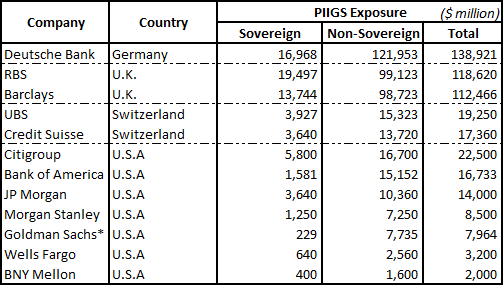
Exposure of Banks to PIIGS Economies
Note: The data above represents gross exposure, i.e. excluding the effect of any third-party hedges. Data for Goldman Sachs is incomplete as the bank only mentions exposure in Ireland, stating that exposure in other countries is “not material”.
U.S. Banks Might Not be Taking Enough Risk
Geithner, however, clarified that small bank exposure in Europe cannot negate the significant indirect impact on the U.S. economy in the event that the European economy falters. With the slump in confidence and demand, this would slow the U.S. economy.
That being said, he highlighted that if the U.S. financial institutions remain too cautious, this could hold back the economy and weaken growth during a slowdown. He commented that this risk aversion could be biggest risk the U.S. faces in an attempt to jump-start the economy. [3]
Understand How a Company’s Products Impact its Stock Price at Trefis
Notes:- BofA, Morgan Stanley Rise as Geithner Says U.S. Lenders Stronger Than 2008, Bloomberg, Oct 6 2011 [↩]
- Commission to Outline Bank Plan within a Week, Reuters, Oct 7 [↩]
- Geithner Cites Banks’ Risk-Aversion as Threat to Economy, The Wall Street Journal, Oct 6 2011 [↩]