
Priced for AI, Selling Cars: The Disconnect in Tesla’s 2025 Valuation
Tesla (NASDAQ:TSLA) stands at a precarious intersection as 2025 closes. On one side, its stock price suggests a company on the verge of solving general artificial intelligence, trading at a massive premium that dwarfs the rest of the global automotive industry combined. On the other, its core business—selling electric vehicles—is not faring well. The data from October paints a picture of a company caught in a painful transition. While Wall Street prices Tesla for a robotaxi future, customers are increasingly turning away from its aging car lineup.
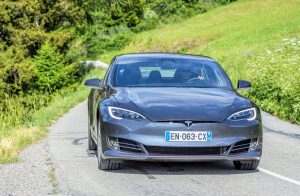
Image by Dominick Vietor from Pixabay
No matter where TSLA stock goes, your portfolio should stay on track. See how the High Quality Portfolio can help you do that.
Automotive Reality Check
The most immediate headwinds are blowing from the automotive division, which still accounts for the vast majority of Tesla’s revenue.
- The Tax Credit Hangover: The expiration of the U.S. federal EV tax credit on September 30, 2025, acted as a hard brake on EV demand. Per Cox Automotive, EV sales in the U.S. fell by about 30% year-over-year in October. The “pull-forward” effect in Q3 saw buyers rushing to secure $7,500 incentives, leaving a demand vacuum in Q4. Without these subsidies, Tesla is forced to compete on price against a revitalized hybrid market and legacy automakers, who are heavily discounting.
- European Collapse: The situation across the Atlantic is worse. In October, Tesla registration in Europe dropped 48.5%. European buyers are flocking to fresher, cheaper alternatives from Chinese players like BYD and SAIC. Tesla’s Model Y and Model 3 – first launched in 2017 and 2020 respectively, are showing their age.
- Margin Compression – Once the envy of the industry at over 25%, automotive gross margins have compressed to approximately 16% to 18%. This places Tesla perilously close to the profitability profiles of mass-market competitors like Ford (13% gross margin in Q3) yet its stock is priced as if it were a high-margin software monopoly. The kicker here is that every point of margin lost could directly starve the massive free cash flow that funds Tesla’s AI and autonomy ambitions.
The Valuation Disconnect
Despite these automotive struggles, Tesla continues to trade at a Price-to-Earnings (P/E) ratio hovering around 260x estimated 2025 earnings. For context, legacy automakers currently trade at levels of roughly 7x to 12x earnings. This massive delta comes from the “AI Premium.” Investors are probably ignoring the car business, betting instead that Elon Musk will deliver on promises of autonomous transport and humanoid robotics. They see Tesla as a proxy for physical AI. So Can A $30K Robot Save Tesla And Make Musk A Trillionaire?
However, the “proof points” for this AI future are slipping:
- Robotaxi Reality vs. Rhetoric: While the company promised thousands of autonomous vehicles by year-end, reports from Austin indicate a pilot fleet of only 30 to 60 vehicles. The “unsupervised” FSD (Full Self-Driving) dream remains stuck in a “supervised” reality, bogged down by regulatory hurdles and safety data that hasn’t yet satisfied NHTSA requirements.
- FSD Licensing: A core pillar of the bull case was that legacy automakers would eventually license Tesla’s FSD software, turning it into the “Windows” of driving. There hasn’t been progress on this front. Major competitors seem more open to partnering with Waymo or developing in-house solutions, rejecting Musk’s overtures amid liability concerns and integration complexities.
- Optimus Delays: The humanoid robot, Optimus, was slated for limited production runs this year. Instead, we are seeing “hundreds” of experimental units rather than the revenue-generating thousands projected. It remains a concept, not a business. Experts indicate that building a general-purpose humanoid robot is vastly harder than Tesla’s timelines imply.
The Sole Bright Spot: Energy
If there is a bridge to the future, it is Tesla Energy. This division is the only part of the “Plan” that is undeniably working. Revenue from energy generation and storage surged by almost 44% in Q3, fueled by insatiable demand for Megapacks batteries to support AI data centers and grid stabilization. This segment is now also posting higher gross margins compared to the automotive business. However, even with this growth, energy cannot help justify a trillion-dollar valuation—nor can it fully replace the billions in cash that a contracting auto margin structure is burning through.
Tesla in late 2025 is a company effectively “treading water” with its car sales while sprinting toward an AI future that is taking longer to arrive than anticipated. The market is willing to look past the shrinking auto sales and falling margins for now, but that patience is predicated on near-term breakthroughs in autonomy. The real danger is the cash-flow chokehold. The stock is priced for perfection (trading at over 260x earnings), yet the automotive cash engine is rapidly losing power. Free cash flow has already dropped from $8.5 billion in 2022 to $4.4 billion in 2023 and roughly $3.6 billion in 2024. If the “Tax Credit Hangover” turns into a prolonged automotive recession and forces sustained price cuts, free cash flow could be strangled, starving the AI programs that Tesla’s valuation depends on.
The Trefis High Quality (HQ) Portfolio, with a collection of 30 stocks, has a track record of comfortably outperforming its benchmark that includes all 3 – the S&P 500, S&P mid-cap, and Russell 2000 indices. Why is that? As a group, HQ Portfolio stocks provided better returns with less risk versus the benchmark index; less of a roller-coaster ride, as evident in HQ Portfolio performance metrics.
Invest with Trefis Market-Beating Portfolios
See all Trefis Price Estimates