
How Gold Protects You When The S&P Crashes
When markets tumble, most portfolios have nowhere to hide – except, historically, gold. We look at the 10 worst months for the S&P 500 since 2015, and gold outperformed stocks every single time, often swinging positive while equities were deep in the red. A simple shift – allocating just 10% of a portfolio to gold – would have reduced losses in each of those crashes while barely affecting your long-term alpha.
Markets can turn fast, and March 2020 proved it (see S&P crashes during past crises). In the S&P’s 10 worst months since 2015, gold consistently cushioned the blow.
- Gold was positive in 5 out of the 10 worst months for the SPDR S&P 500 exchange traded fund (SPY)
- Even when gold was negative, it generally fell much less than SPY
- In extreme crash months like March 2020 (Covid-19 panic), gold barely moved (-0.2%) while SPY tanked (-12.5%).
- If you allocated 10% of your equity to gold, the excess return would have been consistently between +0.6% and +1.5% vs SPY. That kind of cushion is reassuring.
Protecting wealth is at the cornerstone of what we do. Trefis works with Empirical Asset Management – a Boston area wealth manager – whose asset allocation strategies yielded positive returns during the 2008-09 period when the S&P lost more than 40%. Empirical has incorporated the Trefis HQ Portfolio in this asset allocation framework to provide clients better returns with less risk versus the benchmark index; less of a roller-coaster ride, as evident in HQ Portfolio performance metrics.
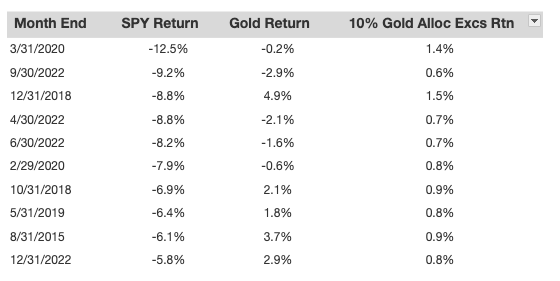
Returns Comparison
If a 10% gold allocation can soften equity crashes without hurting long-term returns, imagine what’s possible when you blend multiple uncorrelated assets. Consider what long-term performance for your portfolio could be if you combined 10% commodities, 10% gold, and 2% crypto with equities?