
The Radical Bet At The Heart Of SpaceX’s $1.75 Trillion IPO
There are data centers in Texas that were fully built out over a year ago, kitted with server racks, networking, and GPUs, and are sitting idle, waiting for a grid connection. It is a power problem, and it is the same problem slowing AI infrastructure build-out across the U.S. and increasingly abroad.
The answer a growing number of companies are exploring is to go up. Put the compute in orbit, where the sun never sets on a solar array, where there is no grid to wait for, and where waste heat radiates into a vacuum instead of a river. Several players are circling this idea.
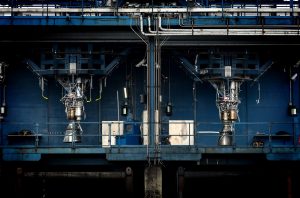
SpaceX (SPCX) may be the best equipped to actually do it.
On June 8, four days before its IPO, the company unveiled AI1. It is, in the plainest possible terms, a data center in orbit, and it may be the single most important piece of the argument for why SpaceX deserves a valuation that no rocket company has ever justified. See How Seriously Should Investors Take SpaceX’s AI Narrative?
- Cintas Stock Bears Are Overlooking This Profit Engine
- DraftKings Just Changed the Game
- Did The Market Panic On Oracle’s Best Signal?
- Is Amazon’s $225 Billion AI Chip Bet Too Big To Fail?
- The Hidden Flywheel That Could Reignite Salesforce Stock
- How CAT Stock – An Old-School Industrial – Became An AI Darling
Why It Matters For Valuation
SpaceX is heading into its IPO at a valuation of $1.75 trillion, roughly 100x trailing revenue. For context, industrial companies trade at 1 to 5x revenue at the max. Telecom companies trade at similar levels. A launch business, however dominant, and a satellite internet network, however profitable, do not get you to 100x. For that multiple to make sense, SpaceX needs to be valued as something else entirely. AI infrastructure is the answer the company is offering.
We recently initiated coverage on SpaceX at $79 per share. Read our full analysis here: SpaceX: Great Company, Overpriced Stock
Each AI1 satellite delivers 120 kW of sustained compute, roughly equivalent to one Nvidia GB300 rack. The company’s mega-rocket Starship can carry 30 to 50 satellites per launch. At the launch cadences SpaceX is projecting, the company believes it could deploy 100 gigawatts of orbital AI compute annually, scaling toward one terawatt. Goldman Sachs has flagged AI as the biggest driver of SpaceX’s future value, with revenue potentially growing 100x by 2030.
The Problems It Would Solve
The bull case rests on real constraints in terrestrial AI infrastructure. Power grids are strained. Communities are blocking new data center construction over land use, water, and energy demand. Permitting timelines stretch years. In orbit, none of that applies.
AI1’s design addresses the two core physics problems. Power comes from near-constant sunlight via a 70-meter solar array. Cooling, normally the limiting factor in dense compute, is handled by a 110-square-meter liquid radiator that sheds waste heat as infrared into the vacuum. There is no water requirement, no fans, and no utility interconnection queue. If the economics work, orbital compute will help sidestep the bottlenecks already slowing the AI build-out on the ground.
The Challenges
SpaceX’s own S-1 is candid about the risks. Satellites cannot be repaired or upgraded in orbit, a significant problem in an industry where chip generations turn over every two years. Radiation degrades electronics faster than any terrestrial environment. The cooling system has also never been proven at scale. The entire constellation depends on Starship, SpaceX’s megarocket, which it is banking on to cut payload costs to reach an acceptable launch cadence and cost structure.
The cautionary parallel is Microsoft’s Project Natick, which put a data center on the seabed in 2015, met every technical target it set, and was still abandoned because the economics never closed and clients did not want compute they could not access or upgrade.
What Proof Points Should Investors Watch?
SpaceX plans to launch two AI1 prototype satellites in early 2027. The tests are straightforward: can each satellite sustain 120 kW of compute continuously, and does the thermal management hold up over months in actual orbit? Underperformance here would call the entire premise into question.
Beyond the hardware, three things on the ground matter as much. First, Starship needs to hit its stride in terms of launch cadence to deploy satellites at the scale where the economics work. Second, Gigasat, the dedicated AI1 factory SpaceX is building in Bastrop, Texas, needs to produce satellites fast enough to fill those flights. Third, Terafab, SpaceX’s in-house chip effort, needs to deliver. The company’s own S-1 admits it cannot yet secure enough GPUs externally, which makes vertical integration on chips not a strategic choice but a necessity.
See how SpaceX’S financials compare with other publicly listed Space stocks such as Redwire (RDW) and Rocket Lab (RKLB)
As SpaceX’s IPO tempts investors into a $1.75 trillion bet on rockets, satellites, and unproven AI, balancing speculative positions against proven cash-generating platforms becomes critical. A disciplined portfolio approach helps you stay invested by limiting the impact of market shocks. While consistently beating the market is a challenge, the Trefis High Quality (HQ) Portfolio is designed to make it a more achievable goal. The HQ strategy has consistently outperformed its market benchmark since inception, delivering cumulative returns of over 105 percent.