
Is Microsoft Stock Too Cheap To Ignore?
Microsoft (MSFT) stock is at an interesting point right now. If you bet on it, you are betting on a company that’s growing reasonably, is sustaining good cash flow and margin, has a low-debt to market cap structure, and is relatively cheaply valued. But is that enough?
Why Bet On MSFT Now?
The investment thesis is centered on Microsoft’s unique ability to monetize generative AI by leveraging its two primary strategic assets: its priority cloud partnership with OpenAI and its massive, embedded enterprise distribution channel via Microsoft 365. This allows Microsoft to both capture new AI workloads in Azure and drive significant Average Revenue Per User (ARPU) uplift from its existing 450 million+ commercial seats.
- Azure revenue growth accelerated to +40% YoY in Q3 FY26, driven by a 123% increase in AI business.
- Commercial Remaining Performance Obligation (RPO) surged 99% YoY to $627B, indicating a massive pipeline of future revenue.
- The addressable market for the Copilot upsell is over 450 million commercial paid seats, representing a substantial, high-margin revenue opportunity.
While there may be reasons to consider MSFT stock for your portfolio, it is important to analyze what has been driving its stock price recently to understand ground reality.
How Do The Fundamentals Look?
- Revenue Growth: 17.9% LTM and 15.3% last 3-year average.
- Operating Margin: Nearly 45.6% 3-year average operating margin.
- No Margin Shock: Microsoft has improved in the last 12 months.
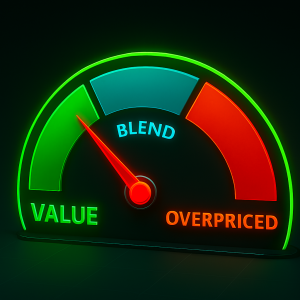
- Modest Valuation: Despite these fundamentals, MSFT stock trades at a PE multiple of 23.9
Below is a quick comparison of MSFT fundamentals with S&P medians.
| MSFT | S&P Median | |
|---|---|---|
| Sector | Information Technology | – |
| Industry | Systems Software | – |
| PE Ratio | 23.9 | 23.9 |
|
|
||
| LTM* Revenue Growth | 17.9% | 7.4% |
| 3Y Average Annual Revenue Growth | 15.3% | 5.8% |
| LTM Operating Margin Change | 1.6% | 0.2% |
|
|
||
| LTM* Operating Margin | 46.8% | 18.4% |
| 3Y Average Operating Margin | 45.6% | 18.3% |
| LTM* Free Cash Flow Margin | 22.9% | 14.5% |
*LTM: Last Twelve Months
The Bear View And The Current Investment Debate
The current investment debate on MSFT is centered around: Bulls see massive AI capex as necessary to capture a generational opportunity, while bears fear diminishing returns, margin pressure, and that demand won’t justify the $190B+ annual spend.
The prevailing sentiment is neutral. The massive AI-driven backlog is being directly offset by concerns around the immense capex spend and Azure growth lagging behind some of its hyper-scale peers. Investors are weighing the long-term AI prize against near-term margin pressure and execution risk.
| Bull View | Bear View |
|---|---|
| Demand remains supply-constrained. The $627B RPO (which includes key partner commitments) and 123% growth in AI services strongly signal that infrastructure investments are mapping to active enterprise pipelines, positioning the company for a prolonged growth cycle. | Massive forward capex intensity (guided to exceed $40B in Q4 and $190B for calendar 2026) places immense pressure on free cash flow margins. Furthermore, while Azure accelerated to 40% growth, it continues to lag hyper-scale peers like Google Cloud, which surged 63% in Q1 2026. This signals that unprecedented infrastructure spend faces a highly back-weighted ROI cycle with real structural execution risks. |
It is one thing to understand the bear view; it is completely another to hold an investment through volatile market phases. It certainly makes you a more resilient investor if you internalize how the stock has fallen during past market crashes. Staying invested is critical to realize large gains.
MSFT Is Just One Of Several Such Stocks
Not ready to act on MSFT? Consider these alternatives:
These stocks have strong operating margins and are trading meaningfully below 1Y high with P/E below the S&P 500 median and P/S below the historical average.
A portfolio that was built starting 12/31/2016 with stocks that fulfill the criteria above would have resulted in average 6-month and 12-month forward returns of 12.7% and 25.8%, respectively, with a win rate (percentage of picks returning positive) of above 70%.
Portfolios Over Value Hunting
Buying stocks that seem like a bargain is a high-conviction move, but it comes with its own set of risks. When a value play takes longer than expected to turn around, or dips even further, it is easy to lose patience and exit, thus missing the exact recovery you were waiting for. The most reliable way to survive the wait is through a portfolio approach
The Trefis High Quality Portfolio (HQ) is designed to keep you in the trade. By spreading your exposure across 30 quality stocks, it washes out the risk of a single “falling knife” ruining your returns. The rule-based HQ strategy has cumulative returns of over 105% since inception and has beaten its benchmark.