
What’s Behind The 3x Rise In Oracle Stock?

With a 43% rise year-to-date (YTD), Oracle stock (NYSE:ORCL) has fared much better than the broader S&P 500 index, which has gained 7%. This outperformance is partly attributed to rising demand for Oracle’s cloud services amid the AI boom. The company’s Cloud Infrastructure (OCI) and Cloud Application (SaaS) revenues have been consistently growing at high rates. Even if we look at a slightly longer timeframe, ORCL stock has surged a whopping 3x since early 2023, supported by three major factors:
- a 127% increase in the Price-to-Sales (P/S) ratio: The P/S multiple rose from 5.7x in 2022 to 11.8x now;
- a 35% jump in revenues: Revenues grew from $42 billion to $57 billion over this period, partly offset by:
- a 3% rise in total shares outstanding.
We’ll examine these drivers in more detail. While ORCL stock has delivered strong returns, those seeking growth with less volatility than individual stocks might explore the High Quality portfolio, which has outpaced the S&P 500 with returns exceeding 91% since inception. Also, see – SOUN Stock To $20?
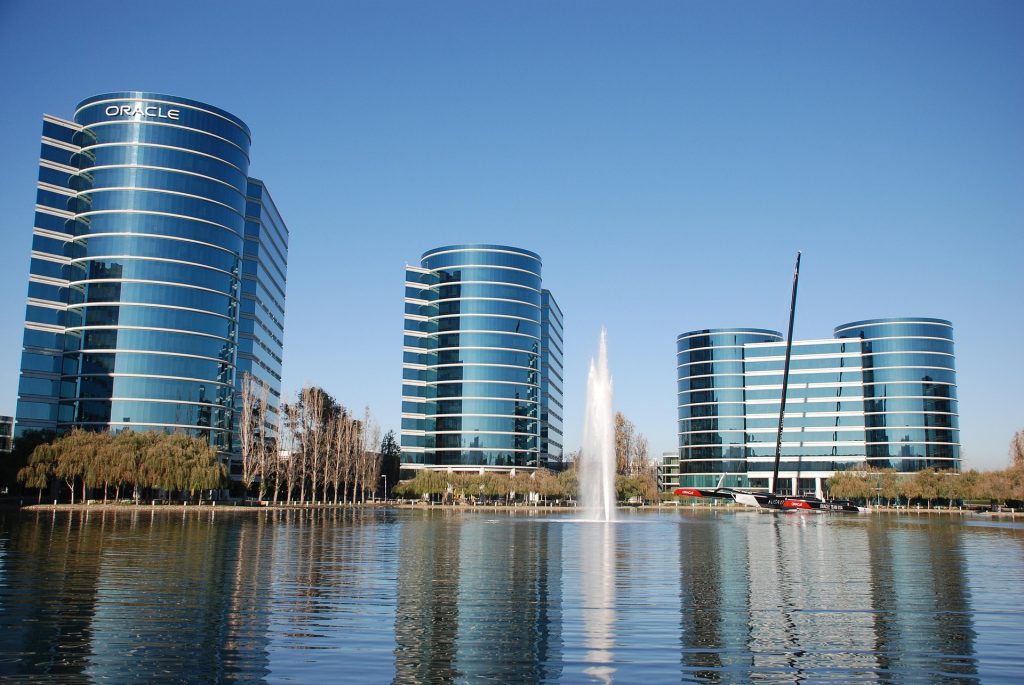
Image by JJ from Pixabay
What’s Behind The Revenue Growth?
Oracle has demonstrated solid fundamental performance with a 35% rise in revenue, growing from $42 billion in 2022 to $57 billion in the trailing twelve months. The company’s impressive growth is primarily fueled by the surging demand for its Cloud Infrastructure (OCI), especially driven by the Artificial Intelligence (AI) boom.
- ORCL Stock: Why The Discount May Not Last
- Oracle Gets Cheaper Only If The Megawatts Arrive
- Is Oracle Still The Software Business You Bought?
- Oracle Stock Fell While Its Operating Margin Climbed For A Third Straight Year
- Oracle’s AI Build-Out Is Squeezing Gross Margin, Not Its Valuation
- Could Oracle Go Bankrupt – Really?
- Cloud Infrastructure Dominance and AI-Driven Growth: Oracle Cloud Infrastructure (OCI) is a significant growth engine. The company’s Cloud Services and License Support revenue (which includes OCI) for full fiscal year 2025 reached $44 billion, compared to $30 billion in 2022. This performance, especially OCI’s strong growth, validates Oracle’s position as a major hyperscaler.
- Expanding Cloud Portfolio and Future Revenue: Oracle’s overall cloud services revenue demonstrates consistent strength. For fiscal year 2025, total cloud services revenue was $24.5 billion, up over 2x from $10.8 billion in 2022. The company has secured record contract bookings, with Total Remaining Performance Obligations (RPO) increasing 41% to $138 billion by the end of FY25. This substantial RPO provides strong visibility into Oracle’s future revenue streams.
What’s Driving The Valuation Higher For Oracle Stock?
Oracle’s stock has experienced a significant increase in valuation multiples, with its price-to-sales (P/S) ratio jumping 127% from 5.2x in 2022 to 11.8x currently. Several key factors are driving this sustained growth:
- Cloud Infrastructure Market Leadership: Oracle’s OCI business has become the primary catalyst for investor enthusiasm. With quarterly revenue growing from $1.0 billion in early 2023 to $3.0 billion in the latest quarter, representing consistent 40-60% year-over-year growth rates, Oracle has established itself as a legitimate hyperscaler player, boosting investor confidence.
- AI Infrastructure Premium: Oracle has positioned itself as a critical enabler of the AI revolution through its cloud infrastructure offerings. The company’s specialized GPU clusters and AI-optimized infrastructure have attracted major AI companies and enterprises, creating a scarcity premium as demand for AI computing resources continues to outpace supply.
- Transformation to High-Growth Cloud Model: Oracle’s successful pivot from a traditional license-based software company to a cloud-first enterprise has fundamentally changed its growth trajectory. The company expects its revenue to rise from $57 billion in fiscal 2025 to over $104 billion by 2029. This does not even include the company’s recently announced $30 billion in annual revenues from 2026, likely from OpenAI. With very high growth prospects, investors are rewarding the stock with a higher valuation multiple.
- Margin Expansion Potential: With an operating margin of approximately 31%, Oracle has demonstrated the ability to maintain profitability while scaling its cloud infrastructure business. Investors anticipate significant operating leverage as the company continues to scale its high-margin cloud services, particularly as AI-driven demand continues to grow.
But What Next? Is ORCL Stock A Buy At $235?
At its current trading price of around $235, Oracle (ORCL) stock appears richly valued. Its price-to-sales (P/S) multiple stands at 11.7x, significantly above its four-year average of 6.5x. Similarly, the stock’s trailing adjusted earnings multiple is 54 times, which is also much higher than its average price-to-earnings (P/E) ratio of 32 times over the past four years. While Oracle is undoubtedly well-positioned to benefit from the increasing adoption of AI and the rising demand for cloud infrastructure, these positive factors seem to be fully reflected in the current stock price. Refer to Oracle’s Valuation Ratios for additional context.
But There Are Risks
Despite the strong outlook, there are notable risks. In the inflation-led 2022 downturn, ORCL stock dropped 41%, declining from a high of $104 in December 2021 to $61 in September 2022. In contrast, the S&P 500 saw a smaller decline of 25%. Although ORCL rebounded to its pre-crisis peak by May 2023, a similar sell-off occurred earlier this year amid trade war concerns, where ORCL fell nearly 34%, steeper than the 19% drawdown for the S&P 500. More on this is available in our Buy or Sell Oracle Stock dashboard.
Apart from macro and geopolitical risks, Oracle faces internal challenges, especially regarding its significant capital expenditures. From just $4.5 billion in 2022, the company’s capital expenditures crossed $21 billion in fiscal 2025, and it is expected to grow to over $25 billion this year. A pressing question remains: What if these large-scale investments don’t yield the expected returns?
Now, we apply a risk assessment framework while constructing the 30-stock Trefis High Quality (HQ) Portfolio, which has a track record of comfortably outperforming the S&P 500 over the last 4-year period. Why is that? As a group, HQ Portfolio stocks provided better returns with less risk versus the benchmark index; less of a roller-coaster ride, as evident in HQ Portfolio performance metrics.
Invest with Trefis Market-Beating Portfolios
See all Trefis Price Estimates