
Bitcoin Escaped GPU Cost, Is AI Next?

Nvidia’s (NASDAQ:NVDA) dominance in artificial intelligence accelerators has turned it into one of the most valuable companies in the world, with a market cap topping $4 trillion. Its financial performance has been solid, with revenue rising 56% from the same period a year ago to $47 billion over the most recent quarter and net margins routinely exceeding 50%. But history offers a cautionary tale. In cryptocurrency, GPUs once reigned supreme, only to be replaced by custom-designed ASICs that offered better efficiency. With Broadcom recently disclosing a massive $10 billion order for its custom AI chips, widely reported to be from OpenAI, investors are beginning to ask whether AI could follow a similar trajectory. So what could this mean for Nvidia’s long-term prospects?
No matter how fast growing and attractive, investing in a single stock carries high risk. Trefis High Quality Portfolio and is designed to reduce stock-specific risk while giving upside exposure.
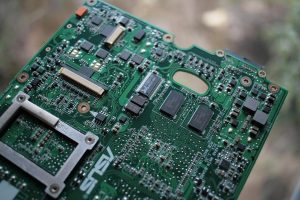
Image by Joachim Schnürle from Pixabay
From CPUs to ASICs: The Bitcoin Mining Precedent
When Bitcoin first launched, mining was done on regular CPUs. Soon, miners figured that GPUs were better suited for the parallel computations required by Bitcoin’s algorithm. GPUs eventually became the hardware of choice, only to be displaced a few years later by FPGAs and ultimately ASICs (Application-Specific Integrated Circuits). ASICs brought in a big change. These chips, purpose-built for Bitcoin’s hashing algorithm, delivered orders of magnitude more efficiency and raw speed compared to GPUs. A single ASIC miner could achieve terahashes per second (essentially the speed at which a machine can perform these guesses), while consuming far less power compared to rigs built around GPUs.
The trade-off was specialization: ASICs could only mine Bitcoin or similar algorithms, whereas GPUs could switch between coins or even be repurposed for gaming and AI. The result was a complete reshaping of the industry. Mining became capital-intensive and dominated by large industrial operators who could afford massive ASIC farms. GPUs still remain popular among small-scale miners, hobbyists, and those mining altcoins that are ASIC-resistant or designed for GPU mining.
Could AI Be Next?
Nvidia’s GPUs are the gold standard for training large language models such as OpenAI’s GPT-4, and they power the bulk of the AI infrastructure at hyperscalers . Over the past three years, tens of billions have been poured into GPU clusters, fueling Nvidia’s rapid rise. For perspective, Amazon (AMZN), Alphabet (GOOG), Microsoft (MSFT), and Meta (META) indicated that they could spend a cumulative $364 billion in capex for their respective fiscal years. However, the economics of AI may also be changing.
Training large models is still GPU-heavy, but this is likely to be a relatively front loaded process. As most of the easily available data on the Internet is absorbed by LLMs (large language models) with incremental gains from larger models slowing down, training growth could cool a bit. The bulk of future demand lies in inference – running trained models at scale to serve billions of queries. Unlike training, inference is repetitive, predictable, and very cost-sensitive. This is exactly where custom chips could shine, just as ASICs did for Bitcoin. related: Will Broadcom Chips End AMD Stock’s AI Dreams?
The strongest signal yet came last week, when Broadcom disclosed a $10 billion order for custom AI chips from a single customer, widely believed to be OpenAI. If accurate, this might suggests OpenAI is moving a part of its inference workload away from Nvidia GPUs, likely in search of better efficiency and lower costs. Broadcom’s CEO, Hock Tan, has emphasized the rise of XPUs or custom accelerators, designed for specific workloads. These chips could give hyperscalers more control over their infrastructure costs, while reducing dependence on Nvidia’s premium-priced GPUs. For OpenAI, whose ChatGPT serves millions of users daily, small improvements in cost per inference could translate into massive savings at scale. Having alternatives to Nvidia also helps to improve bargaining power for GPUs.
Drawbacks of ASICs
The appeal of ASICs in both crypto and AI is clear: efficiency, lower power consumption, and predictable performance for repetitive tasks. For companies running AI workloads at hyperscale, these advantages could prove irresistible. But there are drawbacks, too. Once manufactured, the ASIC chip’s functionality is largely fixed, unlike GPUs which can be reprogrammed or updated. Just as Bitcoin ASICs were locked into SHA-256 algorithm and vulnerable to protocol changes, AI-specific chips may lack the flexibility of GPUs. If AI models evolve rapidly or architectures shift, ASICs could become obsolete. GPUs, by contrast, remain highly versatile, capable of handling both training and inference across a wide variety of models. Designing and fabricating custom ASICs is also costly and time-consuming, and this could make ASICs less accessible to smaller companies.
Implications for Nvidia
For Nvidia, the risk is that its core growth engine – GPUs for AI – may not be as secure as it seems. Training workloads will likely remain GPU-dominated, but the inference shift toward custom silicon plays out, Nvidia could see an erosion of demand. Broadcom’s deal may represent the first step in a broader trend, as hyperscalers like Google, Amazon, and Meta weigh similar strategies while also building out their own chips. Nvidia still has ecosystem advantages and a deep software stack (CUDA) that helps it to better lock in customers. That said, given the lofty valuations and strong recent momentum, the ASIC threat is one that investors should keep a close eye on.
The Trefis High Quality (HQ) Portfolio, with a collection of 30 stocks, has a track record of comfortably outperforming its benchmark that includes all 3 – S&P 500, Russell, and S&P midcap. Why is that? As a group, HQ Portfolio stocks provided better returns with less risk versus the benchmark index; less of a roller-coaster ride, as evident in HQ Portfolio performance metrics.