
MU Stock: History Signals A Rebound After 13% Drop

Micron Technology (MU) stock has fallen by 13.1% in about a week, from $803.63 on 13th May, 2026, to $698.74 now, amid concerns around Micron’s aggressive capex expansion and some broader semiconductor profit taking.
What comes next?
We believe there is a good chance of a stock rebound considering the history of recovery post-dips and our current Attractive but Volatile opinion of the stock. Read Buy or Sell Micron Technology Stock to see how we arrive at this opinion.

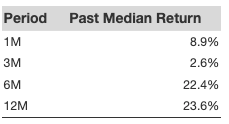
Dip buying is a viable strategy for quality stocks that have a history of recovering from dips. As it turns out, MU stock passes basic quality checks. Historically, the median return for the 12-month period following sharp dips was 24%, with median peak returns reaching 69%. We define a sharp dip as a stock going down 30% or more in less than a 30-day period.
- Does Micron Technology Stock Still Have Room to Run?
- Micron Stock Surged 9x But History Suggests Caution.
- MU, FSLR Top ON Semiconductor Stock on Price & Potential
- The Bear Case: How MU Behaves During Market Shocks
- Better Value & Growth: MU Leads Analog Devices Stock
- What Can Trigger Micron Technology Stock’s Slide?
Below, we get into details of historical dips and subsequent returns.
Historical Median Returns Post Dips
Historical Dip-Wise Details
MU had 7 events since 1/1/2010 where the dip threshold of -30% within 30 days was triggered
- 69% median peak return within 1 year of dip event
- 327 days is the median time to peak return after a dip event
- -18% median max drawdown within 1 year of dip event
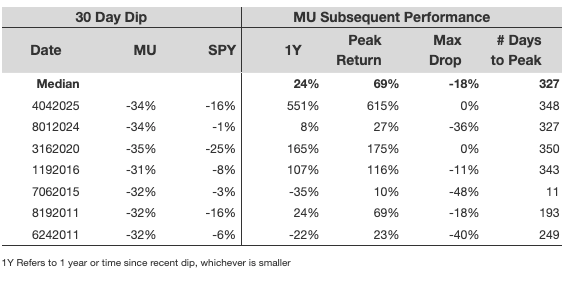
1Y Refers to 1 year or time since recent dip, whichever is smaller
While the table provides a good summary of past dips for MU stock, isolating dips and subsequent recovery during major market crashes is another critical piece of information.
Micron Technology Passes Basic Financial Quality Checks
Revenue growth, profitability, cash flow, and balance sheet strength need to be evaluated to reduce the risk of a dip being the sign of a deteriorating business situation.
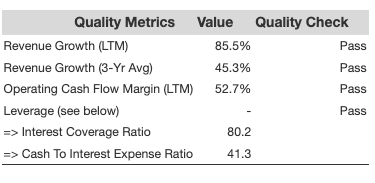
While these are some basic checks required for conviction, there is a lot more to unpack before taking any investment decision.
Beyond historical recovery patterns, Micron’s long-term AI memory positioning still appears strong for three reasons.
First, AI systems are becoming dramatically more memory-intensive, with newer GPUs requiring far larger amounts of high-bandwidth memory (HBM), especially as inference workloads such as AI agents and real-time video generation scale.
Second, HBM demand is increasingly backed by multi-year supply agreements, improving revenue visibility and reducing the sharp cyclicality historically seen in memory markets.
Third, supply remains constrained due to HBM’s manufacturing complexity, allowing Micron to rapidly gain share in a fast-expanding market.
Staying Invested Over Timing The Bottoms
Buying the dip on a stock like MU looks easy on a historical chart, but living through it is a high-stakes game. When a “bargain” keeps dipping, the volatility often forces investors to lose their nerve and exit right before the recovery begins. To actually capture that upside, you need a strategy that makes “staying invested” a mechanical reality rather than a test of willpower.
The Trefis High Quality Portfolio (HQ) is engineered to give you that staying power. By diversifying across 30 quality stocks, it dampens the stomach-churning drops of a market dip while retaining upside exposure. The HQ strategy has outpaced the S&P 500, S&P Mid-cap, and Russell 2000 and has returned > 105% since inception.