
Why You Shouldn’t Be Buying Microchip Technology Stock

Microchip Technology stock (NASDAQ:MCHP) a company that manufactures microcontrollers, mixed-signal, analog, and Flash-IP integrated circuits, surged by close to 12% in Friday’s trading and remains up by 17% over the past five trading days. The gains come after the company posted a better-than-expected set of Q4 FY’25 earnings (March year) and provided an optimistic top-line forecast for Q1 FY’26. Demand for Microchip’s low-end semiconductors has seen a slowdown in recent quarters from sectors including automotive and industrial electronics, and this has led to higher inventory and reduced order volumes, which has driven the stock down by about 50% from highs seen in mid-2024. So has MCHP stock turned the corner? Is it a good buy at current levels?
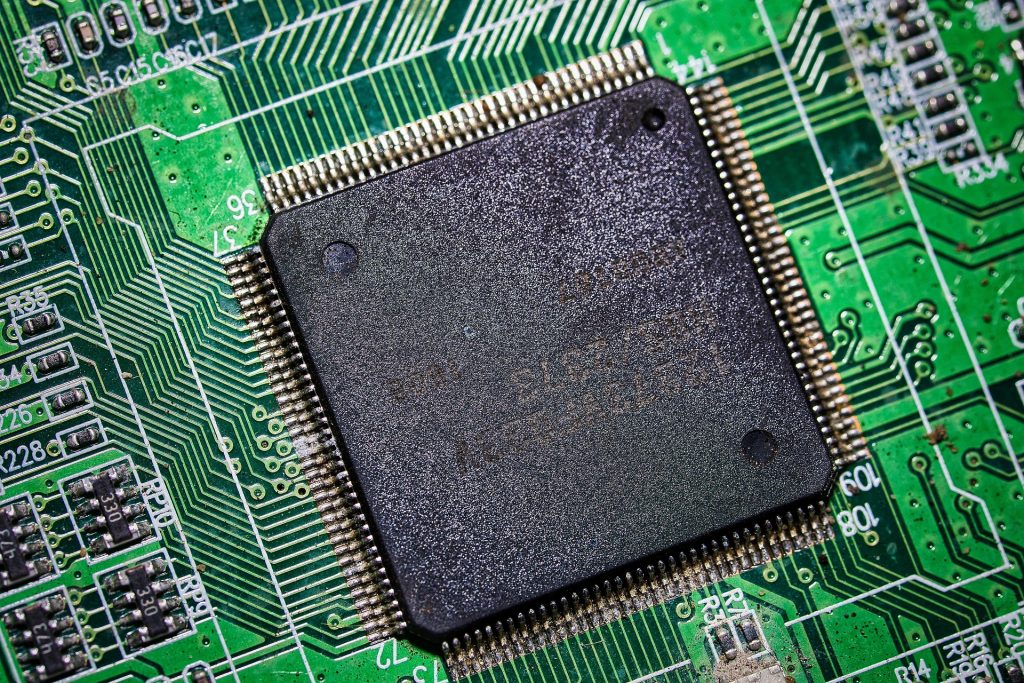
Image by Nico Franz from Pixabay
We believe MCHP stock looks unattractive, making it a very bad bet at its current price of around $60. We believe there are several concerns with MCHP stock, which makes it unattractive given that its current valuation looks very high.
We arrive at our conclusion by comparing the current valuation of MCHP stock with its operating performance over the recent years as well as its current and historical financial condition. Our analysis of Microchip Technology along key parameters of Growth, Profitability, Financial Stability, and Downturn Resilience shows that the company has a very weak operating performance and financial condition, as detailed below. That said, if you seek upside with lower volatility than individual stocks, the Trefis High Quality portfolio presents an alternative, having outperformed the S&P 500 and generated returns exceeding 91% since its inception.
- Ripple Doesn’t Need XRP to Win. That’s the Problem.
- Can Tesla Stock’s $1.3T Valuation Withstand China’s Humanoid Surge?
- Tempus AI Stock: Why The AI Oncology Platform Is Worth Paying Up For
- Apple’s $14B Capex in a $700B AI World: Smart or Shortsighted?
- What Could Rocket Broadcom Stock to New Heights
- Can NVIDIA Stock Withstand These Pressures?
How Does Microchip Technology’s Valuation Look vs. The S&P 500?
Going by what you pay per dollar of sales or profit, MCHP stock looks expensive compared to the broader market.
• Microchip Technology has a price-to-sales (P/S) ratio of 5.2 vs. a figure of 2.8 for the S&P 500
• Additionally, the company’s price-to-free cash flow (P/FCF) ratio is 22.0 compared to 17.6 for S&P 500
• And, it has a price-to-earnings (P/E) ratio of 79.9 vs. the benchmark’s 24.5
How Have Microchip Technology’s Revenues Grown Over Recent Years?
Microchip Technology’s Revenues have fallen considerably over recent years.
• Microchip Technology has seen its top line shrink at an average rate of 4.4% over the last 3 years (vs. increase of 6.2% for S&P 500)
• Its revenues have declined 44.3% from $8.5 Bil to $4.8 Bil in the last 12 months (vs. growth of 5.3% for S&P 500)
• Also, its quarterly revenues decreased 41.9% to $1.0 Bil in the most recent quarter from $1.8 Bil a year ago (vs. 4.9% improvement for S&P 500)
How Profitable Is Microchip Technology?
Microchip Technology’s profit margins are worse than most companies in the Trefis coverage universe.
• Microchip Technology’s Operating Income over the last four quarters was $641 Mil, which represents a poor Operating Margin of 13.5% (vs. 13.1% for S&P 500)
• Microchip Technology’s Operating Cash Flow (OCF) over this period was $1.1 Bil, pointing to a moderate OCF Margin of 23.6% (vs. 15.7% for S&P 500)
• For the last four-quarter period, Microchip Technology’s Net Income was $309 Mil – indicating a poor Net Income Margin of 6.5% (vs. 11.3% for S&P 500)
Does Microchip Technology Look Financially Stable?
Microchip Technology’s balance sheet looks weak.
• Microchip Technology’s Debt figure was $6.8 Bil at the end of the most recent quarter, while its market capitalization is $30 Bil (as of 5/9/2025). This implies a moderate Debt-to-Equity Ratio of 27.5% (vs. 21.5% for S&P 500). [Note: A low Debt-to-Equity Ratio is desirable]
• Cash (including cash equivalents) makes up $586 Mil of the $16 Bil in Total Assets for Microchip Technology. This yields a poor Cash-to-Assets Ratio of 3.8% (vs. 15.0% for S&P 500)
How Resilient Is MCHP Stock During A Downturn?
MCHP stock has fared worse than the benchmark S&P 500 index during some of the recent downturns. Worried about the impact of a market crash on MCHP stock? Our dashboard How Low Can Microchip Technology Stock Go In A Market Crash? has a detailed analysis of how the stock performed during and after previous market crashes.
Inflation Shock (2022)
• MCHP stock fell 37.2% from a high of $89.35 on 27 December 2021 to $56.14 on 5 July 2022, vs. a peak-to-trough decline of 25.4% for the S&P 500
• The stock fully recovered to its pre-Crisis peak by 30 June 2023
• Since then, the stock has increased to a high of $99.49 on 22 May 2024 and currently trades at around $60
Covid Pandemic (2020)
• MCHP stock fell 49.9% from a high of $55.60 on 13 January 2020 to $27.89 on 16 March 2020, vs. a peak-to-trough decline of 33.9% for the S&P 500
• The stock fully recovered to its pre-Crisis peak by 1 September 2020
Global Financial Crisis (2008)
• MCHP stock fell 60.6% from a high of $21.03 on 15 June 2007 to $8.29 on 20 January 2009, vs. a peak-to-trough decline of 56.8% for the S&P 500
• The stock fully recovered to its pre-Crisis peak by 31 October 2013
Putting All The Pieces Together: What It Means For MCHP Stock
In summary, Microchip Technology’s performance across the parameters detailed above is as follows:
• Growth: Extremely Weak
• Profitability: Weak
• Financial Stability: Weak
• Downturn Resilience: Weak
• Overall: Very Weak
In addition, keeping in mind its very high valuation, we think that the stock is extremely unattractive, which supports our conclusion that MCHP is a bad stock to buy.
While you would do well to avoid MCHP stock for now, you could explore the Trefis Reinforced Value (RV) Portfolio, which has outperformed its all-cap stocks benchmark (combination of the S&P 500, S&P mid-cap, and Russell 2000 benchmark indices) to produce strong returns for investors. Why is that? The quarterly rebalanced mix of large-, mid- and small-cap RV Portfolio stocks provided a responsive way to make the most of upbeat market conditions while limiting losses when markets head south, as detailed in RV Portfolio performance metrics.
Invest with Trefis Market-Beating Portfolios
See all Trefis Price Estimates