
Trade Wars, Sanctions: Is America Digging the Dollar’s Grave?
What stops the dollar from falling? In large part, China. The United States is a vast consumer market — the single largest destination for many countries’ exports. When the dollar weakens, imports into the U.S. become more expensive, prompting American consumers to buy less. That directly hurts exporters abroad, especially in countries like China that depend on U.S. demand for growth. But will this favorable arrangement continue indefinitely? With trade wars, sanctions, and shifting geopolitical alignments pushing nations to rethink dollar dependence, cracks are starting to show.
For investors, the fate of the dollar matters deeply — it shapes global capital flows, commodity prices, and the relative performance of international markets. A shift in dollar dominance could ripple through exchange rates, inflation expectations, and asset valuations worldwide. Related: This metric says the S&P 500 Poised For A 40% Crash?
For investors looking to navigate a changing environment, the Trefis High Quality Portfolio offers a disciplined way to stay ahead of shifting market dynamics. It has significantly outperformed its benchmark – a combination of all 3, the S&P 500, Russell, and S&P MidCap indices—and has generated returns exceeding 105% since its inception. Why is this the case? As a group, HQ Portfolio stocks have provided improved returns with less risk compared to the benchmark index; less of a roller-coaster experience, as demonstrated in HQ Portfolio performance metrics.
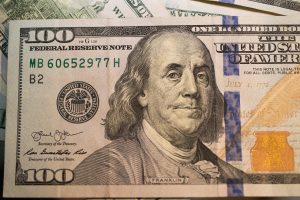
Image by benscripps from Pixabay
Global Stake in America’s Currency
Yet, for now, Beijing still has a strong incentive to prevent the dollar from falling too much. In 2023, the U.S. accounted for around 14% of China’s total exports — roughly 3% of its GDP — a meaningful share for an economy where exports remain a key growth driver. China often intervenes in currency markets by buying U.S. dollars and selling yuan (Renminbi), helping to keep the yuan from appreciating sharply and preserving export competitiveness. This logic extends beyond China.
For export-driven economies such as South Korea, and much of Southeast Asia, a stable or strong dollar supports trade, jobs, and overall growth. Their central banks hold large dollar reserves and intervene in currency markets, partly to protect this export engine. Even countries that aren’t major exporters to the U.S. might often end up doing the same, because their trading partners invoice goods in dollars. In effect, the rest of the world has a shared interest in keeping the dollar stable — not because they want to help the U.S., but because it helps drive their own stability and prosperity.
Why Dollar Dominates
The U.S. dollar’s role as the leading global reserve currency is supported by strong demand for Treasury securities, the U.S. economic size, financial markets depth, and geopolitical influence. The Treasury market is the world’s deepest and most liquid asset class, offering investors safety, transparency, and the ability to move enormous sums at any time. No other currency has markets large and open enough to perform this role. Global banks, corporations, and central banks rely on the dollar for lending, borrowing, and cross-border settlement. Over decades, that has created a network effect: the more the dollar is used, the more essential it becomes. The U.S. dollar’s widespread use in international trade, finance, and as a reserve asset creates structural demand that supports its value. So how long can this equilibrium last?
Threats Include Trade War, Gold, and Digital Money
Tensions between the U.S. and China have complicated this relationship. The ongoing trade war – which has been marked by tariffs, high-tech export restrictions, and supply chain realignment — has begun to alter trade flows. Based on Chinese customs data, China’s exports to the U.S. fell 16.9%, in dollar terms, in the first nine months of 2025 compared to the same period in 2024. China’s overall exports grew 6.1% globally. This suggests a partial decoupling. China is finding new markets, but the U.S. still remains too large to replace easily. Despite political friction, the economic link between the two powers continues to underpin demand for the dollar.
There are several other global shifts gradually challenging the dollar’s dominance. The extensive use of U.S. economic sanctions – enabled by the dollar’s central role in global finance – has pushed some countries to actively seek alternatives. This has been especially pronounced after the Russian invasion of Ukraine, which prompted the U.S. to freeze Russia’s foreign reserves and cut major Russian banks off from the SWIFT payment network. That move underscored the financial power that comes with dollar dominance — but it also sent a clear message to other nations: over-reliance on the U.S.-centric system carries political risk. Since then, several countries have accelerated efforts to build alternative payment mechanisms, expand bilateral trade in local currencies, and reduce exposure to the dollar in their reserves.
Rising U.S. debt – which now tops $38 trillion, and political polarization have raised questions about fiscal discipline, prompting some countries to diversify their currency reserves. $38 Trillion U.S. Debt: Too Big To Go Broke? For instance, Central banks, led by China, India, and Turkey, are steadily increasing gold holdings. This could be seen as a hedge against sanctions, inflation, and financial risk. At the same time, the rise of digital currencies, the growing adoption of Central Bank Digital Currencies (CBDCs) worldwide, is encouraging a more multipolar currency environment, with digital versions of the euro, yuan, and other currencies offering alternatives to dollar-based payments. This digital evolution could reduce dependence on intermediaries like SWIFT and challenge the traditional dollar-centric system.
Investing Amid Uncertainty
As the global monetary order evolves, preserving capital and remaining adaptive may prove just as vital as pursuing high returns. Consider strategies such as the Trefis Reinforced Value (RV) Portfolio, which has surpassed its all-cap stocks benchmark (a combination of the S&P 500, S&P mid-cap, and Russell 2000 benchmark indices) to yield strong returns for investors. Why is this so? The quarterly rebalanced mix of large-, mid-, and small-cap RV Portfolio stocks provided a responsive solution to leverage favorable market conditions, while mitigating losses when markets decline, as detailed in RV Portfolio performance metrics. In the face of a potential 40-60% downside, strategies that can “limit losses when markets head south” are especially crucial.
Invest with Trefis Market-Beating Portfolios
See all Trefis Price Estimates