
Which Is A Better Pick: Johnson & Johnson or Pfizer Stock?

Pharmaceutical giant Johnson & Johnson (NYSE: JNJ) has dramatically outperformed its peer Pfizer (NYSE: PFE) this year. JNJ is up nearly 45%, while PFE is down 6%, significantly outpacing the S&P 500’s 13% gain. This performance gap is driven by strong strategic execution at Johnson & Johnson, contrasting with post-pandemic headwinds facing Pfizer. We think JNJ stock still remains a favorable pick over Pfizer. We will delve into the details in the sections below. But if you seek an upside with less volatility than holding an individual stock like JNJ or PFE, consider the High Quality Portfolio. It has comfortably outperformed its benchmark—a combination of the S&P 500, Russell, and S&P MidCap indexes—and has achieved returns exceeding 105% since its inception. Why is that? As a group, HQ Portfolio stocks provided better returns with less risk versus the benchmark index; less of a roller-coaster ride, as evident in HQ Portfolio performance metrics.

Image by Renate Köppel from Pixabay
Johnson & Johnson’s Rally: Drivers of Growth
JNJ’s stock ascent is supported by multiple positive factors:
- Strong Earnings & Outlook: JNJ delivered robust Q3 2025 results, beating sales and profit expectations, and raised its full-year guidance. This signals management confidence in continued growth.
- Strategic Acquisitions: Key acquisitions, such as Halda Therapeutics (prostate cancer) and Intra-Cellular Therapies (neurology), have enhanced and bolstered JNJ’s high-growth portfolio.
- Portfolio Focus: The planned spin-off of the orthopedics business (DePuy Synthes) is viewed positively, allowing JNJ to concentrate on faster-growing, higher-margin areas like cardiovascular and surgical technologies.
- Segment Strength: Both the Innovative Medicines segment (driven by drugs like Darzalex and Tremfya) and the MedTech segment (boosted by new launches and acquisitions like Abiomed and Shockwave) showed consistent, strong operational growth.
Pfizer’s Decline
Pfizer’s stock decline is primarily due to:
- Plummeting COVID-19 Demand: Decreasing demand for its flagship COVID-19 products, Comirnaty and Paxlovid, compared to pandemic-era sales, has created a significant revenue gap.
- Growth Concerns: Investor concern over future growth persists, exacerbated by patent expirations, a complex regulatory environment (especially around vaccines), and the recent discontinuation of a weight-loss drug candidate.
Overall, JNJ stock shows stronger revenue growth performance over key periods, better margins, and relatively lower valuation vs PFE stock, suggesting you may be better off investing in JNJ.
- JNJ’s quarterly revenue growth was 6.8%, vs. PFE’s -5.9%.
- In addition, its Last 12 Months revenue growth came in at 5.1%, ahead of PFE’s 3.9%.
- JNJ has stronger profitability across both periods, with LTM margin at 26.2% and 3-year average at 26.4%.
See how Johnson & Johnson’s financials compare with its peers, including Pfizer.
These differences become even clearer when you look at the financials side by side. The table highlights how JNJ’s fundamentals stack up against those of PFE on growth, margins, momentum, and valuation multiples.
Valuation & Performance Overview
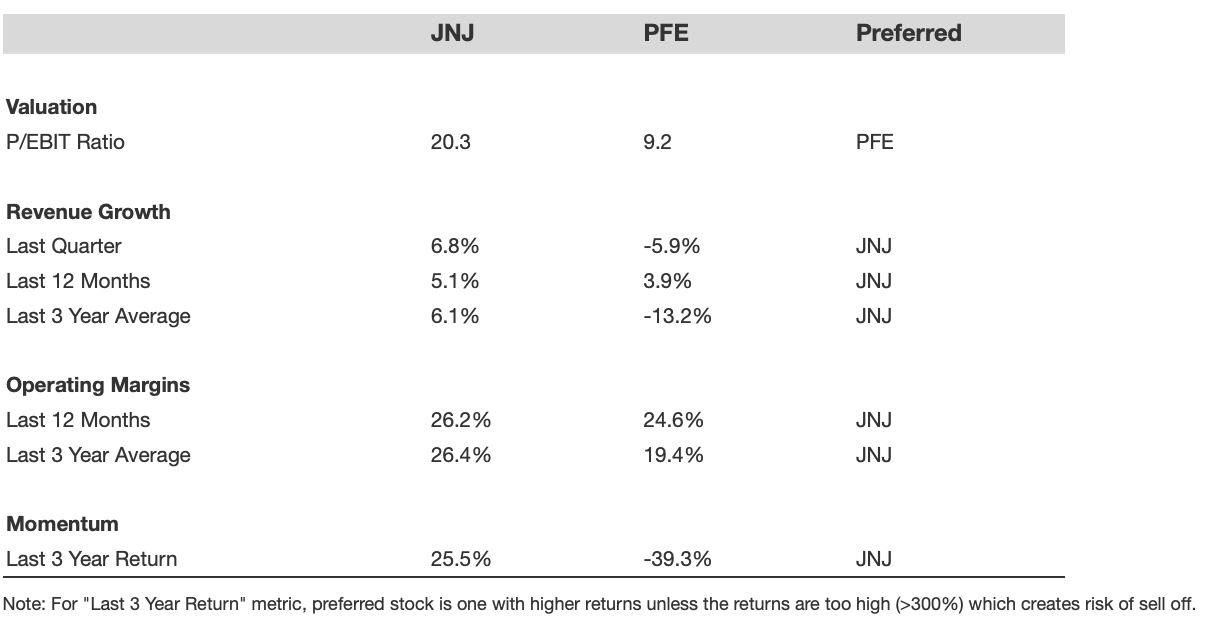
Valuation & Performance Overview
See more revenue details:
See more margin details:
See detailed fundamentals on Buy or Sell PFE Stock and Buy or Sell JNJ Stock. Below, we compare market return and related metrics across years.
Historical Market Performance
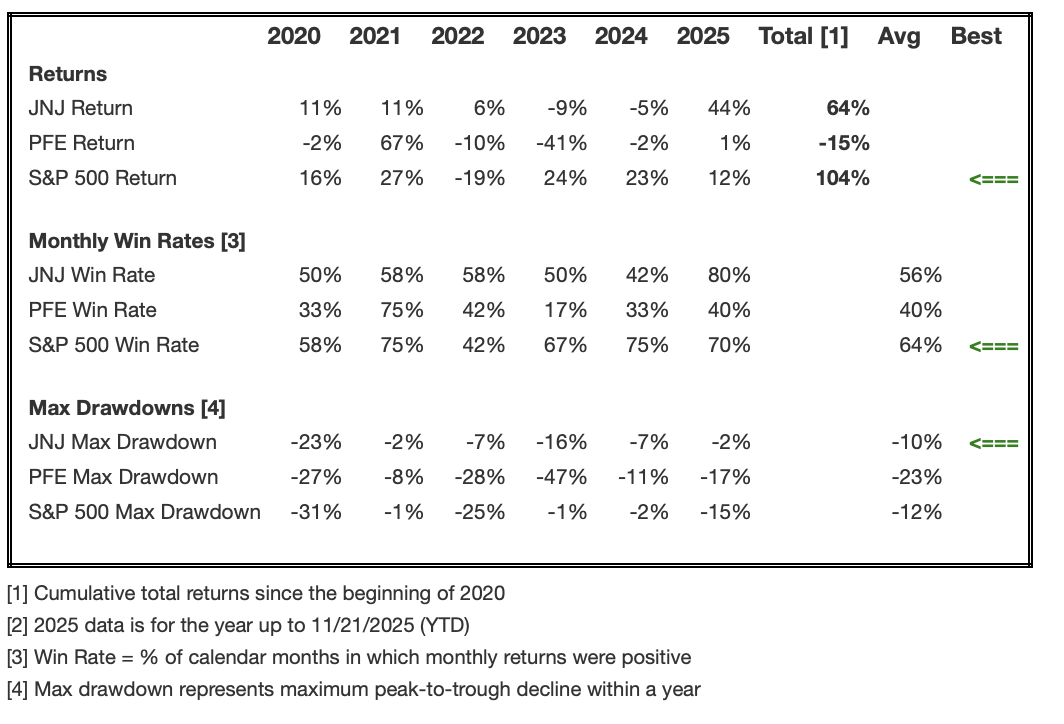
Still not sure about JNJ or PFE? Consider a portfolio approach.
The Best Investors Think In Portfolios
Individual picks can be volatile, but staying invested is what matters. A diversified portfolio helps you stay the course, capture upside, and reduce downside. Consider the Trefis Reinforced Value (RV) Portfolio, which has outperformed its all-cap stocks benchmark (combination of the S&P 500, S&P mid-cap, and Russell 2000 benchmark indices) to produce strong returns for investors. Why is that? The quarterly rebalanced mix of large-, mid-, and small-cap RV Portfolio stocks provided a responsive way to make the most of upbeat market conditions while limiting losses when markets head south, as detailed in RV Portfolio performance metrics.
Invest with Trefis Market-Beating Portfolios
See all Trefis Price Estimates