
Johnson Controls Powers Through Its Financial Year 2016
Johnson Controls (NYSE:JCI) fell to a fourth quarter loss amid costs linked to the spinoff of its auto-parts business, Adient, and its merger with Tyco. However, revenue and adjusted earnings per share exceeded expectations.

Click here to see our complete analysis of Johnson Controls
[trefis_slideshow ticker=”JCI” rhs=”03″]
A lot has happened to Johnson Controls in its FY 2016, ended September. First, in October of last year, the company completed its integration with Hitachi appliances, to provide its global customers with a wide range of air conditioning products and technology. Through this agreement, JCI obtained a 60% ownership stake in Hitachi’s over $2.6 billion global air conditioning business. The performance of this venture, and the integration activities, have far exceeded expectations, and will prove to be a great platform going forward.
[trefis_forecast ticker=”JCI” driver=”0324″]
Secondly, the spin-off of the company’s automotive segment also received approval in the year. The new company, Adient, is a global leader in automotive seating and interiors, providing its products to all major automobile manufacturers. It began operating as an independent company, and trade on the New York Stock Exchange under the symbol ADNT, on October 31, 2016. Alex Molinaroli, CEO of Johnson Controls, cited two reasons for the spin-off. The cyclical nature of the auto industry wreaked havoc on the company’s cash flows. Furthermore, the enormous capital investment needed by the seating business was not something JCI was willing to make. Dedicated capital and cash flow will ensure flexibility to the company to come up with a targeted capital allocation strategy, and to deliver smarter reinvestment opportunities, including for M&A. This will, in turn, increase the value for shareholders and customers. In the future, Adient will aim to attain a leaner cost structure, as it will only be focused on automotive seating. As a result, the company expects 200 basis points of margin improvement, along with double-digit EPS growth over the medium-term. The company’s leading market position, together with a well-diversified revenue base, will ensure growth in the future. The company also has an industry leading position in China, unarguably one of the fastest growing markets in this industry. This region is considered a key growth driver, with the company leveraging its position in the country, to outpace the overall market growth. Adient has 17 seating joint ventures in China, operating 60 manufacturing locations in 32 cities. This results in high profitability and strong cash flow generation, with 65%-70% of the annual JV equity income paid as cash dividends in prior years.
[trefis_forecast ticker=”JCI” driver=”0518″]
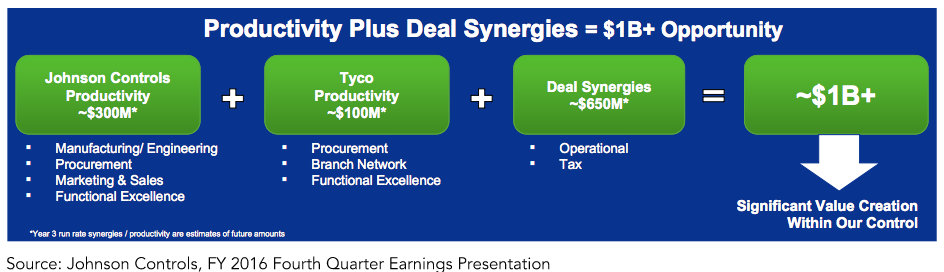
One of the most important events occurring during the year was the merger with Tyco, which happened a month ahead of schedule. This created an Ireland-based company that will be run from Milwaukee, and have approximately $30 billion in annual sales. The company will realize savings of $1 billion, related to both “merger synergies and productivity initiatives.” The new company combines the heating, ventilating, and air conditioning (HVAC) equipment business of Johnson Controls, with the fire and security protection products of Tyco. The main purpose of the merger seems to be gaining size in its area of focus, which is becoming a colossus in the building controls and equipment market. The new company will be able to witness immediate opportunities for growth, through cross-selling of products, complementary distribution networks, and a widened global reach. The geographic fit seems to be ideal, with JCI strong in the Chinese market, and Tyco effective in Europe.
The company also announced plans to invest $445 million to boost the output of its Absorbent Glass Mat (AGM) batteries. These are technologically advanced car batteries that are more expensive than a conventional lead acid battery, but they are better equipped to handle the strain of frequent engine restarts and the ever-increasing load placed on car batteries. They are employed in vehicles with the start-stop technology, which, while being fuel-saving, can tax a car battery since the electrical system still uses the energy from the battery when the vehicle turns off. Of the investment, $245 million will be expended to double its battery output in North America by investing in existing plants, and $200 million will go towards building a new battery plant in China. JCI also stated that it plans to invest a total of $780 million globally by 2020 to increase the production of these batteries. The fuel savings with the start-stop technology is one of the main drivers for its increased adoption. Under average driving conditions, savings amount to 3% to 5%. However, with a high number of stops and with traffic lights staying red for extended periods, the figure can rise to 10%, according to Robert Fascetti, vice president for powertrains at Ford. Car manufacturers are also under intense pressure to meet strict fuel economy standards by 2025, and with the increased fuel efficiency of AGM batteries, this technology is destined to be on a majority of cars in the next few years. This was reflected in the strong growth of start-stop shipments in the fourth quarter, which was up 30% year-on-year, growing from 3.1 million units to 4 million units.
[trefis_forecast ticker=”JCI” driver=”0439″]
Have more questions on Johnson Controls? See the links below:
- How Will Johnson Controls Perform In Its Fourth Quarter?
- How Is Johnson Controls’ Power Solutions Business Expected To Grow In The Next Five Years?
- How Is Adient Expected To Perform In The Next Year?
- Why Has Johnson Controls’ Stock Price Appreciated 29% This Year?
- What Drivers Will Ensure Growth For Adient In The Future?
- What Is Adient’s Position In The Global Automotive Seating Market?
- How Has Adient Performed For Johnson Controls?
- How Can Increasing Interest In Energy Efficiency Help Johnson Controls?
- How Did Johnson Controls Fare In Q3 2016?
- How Will Johnson Controls Perform In Q3 2016?
- Why Is Johnson Controls Banking On China For Its Absorbent Glass Mat Batteries?
- Why Is Johnson Controls Increasing The Production Of Its Absorbent Glass Mat (AGM) Batteries?
- What Are The Prospects For Johnson Controls’ Power Solutions Business?
- What Will Be The Effect On The Segment Operating Margin As A Result Of The Johnson Controls-Tyco Merger?
- What Are The Benefits Johnson Controls Will Attain From The Tyco Merger?
- Will The U.S. Treasury Department Rules, That Killed The Pfizer-Allergan Deal, Affect Johnson Controls-Tyco Merger?
- Johnson Controls’ Earnings Beats Expectations
- Will Johnson Controls Miss Estimates Again?
- How Has Johnson Controls’ Net Sales Changed By Geographic Areas?
- How Does The Adient Spin-Off And Tyco Merger Create Value For Johnson Controls’ and Tyco’s Shareholders?
Notes:
View Interactive Institutional Research (Powered by Trefis):
Global Large Cap | U.S. Mid & Small Cap | European Large & Mid Cap
More Trefis Research