
What’s Happening With GameStop Stock?
For four years, Wall Street has analyzed GameStop (NYSE: GME) as a dying mall retailer. They counted foot traffic, obsessively tracked video game hardware cycles, and laughed at the declining revenue.
The Q3 earnings report proved that those analysts are now studying the wrong company.
On the surface, the numbers look like a retailer in retreat: Net sales fell to $821 million (down from $860 million last year). But look at the bottom line. Net income exploded to $77.1 million, up from just $17.4 million a year ago.
How does a company shrink its revenue by 4.5% but quadruple its profit?
Simple → It stopped trying to be a store and started acting like a bank. And that bank is now like a call option on what CEO Ryan Cohen does with that cash pile next.
Before we delve deeper, if you seek an upside with less volatility than holding an individual stock like GME, consider the High Quality Portfolio. It has comfortably outperformed its benchmark—a combination of the S&P 500, Russell 2000, and S&P MidCap indexes—and has achieved returns exceeding 105% since its inception. Why is that? As a group, HQ Portfolio stocks provided better returns with less risk versus the benchmark index; less of a roller-coaster ride, as evident in HQ Portfolio performance metrics.
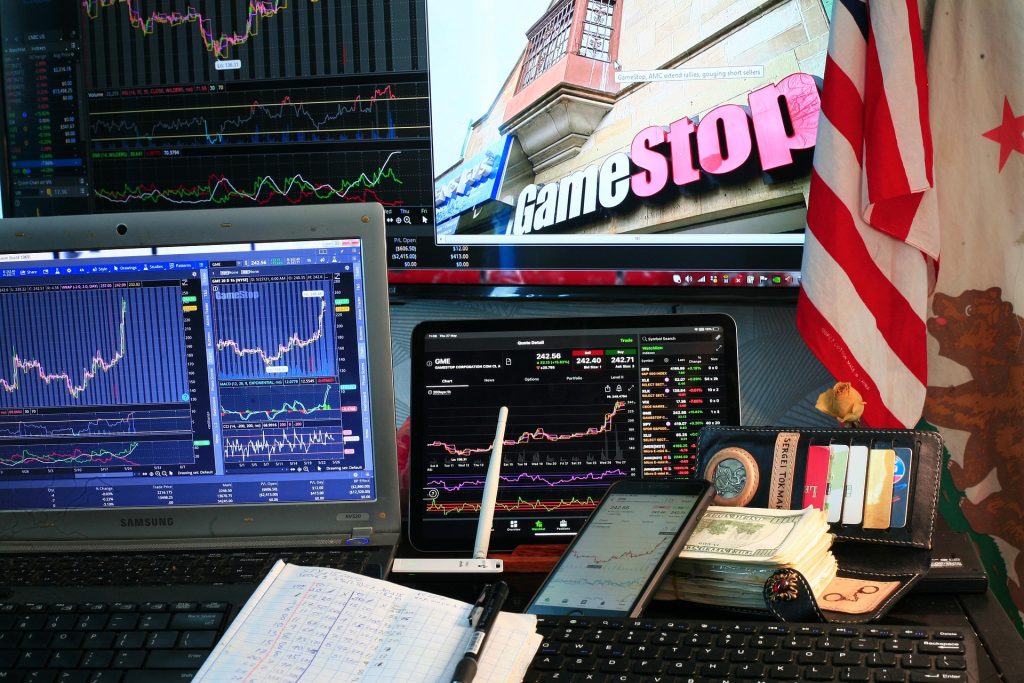
Image by Sergei Tokmakov, Esq. https://Terms.Law from Pixabay
-
The Thematic Anchor: The “Berkshire” Pivot
The market has finally accepted the “Ryan Cohen Thesis.”
- The Old Narrative: “GameStop is Blockbuster 2.0. Digital downloads will kill it.”
- The New Narrative: “GameStop is a closed-end investment fund.”
- The Evidence: The company is aggressively closing unprofitable stores and slashing costs (SG&A expenses dropped to $221.4 million from $282.0 million). They are “managing the decline” of the retail business to maximize cash flow, which they then deploy into their true engine: The Balance Sheet.
-
The Valuation Sanity Test: Valuing the Cash, Not the Consoles
If you value GME as a retailer, it is expensive. If you value it as a fortress balance sheet, the math changes.
- The Disconnect: Revenue is shrinking. In a normal retailer, this is a death spiral.
- The Reality: GameStop is profitable not because it sold more PS5s, but because it cut costs faster than sales fell. Operating Income swung to $41.3 million (from a loss of $33.4 million last year).
- The Multiplier: You are paying for Optionality. With nearly $8.8 billion in cash and equivalents earning interest, the company has a “floor” that prevents bankruptcy. The stock is essentially a call option on what CEO Ryan Cohen uses the cash pile for.
-
The Black Box: The “Interest” Engine
What generated that $77.1 million profit?
- The Asset: It wasn’t Call of Duty. A significant chunk of their profitability comes from Interest Income generated by their massive cash hoard.
- The Transformation: GameStop has effectively become a “yield farmer.” They raise cash from shareholders (via ATM offerings during meme spikes) and park it in T-Bills.
- The Implication: This creates a bizarre “infinite loop.” As long as interest rates remain decent, GameStop can remain profitable indefinitely, even if the retail business breaks even. They have successfully decoupled their survival from the video game cycle.
-
The Competitive Moat: The “Austere” Culture
While other retailers (like Target or Macy’s) struggle with bloated overhead, GameStop has instituted a culture of extreme austerity.
- The Data: SG&A expenses are now just 27% of sales (down from 32.8% last year).
- The Moat: This cost discipline is their moat. It allows them to survive a 5% revenue drop without going back into the red. Most competitors cannot shrink their way to profitability; GameStop just proved it can.
-
The Catalyst: The “Deployment” Question
The stability is here. The question is growth.
- The Trigger: The market is waiting for the “Big Buy.” You don’t hoard billions just to collect 4% interest forever.
- The Speculation: Will they buy a dying brand to revitalize it? Will they invest in equity markets (as their updated investment policy allows)?
- The Risk: If they sit on the cash for another year, investors might get bored. “Shrinking to glory” works for profitability, but it doesn’t drive stock price expansion forever.
Our Take
GameStop has successfully transformed from a “distressed asset” into a “Safe House” for capital. The retail business is now just a side hustle to fund the investment portfolio.
- Bull Case: Ryan Cohen uses the cash pile to acquire a cash-flowing business unrelated to gaming, officially turning GME into a conglomerate.
- Bear Case: The retail decline accelerates (Sales drop >10%), overwhelming the cost cuts, and the cash pile sits idle, earning a meager return while the stock trades at a premium to book value.
The Outlook: The bankruptcy thesis is dead. GameStop is now a financial fortress. At these levels, you aren’t betting on video games; you are betting on the capital allocation skills of the management team.
That said, investing in a single stock without comprehensive analysis can be risky. Consider the Trefis Reinforced Value (RV) Portfolio, which has outperformed its all-cap stocks benchmark (combination of the S&P 500, S&P mid-cap, and Russell 2000 benchmark indices) to produce strong returns for investors. Why is that? The quarterly rebalanced mix of large-, mid-, and small-cap RV Portfolio stocks provided a responsive way to make the most of upbeat market conditions while limiting losses when markets head south, as detailed in RV Portfolio performance metrics.
Invest with Trefis Market-Beating Portfolios
See all Trefis Price Estimates