
How Amazon Stock Behaves During Market Shocks

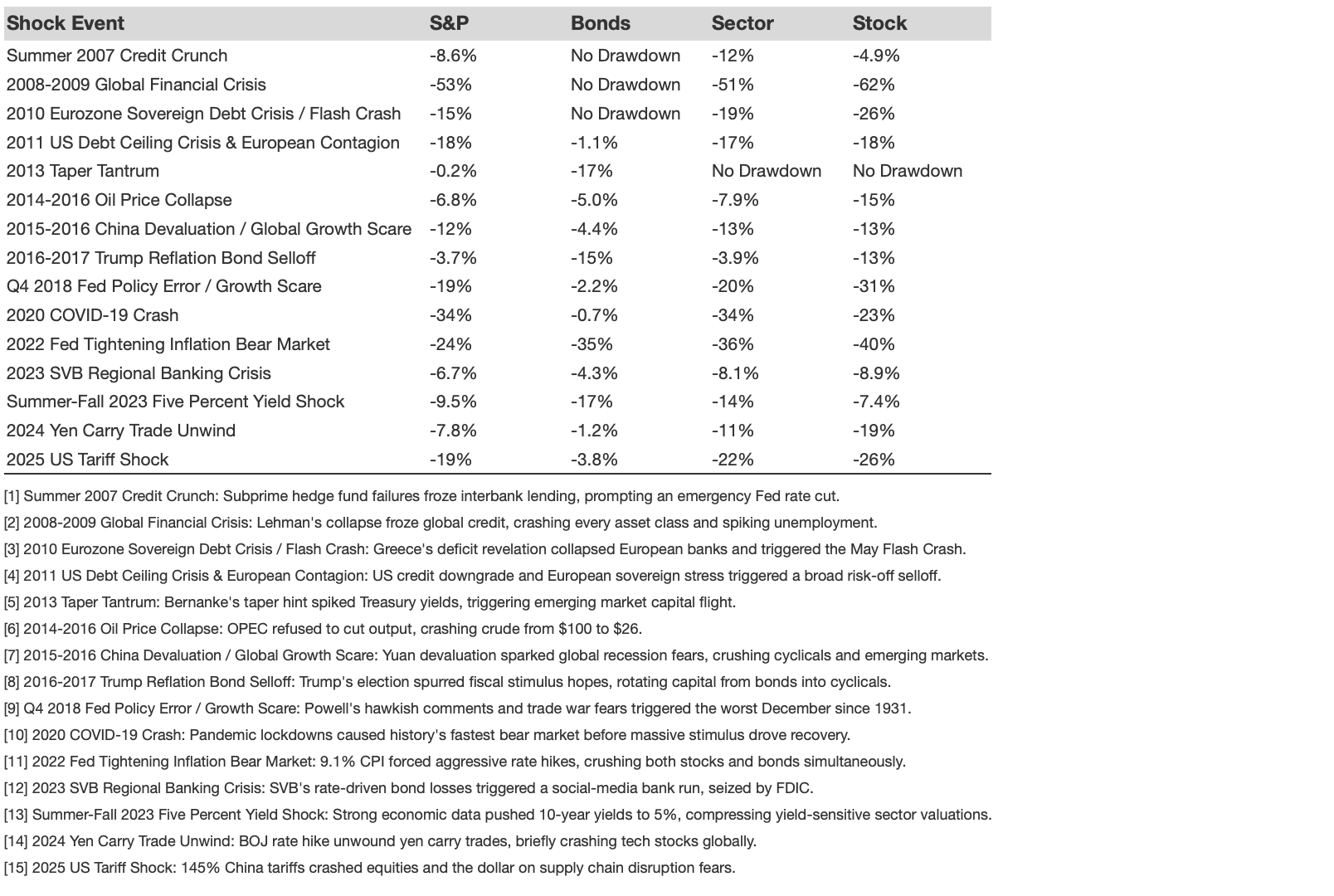
- General Market Dislocations: Across the 15 major market shocks since it began trading, AMZN has proven more volatile than the broader market. The stock has averaged a -20% contraction during these periods, compared to the S&P 500’s -16% drop.
- The Greatest Vulnerability: Historical data identifies credit and liquidity crises as AMZN’s worst-case scenario. While broad market equities always suffer in these environments, Amazon experiences outsized downside when this specific mechanism is triggered.

Image by Finn from Pixabay
1. Credit & Liquidity Crises
2008–2009 Global Financial Crisis (Dec 2007 to Mar 2009)
This crisis was triggered by the unwinding of excess housing leverage and the bankruptcy of Lehman Brothers in September 2008. The sudden absence of an institutional bailout froze the global financial system overnight. Commercial paper collapsed, money markets “broke the buck,” and banks halted lending entirely. The broader economy stalled as unemployment surged to 10% and evaporating demand crashed oil prices to $35/barrel.
Asset Performance:
- AMZN Stock: Plunged -62%
- S&P 500: Declined -53%
- Bonds: Saw no drawdown
2. Sovereign & Geopolitical Risks
2025 U.S. Tariff Shock (Feb 2025 to Jun 2025)
In April 2025, the U.S. administration implemented 145% tariffs on Chinese imports, marking the most aggressive trade action since the 1930s. This severe policy move shattered market confidence, causing equities and the U.S. dollar to drop simultaneously. Widespread supply chain disruptions and input inflation rippled through the economy, driving declines across nearly every market sector.
Asset Performance:
- AMZN Stock: Fell -26%
- S&P 500: Declined -19%
- Bonds: Drawdown -3.8%
3. Growth & Demand Scares
Q4 2018 Perceived Fed Policy Error (Oct 2018 to Jan 2019)
In October 2018, the Federal Reserve signaled a hawkish stance, stating that interest rates were “far from neutral.” This coincided with escalating trade wars and an inverted yield curve, which signaled a looming recession. Markets quickly priced in a massive monetary policy error, leading to an indiscriminate selloff. It became the worst December for equities since 1931, halting only when the Fed reversed its course in January 2019.
Asset Performance:
- AMZN Stock: Dropped -31%
- S&P 500: Declined -19%
- Bonds: Drawdown -2.2%
Past Market Shock Drawdowns Summarized For AMZN
So, What Can You Do For Your Investments?
While the headline panic over macroeconomic shocks can be deafening, letting fear dictate your trades leaves your portfolio highly exposed. Drawdowns of this magnitude are embedded in AMZN’s historical profile. If the thesis for owning the business remains intact, a steep contraction during a Credit & Liquidity Crises environment should be viewed as the baseline expectation, not a fundamental failure.
This is where a rule-based portfolio investment approach, such as Trefis High Quality Portfolio (HQ), makes a difference. It allows you to stay invested when markets are fearful and volatile by dampening the risk. HQ has returned > 105% since inception.