
SBC Medical (SBC)
Market Price (9/30/2026): $4.955 | Market Cap: $508.3 MilSector: Industrials | Industry: Research & Consulting Services
SBC Medical (SBC)
Market Price (9/30/2026): $4.955Market Cap: $508.3 MilSector: IndustrialsIndustry: Research & Consulting Services
Investment Highlights Why It Matters Detailed financial logic regarding cash flow yields vs trend-riding momentum.
Attractive yieldTotal YieldTotal Yield = Earnings Yield + Dividend Yield, Earnings Yield = Net Income / Market Cap Dividend Yield = Total Dividends / Market Cap is 9.9%, ERPEquity Risk Premium (ERP) = Total Yield - Risk Free Rate, Reflects the premium above risk free assets offered by the investment. is 6.0%, FCF Yield is 12% Cash is significant % of market capNet D/ENet Debt/Equity. Debt net of cash. Negative indicates net cash. Equity is taken as the Market Capitalization is -27% Attractive operating marginsOp Mgn LTMOperating Margin = Operating Income / Revenue Reflects profitability before taxes and before impact of capital structure (interest payments). is 37% Attractive cash flow generationCFO/Rev LTMCash Flow from Operations / Revenue (Sales), Last Twelve Months (LTM) is 36%, FCF/Rev LTMFree Cash Flow / Revenue (Sales), Last Twelve Months (LTM) is 34% Megatrend and thematic driversMegatrends include Precision Medicine, and Digital Health & Telemedicine. Themes include Advanced Diagnostics, Targeted Therapies, Show more. | Weak multi-year price returns2Y Excs Rtn is -61%, 3Y Excs Rtn is -132% | Weak revenue growthRev Chg LTMRevenue Change % Last Twelve Months (LTM) is -6.9% Key risksSBC key risks include [1] significant governance issues stemming from the founder-CEO's concentrated voting power and related-party structures, Show more. |
| Attractive yieldTotal YieldTotal Yield = Earnings Yield + Dividend Yield, Earnings Yield = Net Income / Market Cap Dividend Yield = Total Dividends / Market Cap is 9.9%, ERPEquity Risk Premium (ERP) = Total Yield - Risk Free Rate, Reflects the premium above risk free assets offered by the investment. is 6.0%, FCF Yield is 12% |
| Cash is significant % of market capNet D/ENet Debt/Equity. Debt net of cash. Negative indicates net cash. Equity is taken as the Market Capitalization is -27% |
| Attractive operating marginsOp Mgn LTMOperating Margin = Operating Income / Revenue Reflects profitability before taxes and before impact of capital structure (interest payments). is 37% |
| Attractive cash flow generationCFO/Rev LTMCash Flow from Operations / Revenue (Sales), Last Twelve Months (LTM) is 36%, FCF/Rev LTMFree Cash Flow / Revenue (Sales), Last Twelve Months (LTM) is 34% |
| Megatrend and thematic driversMegatrends include Precision Medicine, and Digital Health & Telemedicine. Themes include Advanced Diagnostics, Targeted Therapies, Show more. |
| Weak multi-year price returns2Y Excs Rtn is -61%, 3Y Excs Rtn is -132% |
| Weak revenue growthRev Chg LTMRevenue Change % Last Twelve Months (LTM) is -6.9% |
| Key risksSBC key risks include [1] significant governance issues stemming from the founder-CEO's concentrated voting power and related-party structures, Show more. |
Qualitative Assessment
AI Analysis | Feedback
SBC Medical (SBC) stock has gained about 50% since 5/31/2026 because of the following key factors:
1. Significant Reacceleration in Fiscal Q2 2026 Financial Performance.
SBC Medical Group reported a strong reacceleration in growth for fiscal Q2 2026 (three months ended June 30, 2026), with total revenues increasing by 13% year-over-year to $49 million, surpassing the consensus estimate of $45.37 million. Net income attributable to SBC Medical saw a substantial 335% year-over-year increase, reaching $11 million. Additionally, basic Earnings Per Share (EPS) rose by 400% year-over-year to $0.10, and Adjusted EBITDA increased by 32% year-over-year to $20 million. This reacceleration was attributed to fee expansion in its points business and enhanced AI-enabled services, with management expecting full-year 2026 revenue growth to exceed 15%.
2. Strategic Expansion Driven by AI Integration, Non-Aesthetic Healthcare, and Global Reach.
The company has strategically focused on leveraging artificial intelligence (AI) to drive growth and improve margins, including AI-enabled service enhancements and new AI call centers. Management anticipates that increased AI efforts will contribute up to an additional $15 million in revenue during the second half of fiscal year 2026. SBC Medical is also actively expanding into the non-aesthetic healthcare market, which currently represents 16% of its transaction value, and has established "SBC AI Longevity Innovation Inc." to explore opportunities in longevity, dentistry, orthopedics, eye care, and reproductive treatments. Concurrently, the company is pursuing global expansion, notably through partnerships like OrangeTwist in the U.S. and a growing clinic network in Singapore, Vietnam, and Thailand, contributing to a year-over-year increase of 34 locations, totaling 287 clinics by the end of June 2026.
Show more
SBC Medical (SBC) stock has gained about 50% since 5/31/2026 because of the following key factors:
1. Significant Reacceleration in Fiscal Q2 2026 Financial Performance.
SBC Medical Group reported a strong reacceleration in growth for fiscal Q2 2026 (three months ended June 30, 2026), with total revenues increasing by 13% year-over-year to $49 million, surpassing the consensus estimate of $45.37 million. Net income attributable to SBC Medical saw a substantial 335% year-over-year increase, reaching $11 million. Additionally, basic Earnings Per Share (EPS) rose by 400% year-over-year to $0.10, and Adjusted EBITDA increased by 32% year-over-year to $20 million. This reacceleration was attributed to fee expansion in its points business and enhanced AI-enabled services, with management expecting full-year 2026 revenue growth to exceed 15%.
2. Strategic Expansion Driven by AI Integration, Non-Aesthetic Healthcare, and Global Reach.
The company has strategically focused on leveraging artificial intelligence (AI) to drive growth and improve margins, including AI-enabled service enhancements and new AI call centers. Management anticipates that increased AI efforts will contribute up to an additional $15 million in revenue during the second half of fiscal year 2026. SBC Medical is also actively expanding into the non-aesthetic healthcare market, which currently represents 16% of its transaction value, and has established "SBC AI Longevity Innovation Inc." to explore opportunities in longevity, dentistry, orthopedics, eye care, and reproductive treatments. Concurrently, the company is pursuing global expansion, notably through partnerships like OrangeTwist in the U.S. and a growing clinic network in Singapore, Vietnam, and Thailand, contributing to a year-over-year increase of 34 locations, totaling 287 clinics by the end of June 2026.
3. Favorable Analyst Sentiment and Raised Price Targets.
Analysts have expressed increasingly positive sentiment towards SBC Medical, contributing to the stock's upward trend. Emerging Growth Research upgraded SBC to a "Buy" rating and increased its 12-month price target from $9.00 to $10.00 in May 2026. BTIG Research reiterated a "buy" rating with an $8.00 target price in August 2026, and Wall Street Zen upgraded the stock from a "buy" to a "strong-buy" rating in September 2026. The average analyst price target stands at $8.50, suggesting a potential upside of 75.62% from the stock's price of $4.84 as of September 29, 2026. Additionally, Danelfin's AI model assigned SBC a "Buy" rating with an AI Score of 7/10 in late September 2026, indicating a 54% probability of outperforming the market in the subsequent three months.
Show less
Stock Movement Drivers
Fundamental Drivers
The 50.8% change in SBC stock from 5/31/2026 to 9/29/2026 was primarily driven by a 25.5% change in the company's P/E Multiple.| (LTM values as of) | 5312026 | 9292026 | Change |
|---|---|---|---|
| Stock Price ($) | 3.21 | 4.84 | 50.8% |
| Change Contribution By: | |||
| Total Revenues ($ Mil) | 169 | 175 | 3.4% |
| Net Income Margin (%) | 24.1% | 28.0% | 16.2% |
| P/E Multiple | 8.1 | 10.1 | 25.5% |
| Shares Outstanding (Mil) | 103 | 103 | 0.0% |
| Cumulative Contribution | 50.8% |
Market Drivers
5/31/2026 to 9/29/2026| Return | Correlation | |
|---|---|---|
| SBC | 50.8% | |
| Market (SPY) | 1.3% | 6.3% |
| Sector (XLI) | -2.1% | 1.8% |
Fundamental Drivers
The 25.4% change in SBC stock from 2/28/2026 to 9/29/2026 was primarily driven by a 15.3% change in the company's Net Income Margin (%).| (LTM values as of) | 2282026 | 9292026 | Change |
|---|---|---|---|
| Stock Price ($) | 3.86 | 4.84 | 25.4% |
| Change Contribution By: | |||
| Total Revenues ($ Mil) | 178 | 175 | -1.8% |
| Net Income Margin (%) | 24.3% | 28.0% | 15.3% |
| P/E Multiple | 9.1 | 10.1 | 10.7% |
| Shares Outstanding (Mil) | 103 | 103 | 0.1% |
| Cumulative Contribution | 25.4% |
Market Drivers
2/28/2026 to 9/29/2026| Return | Correlation | |
|---|---|---|
| SBC | 25.4% | |
| Market (SPY) | 12.0% | 8.2% |
| Sector (XLI) | -4.0% | 8.0% |
Fundamental Drivers
The 18.6% change in SBC stock from 8/31/2025 to 9/29/2026 was primarily driven by a 47.7% change in the company's P/E Multiple.| (LTM values as of) | 8312025 | 9292026 | Change |
|---|---|---|---|
| Stock Price ($) | 4.08 | 4.84 | 18.6% |
| Change Contribution By: | |||
| Total Revenues ($ Mil) | 218 | 175 | -19.5% |
| Net Income Margin (%) | 27.6% | 28.0% | 1.6% |
| P/E Multiple | 6.9 | 10.1 | 47.7% |
| Shares Outstanding (Mil) | 101 | 103 | -1.8% |
| Cumulative Contribution | 18.6% |
Market Drivers
8/31/2025 to 9/29/2026| Return | Correlation | |
|---|---|---|
| SBC | 18.6% | |
| Market (SPY) | 19.8% | 14.7% |
| Sector (XLI) | 12.7% | 10.8% |
Fundamental Drivers
nullnull
Market Drivers
8/31/2023 to 9/29/2026| Return | Correlation | |
|---|---|---|
| SBC | -54.4% | |
| Market (SPY) | 76.1% | 6.5% |
| Sector (XLI) | 63.2% | 6.6% |
Price Returns Compared
| 2021 | 2022 | 2023 | 2024 | 2025 | 2026 | Total [1] | |
|---|---|---|---|---|---|---|---|
| Returns | |||||||
| SBC Return | - | 2% | 6% | -48% | -22% | 17% | -49% |
| Peers Return | 6% | -34% | 29% | -28% | -10% | 0% | -41% |
| S&P 500 Return | 27% | -19% | 24% | 23% | 16% | 12% | 105% |
Monthly Win Rates [3] | |||||||
| SBC Win Rate | - | 100% | 75% | 58% | 33% | 44% | |
| Peers Win Rate | 47% | 42% | 55% | 37% | 45% | 51% | |
| S&P 500 Win Rate | 75% | 42% | 67% | 75% | 67% | 44% | |
Max Drawdowns [4] | |||||||
| SBC Max Drawdown | - | - | -3% | -66% | -48% | -42% | |
| Peers Max Drawdown | -30% | -52% | -36% | -46% | -42% | -39% | |
| S&P 500 Max Drawdown | -5% | -25% | -10% | -8% | -19% | -9% | |
[1] Cumulative total returns since the beginning of 2021
[2] Peers: AIRS, PGNY, HSIC, USPH, XRAY.
[3] Win Rate = % of calendar months in which monthly returns were positive
[4] Max drawdown represents maximum peak-to-trough decline within a year
[5] 2026 data is for the year up to 9/29/2026 (YTD)
How Low Can It Go
| Event | SBC | S&P 500 |
|---|---|---|
| 2025 US Tariff Shock | ||
| % Loss | -37.1% | -18.8% |
| % Gain to Breakeven | 59.0% | 23.1% |
| Time to Breakeven | 58 days | 79 days |
In The Past
SBC Medical's stock fell -37.1% during the 2025 US Tariff Shock. Such a loss loss requires a 59.0% gain to breakeven.
Preserve Wealth
Limiting losses and compounding gains is essential to preserving wealth.
Asset Allocation
Actively managed asset allocation strategies protect wealth. Learn more.
| Event | SBC | S&P 500 |
|---|---|---|
| 2025 US Tariff Shock | ||
| % Loss | -37.1% | -18.8% |
| % Gain to Breakeven | 59.0% | 23.1% |
| Time to Breakeven | 58 days | 79 days |
In The Past
SBC Medical's stock fell -37.1% during the 2025 US Tariff Shock. Such a loss loss requires a 59.0% gain to breakeven.
Preserve Wealth
Limiting losses and compounding gains is essential to preserving wealth.
Asset Allocation
Actively managed asset allocation strategies protect wealth. Learn more.
About SBC Medical (SBC)
SBC Medical Group Holdings (SBC) is a Tokyo, Japan-headquartered company primarily focused on providing comprehensive management services to cosmetic treatment centers, mainly franchisee clinics. Incorporated in 2023 but with roots tracing back to Dr. Aikawa's private practice in 2000, SBC has evolved from operating its own clinics to a model centered on supporting a network of affiliated centers. While its core market is Japan, SBC also owns one center in Vietnam and manages another in California.
SBC's extensive range of services to its franchisee clinics includes critical operational and growth support. These offerings span advertising and marketing across diverse platforms, staff management such as recruitment and training, and booking reservations for clinic customers. Furthermore, SBC assists with facility and employee housing rentals, construction and design of clinics, procurement and resale of medical equipment and consumables, and the provision of cosmetic products for resale. The company also licenses proprietary medical technologies, provides IT software solutions like remote medical consultations, manages customer loyalty programs, and offers payment tools.
The franchisee clinics supported by SBC offer a broad spectrum of cosmetic and aesthetic procedures. These services cater to a wide demand, encompassing treatments such as breast augmentation, liposuction, various rejuvenation therapies, laser skin toning, double fold surgery, rhinoplasty, hair transplants, and cosmetic dental procedures. In essence, SBC serves as a vital business-to-business partner, empowering its network of clinics to efficiently deliver a diverse array of aesthetic solutions to their end customers.
AI Analysis | Feedback
SBC Medical is like:
- Marriott for cosmetic treatment centers. They operate and provide comprehensive management services to a network of branded clinics, some owned and many franchised, much like how a hotel chain manages its properties.
- McDonald's for cosmetic surgery and beauty clinics. Similar to a fast-food giant, SBC provides a full suite of services—from marketing and HR to IT and procurement—to ensure standardized operations and a strong brand across its network of clinics.
AI Analysis | Feedback
AI Analysis | Feedback
Major Customers of SBC Medical (SBC)
SBC Medical Group Holdings primarily sells its services and products to other companies, specifically its network of franchisee clinics and other managed cosmetic treatment centers. The company focuses on providing comprehensive management services, advertising and marketing support, staff management, booking services, facility and equipment procurement, provision of cosmetic products, licensure of medical technologies, IT solutions, customer rewards program management, and payment tools to these clinics.
The specific names and symbols of these franchisee clinics and managed treatment centers are not provided in the background information, as they are likely private entities operating under the SBC brand or management umbrella.
AI Analysis | Feedback
AI Analysis | Feedback
Yoshiyuki Aikawa, Director (Chairman), CEO
Dr. Aikawa graduated from Nihon University School of Medicine in 1997, after which he obtained his medical license. In 2000, he opened Shonan Beauty Clinic in Fujisawa City, Japan, which serves as the origin of SBC Medical Group. He currently holds the position of Chairman and Chief Executive Officer of SBC Medical Group Holdings, Inc., and is also a Director at SBC Medical Group Co., Ltd. (Japan). Since 2008, he has been an active member of the Post Graduate Assembly (PGA) of the Department of Anesthesia at Harvard Medical School. From 2014 to 2015, he served as President and Director of the Japanese Society of Aesthetic Plastic Surgery (JSAPS). As of 2023, his work has expanded to include general medicine in addition to aesthetic medicine.
Yuya Yoshida, Director, CFO, COO
Mr. Yoshida held various roles at Mitsubishi UFJ Financial Group from 2003, focusing on market operations, securitization, M&A, and ALM/treasury functions. He earned an MBA from UCLA Anderson School of Management in 2014. From 2016 to 2023, he worked at Rakuten Group Co., Ltd., where he was responsible for Corporate Development and became the Global Head & Director of Corporate Development in 2018. He was appointed Chief Operating Officer and a member of the Board of Directors of SBC Medical Group Holdings, Inc. on September 29, 2023, and assumed the role of Chief Financial Officer on April 1, 2025. In 2026, he was appointed President and Representative Director of SBC Medical M&A Advisory Co., Ltd. He also leads the group's AI transformation as a core management strategy, establishing the SBC AI Lab and serving as its Director and Chief AI Evangelist.
Miki Shimizu, Chief Strategy Officer
Ms. Shimizu worked in the Investment Banking Division of Goldman Sachs Japan from April 2008 to April 2024, providing a range of advisory services including domestic and cross-border M&A, initial public offerings (IPOs), equity and debt financing, and anti-activist defense. She assumed the role of Chief Strategy Officer of SBC Medical Group Holdings, Inc. on April 10, 2025. Concurrently, she has served as President and Representative Director of AI Med Inc. since February 1, 2026.
Taiki Sakaguchi, Chief Human Resources Officer, Chief Planning Officer
Mr. Sakaguchi spent 20 years at Sumitomo Mitsui Banking Corporation from 2004 to 2024, where his responsibilities included human resources (with over 10 years of experience in both Japan and the United States), corporate governance, and digital transformation. He was appointed Chief Planning Officer of SBC Medical Group Holdings, Inc. on April 1, 2025, and Chief Human Resources Officer on May 1, 2024.
Sheng-FU Hsiao, Chief Technology Officer
Mr. Hsiao was appointed Chief Technology Officer of SBC Medical Group Holdings, Inc., effective March 1, 2026. In this role, he oversees the modernization of core systems and the transformation of the group's clinical, customer, and management data into a strategic AI asset. He has a proven track record of spearheading AI-specialized organizations and establishing IT governance for pre-IPO companies. Prior to joining SBC Medical, he served as Executive Officer and CTO at an AI-specialized firm for over eight years. His past achievements include implementing AI call centers that reduced labor requirements by approximately 31% and improved response times by 30%, as well as modernizing 20-year-old legacy systems into microservices architectures. Mr. Hsiao graduated from National United University in Taiwan, studied at Curtin University in Australia, and moved to Japan in 2008. He collaborates with Vice President Yuya Yoshida on the company's AI strategy.
AI Analysis | Feedback
Key Business Risks for SBC Medical:
- Regulatory Compliance, Medical Liability, and Reputation Risk: SBC Medical operates in the highly regulated cosmetic treatment industry, providing management services and owning centers that perform various medical procedures. This exposes the company to significant risks related to evolving healthcare regulations, potential medical malpractice claims at its owned or franchisee clinics, and reputational damage from adverse events or negative publicity. As the company licenses medical technologies, it must ensure these technologies meet safety and efficacy standards. Any failure to comply with regulations, incidence of medical errors, or public safety concerns can lead to severe legal and financial penalties, loss of licenses, and a significant decline in customer trust across its entire network.
- Dependence on Franchisee Performance and Operational Risks: SBC Medical's business model relies heavily on the operational success, quality control, and adherence to standards by its numerous franchisee clinics. While SBC Medical provides comprehensive management services, it does not directly control all aspects of daily operations at franchised locations. Poor performance, inconsistent service quality, financial instability, or legal issues at franchisee clinics could directly impact SBC Medical's revenue streams from management fees, product sales, and technology licensing. This distributed operational model also presents challenges in maintaining a consistent brand image and service quality across all locations, which can dilute brand value if not managed effectively.
- Intellectual Property Protection and Technological Obsolescence: SBC Medical licenses the use of "patent-pending and non-patented medical technologies" to its franchisee clinics. The "patent-pending" status implies that legal protection is not yet fully secured, leaving the company vulnerable if patents are not granted or are challenged. "Non-patented" technologies offer even less intellectual property protection, allowing competitors to potentially replicate or develop similar solutions without legal impediment. Furthermore, the cosmetic treatment industry is subject to rapid technological advancements. This creates a risk that SBC Medical's licensed technologies could become obsolete or less competitive over time, impacting demand and the value of its licensing agreements.
AI Analysis | Feedback
AI Analysis | Feedback
SBC Medical Group Holdings provides comprehensive management services to cosmetic treatment centers, primarily in Japan, with additional operations in Vietnam and California. The addressable market for SBC Medical's services can be estimated by the size of the aesthetic medicine and cosmetic treatment markets in these regions.
Japan Aesthetic Medicine Market
The aesthetic medicine market in Japan generated a revenue of approximately USD 3,370.6 million in 2024 and is projected to reach USD 11,938.6 million by 2033, demonstrating a compound annual growth rate (CAGR) of 15.1% from 2025 to 2033. Another report indicates the aesthetic medicine market size reached 631.0 billion yen in 2024, which is approximately USD 4.2 billion (using an exchange rate of 1 USD = 150 JPY). The broader Japan aesthetics market was valued at USD 2.6 billion in 2023 and is expected to grow to USD 9.0 billion by 2033, at a CAGR of 13.0%. The Japan cosmetic surgery and procedure market was valued at USD 3,555.7 million in 2022, and is projected to reach USD 7,366.2 million by 2032, growing at a CAGR of 7.60%.
Vietnam Aesthetic Medicine Market
The Vietnam aesthetic medicine market was valued at approximately USD 5.3 billion in 2022 and is anticipated to reach around USD 12.8 billion by 2030, growing at a CAGR of 12.3% from 2022 to 2030. The Vietnam medical aesthetics market was valued at USD 165.93 million in 2022 and is projected to reach USD 399.07 million by 2030, with a CAGR of 11.69% between 2023 and 2030. Another estimate for the Vietnam Aesthetic Services Market was USD 351.35 million in 2024, with a projection to reach USD 672.59 million by 2032 at a CAGR of 9.72%.
United States Aesthetic Medicine Market (including California)
The U.S. aesthetic medicine market size was estimated at USD 37.94 billion in 2023 and is projected to grow to USD 90.82 billion by 2030, exhibiting a CAGR of 13.4% from 2024 to 2030. Another report values the U.S. aesthetic medicine market at USD 25.17 billion in 2024 and projects it to reach USD 71.49 billion by 2033, with a CAGR of 12.65% from 2025-2033. The U.S. medical aesthetics market was valued at USD 4.1 billion in 2024 and is estimated to reach USD 8.8 billion by 2033, with a CAGR of 8.7% from 2025-2033. California is noted as a significant hub within the broader North American cosmetic surgery sector, accounting for a substantial portion of this market.
AI Analysis | Feedback
Expected Drivers of Future Revenue Growth for SBC Medical (SBC)
Over the next 2-3 years, SBC Medical Group Holdings (SBC) is expected to drive future revenue growth through several key strategic initiatives:
- Global Expansion, Particularly in the U.S. and Asia: SBC Medical is actively expanding its international footprint. The company formally entered the United States market in January 2026 through a strategic minority equity investment and collaboration with OrangeTwist, a U.S.-based MedSpa chain, marking a significant milestone in its global expansion strategy. SBC plans to expand its U.S. presence through both directly operated and franchised clinics. Additionally, SBC acquired Aesthetic Healthcare in Singapore in 2024 and is exploring expansion into Thailand. The company is also targeting Chinese consumers for cosmetic tourism in Japan and is holding events in Shanghai to court new customers.
- Diversification and Expansion of Specialized Medical and Aesthetic Services: SBC is strategically shifting its focus from general surgery to specialized dermatology in Japan, responding to increased demand for non-surgical treatments. The company plans to offer advanced aesthetic treatments and better pricing to differentiate itself. Beyond aesthetics, SBC is expanding its medical business to address prevalent issues in Japan, including orthopedic problems, infertility, and alopecia. This includes opening joint pain treatment and rehabilitation centers, offering a wide range of infertility treatments such as egg freezing, and providing comprehensive alopecia treatments. The recent acquisition of JUN CLINIC further enables SBC to offer customized treatments, potentially leading to higher charges.
- Growth in Franchisee Clinics and Customer Base: SBC continues to grow its network of franchisee clinics and expand its customer base. In Q3 2025, the company reported an increase to 258 franchisee locations and an expansion of its customer base to approximately 6.5 million. In fiscal year 2024, SBC added 43 new clinics, representing a 21% increase, bringing the total to 251 clinics, with annual patient visits growing by 15% to 6.03 million. The company's strategic focus is on expanding its market presence and enhancing service offerings to further attract and retain customers, leveraging a high repeat visit rate.
- Leveraging AI and Technology for Operational Efficiency and Management: SBC Medical is investing in technology to enhance its operational capabilities and management infrastructure. A Chief Technology Officer (CTO) was appointed in March 2026 with the goal of building an AI-driven management infrastructure across its global locations. By leveraging medical big data from its extensive network of clinics and patient visits, SBC aims to create a scalable and efficient medical management system. This technological advancement is expected to drive efficiency, optimize operations, and contribute to improved margins.
- Strategic Pricing and Increased Average Revenue Per Customer Visit: The company has noted positive trends in its average revenue per customer visit, indicating effective pricing strategies and service value. SBC plans to offer advanced treatments coupled with better pricing strategies to attract and retain customers. The acquisition of JUN CLINIC, for instance, allows for customized treatments that can command higher prices. Furthermore, SBC revised its franchise fees in April 2025 as part of a strategic restructuring to ensure future growth, which could also contribute to increased revenue.
AI Analysis | Feedback
Share Repurchases
- SBC Medical Group Holdings announced a share repurchase program of up to $20 million on December 31, 2025.
Share Issuance
- SBC Medical Group Holdings became a publicly traded company on Nasdaq on September 18, 2024, following a business combination with Pono Capital Two.
- As of April 3, 2025, the company had 103 million shares issued.
- As of December 26, 2025, there were 102,576,943 shares of common stock outstanding.
Outbound Investments
- In November 2024, SBC Medical Group Holdings acquired Singapore's Aesthetic Healthcare Holdings Pte. Ltd. (AHH), which operates four brands and 21 stores.
- SBC Medical Group Holdings made a strategic investment in the U.S. MedSpa platform OrangeTwist in January 2026, alongside alliances for U.S. market entry and global growth.
- In 2025, the company acquired 66 Bitcoin (BTC) on February 14 and an additional 5 BTC on April 14 as part of its asset diversification strategy.
Capital Expenditures
- SBC Medical Group Holdings expanded its clinic network to 251 locations in 2024, adding 43 new clinics.
- The company's core operations include the construction and design of franchisee clinics and the procurement of medical equipment and consumables. [cite: BACKGROUND]
Peer Outperformance in Research & Consulting Services
null| Industry | Names | 1Y med | 3Y med | 5Y med | Top 3 by 5Y |
|---|---|---|---|---|---|
| Construction & Engineering | 31 | 3.3% | 113.9% | 189.8% | FIX 2283% · STRL 2127% · CDNL 2005% |
| Marine Transportation | 5 | 87.4% | 59.3% | 175.1% | HOS 40479% · MATX 199% · KEX 175% |
| Construction Machinery & Heavy Transportation Equipment | 13 | 3.8% | 46.8% | 114.3% | CAT 369% · WAB 248% · ALSN 245% |
| Aerospace & Defense | 54 | -10.8% | 59.6% | 67.8% | ATI 1036% · FTAI 834% · HWM 651% |
| Trading Companies & Distributors | 19 | 3.8% | 34.4% | 52.9% | DXPE 517% · AIT 289% · WCC 227% |
| Rail Transportation | 7 | 18.8% | 59.2% | 52.1% | FSTR 141% · CSX 69% · UNP 57% |
| Industrial Machinery & Supplies & Components | 72 | 13.8% | 48.8% | 49.3% | CRS 1167% · PSIX 1123% · GHM 600% |
| Diversified Support Services | 33 | 12.7% | 28.0% | 35.8% | LIME 3206% · TH 417% · WLFC 323% |
| Cargo Ground Transportation | 16 | 37.5% | 1.4% | 30.1% | XPO 266% · R 215% · CVLG 151% |
| Building Products | 33 | -14.1% | 1.4% | 21.6% | LMB 624% · GFF 365% · PPIH 302% |
| Electrical Components & Equipment | 41 | 3.4% | 51.6% | 14.0% | POWL 2392% · BE 1456% · VRT 936% |
| Industrial Conglomerates | 17 | 10.7% | 4.9% | -1.0% | RCMT 578% · CSW 135% · DD 76% |
| Passenger Ground Transportation | 3 | -33.9% | 43.0% | -3.5% | UBER 55% · CAR -4% · LYFT -72% |
| Environmental & Facilities Services | 30 | -13.5% | 10.1% | -6.7% | CECO 903% · ADUR 437% · NVRI 315% |
| Agricultural & Farm Machinery | 17 | 8.8% | -0.6% | -7.0% | BLBD 170% · DE 116% · GENC 55% |
| Research & Consulting Services ← | 13 | -18.0% | -27.1% | -14.2% | HURN 201% · CRAI 78% · GRNQ 39% |
| Data Processing & Outsourced Services | 6 | -35.1% | -15.8% | -28.9% | EXLS 40% · BR 6% · G -27% |
| Passenger Airlines | 11 | 16.0% | 16.8% | -31.9% | LTM 2814% · UAL 137% · DAL 106% |
| Office Services & Supplies | 9 | 15.5% | 18.6% | -32.9% | PBI 175% · TILE 134% · HNI 50% |
| Human Resource & Employment Services | 22 | -2.0% | -16.7% | -36.6% | BBSI 70% · ADP 46% · KFY 10% |
| Air Freight & Logistics | 12 | -30.0% | -23.7% | -38.5% | CHRW 94% · FDX 81% · EXPD 67% |
| Security & Alarm Services | 10 | -25.4% | 20.5% | -40.5% | CIX 169% · MG 110% · NL 79% |
| Airport Services | 3 | -70.4% | -78.1% | -68.8% | JOBY -40% · ASLE -69% · UP -100% |
Latest Trefis Analyses
| Title | Date | |
|---|---|---|
| DASHBOARDS | ||
| SBC Medical Earnings Notes | 12/16/2025 | |
| With SBC Medical Stock Surging, Have You Considered The Downside? | 10/17/2025 |
| Title | |
|---|---|
| ARTICLES |
Research & Analysis
Invest in Strategies
Wealth Management
Peer Comparisons
| Peers to compare with: |
Financials
| Median | |
|---|---|
| Name | |
| Mkt Price | 16.88 |
| Mkt Cap | 1.5 |
| Rev LTM | 1,061 |
| Op Inc LTM | 96 |
| FCF LTM | 104 |
| FCF 3Y Avg | 180 |
| CFO LTM | 142 |
| CFO 3Y Avg | 193 |
Growth & Margins
| Median | |
|---|---|
| Name | |
| Rev Chg LTM | 2.4% |
| Rev Chg 3Y Avg | 2.6% |
| Rev Chg Q | 6.0% |
| QoQ Delta Rev Chg LTM | 1.5% |
| Op Inc Chg LTM | 6.3% |
| Op Inc Chg 3Y Avg | 5.1% |
| Op Mgn LTM | 7.1% |
| Op Mgn 3Y Avg | 6.6% |
| QoQ Delta Op Mgn LTM | -0.1% |
| CFO/Rev LTM | 9.5% |
| CFO/Rev 3Y Avg | 10.0% |
| FCF/Rev LTM | 5.9% |
| FCF/Rev 3Y Avg | 5.7% |
Price Behavior
| Market Price | $4.84 | |
| Market Cap ($ Bil) | 0.5 | |
| First Trading Date | 09/26/2022 | |
| Distance from 52W High | -5.8% | |
| 50 Days | 200 Days | |
| DMA Price | $3.90 | $3.80 |
| DMA Trend | up | up |
| Distance from DMA | 24.2% | 27.5% |
| 3M | 1YR | |
| Volatility | 58.1% | 55.8% |
| Downside Capture | -34.92 | 99.05 |
| Upside Capture | 216.39 | 96.68 |
| Correlation (SPY) | 14.8% | 15.5% |
| 1M | 2M | 3M | 6M | 1Y | 3Y | |
|---|---|---|---|---|---|---|
| Beta | 1.12 | 0.38 | -0.10 | 0.20 | 0.61 | 0.29 |
| Up Beta | -0.69 | -1.96 | -1.63 | -0.51 | 0.21 | 0.08 |
| Down Beta | 7.64 | 2.81 | 0.87 | -0.02 | 0.08 | -0.11 |
| Up Capture | 346% | 164% | 60% | 48% | 76% | 13% |
| Bmk +ve Days | 10 | 21 | 32 | 68 | 138 | 427 |
| Stock +ve Days | 9 | 18 | 28 | 56 | 110 | 302 |
| Down Capture | -192% | -37% | -54% | 64% | 105% | 98% |
| Bmk -ve Days | 11 | 21 | 32 | 59 | 113 | 324 |
| Stock -ve Days | 10 | 21 | 31 | 63 | 128 | 326 |
[1] Upside and downside betas calculated using positive and negative benchmark daily returns respectively
Based On 1-Year Data
| Annualized Return | Annualized Volatility | Sharpe Ratio | Correlation with SBC | |
|---|---|---|---|---|
| SBC | 13.4% | 55.7% | 0.42 | - |
| Sector ETF (XLI) | 11.9% | 17.2% | 0.48 | 11.2% |
| Equity (SPY) | 16.5% | 13.0% | 0.90 | 15.5% |
| Gold (GLD) | 10.5% | 29.6% | 0.34 | 2.0% |
| Commodities (DBC) | 40.5% | 20.8% | 1.52 | -14.0% |
| Real Estate (VNQ) | 3.2% | 13.6% | -0.02 | 22.1% |
| Bitcoin (BTCUSD) | -24.6% | 44.7% | -0.50 | 15.4% |
Smart multi-asset allocation framework can stack odds in your favor. Learn How
Based On 5-Year Data
| Annualized Return | Annualized Volatility | Sharpe Ratio | Correlation with SBC | |
|---|---|---|---|---|
| SBC | -19.7% | 74.5% | -0.15 | - |
| Sector ETF (XLI) | 13.1% | 17.6% | 0.57 | 6.1% |
| Equity (SPY) | 13.5% | 17.2% | 0.60 | 5.4% |
| Gold (GLD) | 18.2% | 18.9% | 0.78 | 3.7% |
| Commodities (DBC) | 10.6% | 19.6% | 0.42 | -0.9% |
| Real Estate (VNQ) | 0.9% | 18.9% | -0.06 | 7.1% |
| Bitcoin (BTCUSD) | 15.3% | 52.4% | 0.46 | 3.5% |
Smart multi-asset allocation framework can stack odds in your favor. Learn How
Based On 10-Year Data
| Annualized Return | Annualized Volatility | Sharpe Ratio | Correlation with SBC | |
|---|---|---|---|---|
| SBC | -10.4% | 74.5% | -0.15 | - |
| Sector ETF (XLI) | 13.4% | 20.0% | 0.58 | 6.1% |
| Equity (SPY) | 15.4% | 17.9% | 0.73 | 5.4% |
| Gold (GLD) | 11.8% | 16.4% | 0.59 | 3.7% |
| Commodities (DBC) | 8.3% | 18.1% | 0.37 | -0.9% |
| Real Estate (VNQ) | 4.6% | 20.7% | 0.18 | 7.1% |
| Bitcoin (BTCUSD) | 63.5% | 66.2% | 1.03 | 3.5% |
Smart multi-asset allocation framework can stack odds in your favor. Learn How
Returns Analyses
Earnings Returns History
Updated 9/16/2026| Forward Returns | |||
|---|---|---|---|
| Earnings Date | 1D Returns | 5D Returns | 21D Returns |
| 8/13/2026 | -0.3% | 20.9% | 39.4% |
| 5/14/2026 | -7.7% | 0.0% | -11.1% |
| 3/27/2026 | 4.2% | 17.6% | -11.1% |
| 11/14/2025 | -1.5% | -7.6% | 22.0% |
| 8/13/2025 | -5.0% | -9.9% | -1.1% |
| 5/15/2025 | 3.6% | 3.3% | 31.8% |
| 3/28/2025 | -12.5% | -15.5% | -4.5% |
| 11/13/2024 | -1.0% | -10.6% | -16.8% |
| SUMMARY STATS | |||
| # Positive | 2 | 4 | 3 |
| # Negative | 6 | 4 | 5 |
| Median Positive | 3.9% | 10.5% | 31.8% |
| Median Negative | -3.2% | -10.3% | -11.1% |
| Max Positive | 4.2% | 20.9% | 39.4% |
| Max Negative | -12.5% | -15.5% | -16.8% |
| Forward Returns | |||
|---|---|---|---|
| Earnings Date | 1D Returns | 5D Returns | 21D Returns |
| 8/13/2026 | -0.3% | 20.9% | 39.4% |
| 5/14/2026 | -7.7% | 0.0% | -11.1% |
| 3/27/2026 | 4.2% | 17.6% | -11.1% |
| 11/14/2025 | -1.5% | -7.6% | 22.0% |
| 8/13/2025 | -5.0% | -9.9% | -1.1% |
| 5/15/2025 | 3.6% | 3.3% | 31.8% |
| 3/28/2025 | -12.5% | -15.5% | -4.5% |
| 11/13/2024 | -1.0% | -10.6% | -16.8% |
| SUMMARY STATS | |||
| # Positive | 2 | 4 | 3 |
| # Negative | 6 | 4 | 5 |
| Median Positive | 3.9% | 10.5% | 31.8% |
| Median Negative | -3.2% | -10.3% | -11.1% |
| Max Positive | 4.2% | 20.9% | 39.4% |
| Max Negative | -12.5% | -15.5% | -16.8% |
Insider Activity
Updated 4/29/2026| # | Owner | Title | Holding | Action | Filing Date | Price | Shares | Transacted Value | Value of Held Shares | Form |
|---|---|---|---|---|---|---|---|---|---|---|
| 1 | Aikawa, Yoshiyuki | Chairman and CEO | Direct | Sell | 4292026 | 3.02 | 465,000 | 1,405,462 | 238,292,268 | Form |
| 2 | Aikawa, Yoshiyuki | Chairman and CEO | Direct | Sell | 4232026 | 3.02 | 3,100,000 | 9,369,750 | 239,697,730 | Form |
| 3 | Aikawa, Yoshiyuki | Chairman and CEO | Aikawa Equity Management Co., Ltd. | Sell | 3102026 | 2.12 | 4,422,900 | 9,376,548 | 1,826,592 | Form |
| # | Owner | Title | Holding | Action | Filing Date | Price | Shares | Transacted Value | Value of Held Shares | Form |
|---|---|---|---|---|---|---|---|---|---|---|
| 1 | Aikawa, Yoshiyuki | Chairman and CEO | Direct | Sell | 4292026 | 3.02 | 465,000 | 1,405,462 | 238,292,268 | Form |
| 2 | Aikawa, Yoshiyuki | Chairman and CEO | Direct | Sell | 4232026 | 3.02 | 3,100,000 | 9,369,750 | 239,697,730 | Form |
| 3 | Aikawa, Yoshiyuki | Chairman and CEO | Aikawa Equity Management Co., Ltd. | Sell | 3102026 | 2.12 | 4,422,900 | 9,376,548 | 1,826,592 | Form |
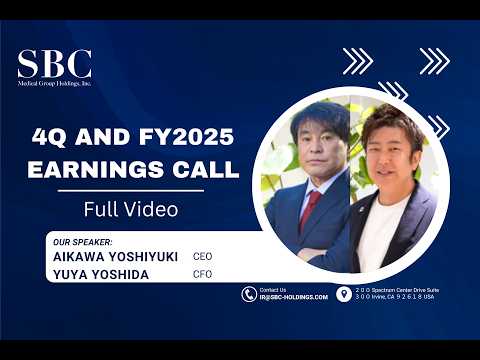
SBC Medical — Investor Video Playlist




Industry Resources
| Industrials Resources |
| IndustryWeek |
| Manufacturing.net |
| Aviation Week |
| Research & Consulting Services Resources |
| Consultancy.org |
| Gartner Research |
| Forrester Insights |
External Quote Links
| Y Finance | Barrons |
| TradingView | Morningstar |
| SeekingAlpha | ValueLine |
| Motley Fool | Robinhood |
| CNBC | Etrade |
| MarketWatch | Unusual Whales |
| YCharts | Perplexity Finance |
| FinViz |
Prefer one of these to Trefis? Tell us why.