
How Tesla Blundered
Three years ago, a rival CEO admitted buyers wanted Teslas and nothing else. Tesla (TSLA) could have been the iPhone of cars. Why is it a rounding error on America’s roads instead? In the analysis below, we look at the blunder, the missed iPhone moment, what Tesla actually got right, and how it can still turn the math around.
Tesla’s robotaxi dream runs on one number, and it isn’t the stock price. It’s how many Teslas are on the road. That’s the number Tesla stopped growing – right after its competitors handed it the market.
Don’t take our word for it. Take Mazda’s.
In November 2023, Mazda’s CEO Masahiro Moro told Fortune: “Other EVs are not taking off, inventory is piling up.” Business Insider’s headline put it more simply: Teslas are the only EVs taking off. Electric cars were about 8% of US sales that year. 57% of them were Teslas.
Read that again. A rival CEO, on the record, saying buyers want your car and nobody else’s.
And he wasn’t the first to notice. Two years earlier, in October 2021, CNBC ran this headline: “Americans are buying Teslas, not EVs.” Tesla had taken 79% of US electric car sales in 2020, according to IHS Markit. The experts in that story said it was about to change. IHS Markit expected Tesla’s share to fall to 20% by 2025, as GM and everyone else flooded in.
Twice. Two years apart. Same message: the customers are waiting for you.
That’s an iPhone moment. Apple (AAPL) got one in 2007 and never let go: today more than half the phones in America are iPhones.
So what did Tesla do with its moment?
It stopped selling more cars. Look at the climb first. 51,000 cars in 2015. About 368,000 in 2019. 936,000 in 2021. 1.81 million in 2023. That’s 35 times in eight years. Phenomenal.
Then 1.79 million in 2024. Then 1.64 million in 2025. Down. Two years in a row. Deliveries are up 8.8% this year through September, but even a big fourth quarter leaves Tesla roughly where it was in 2023.
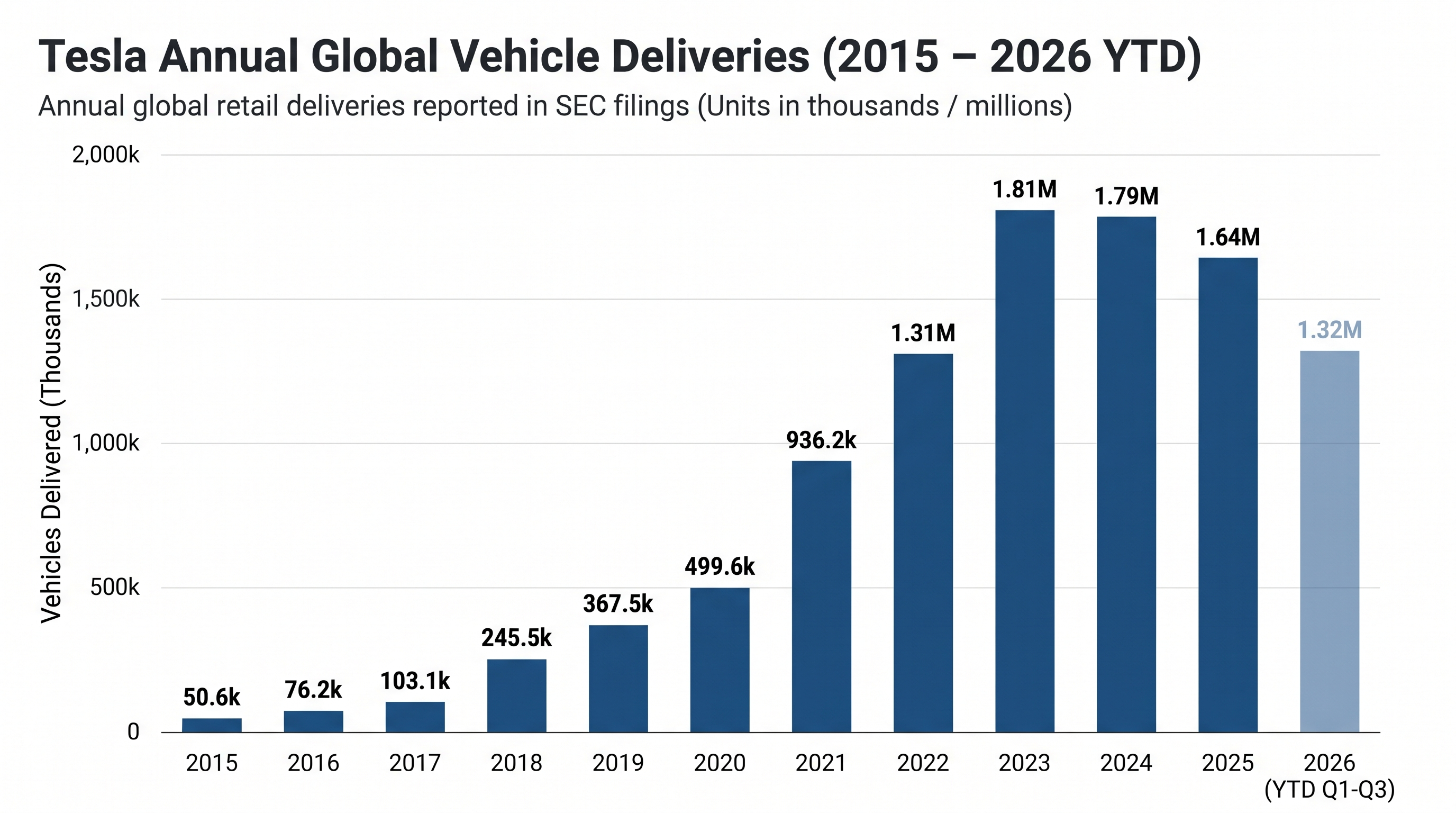
Now remember what Elon Musk once promised he was building toward: 20 million cars a year by 2030 – a target Tesla has since dropped from its filings and replaced with cumulative milestones. At roughly 1.6 million today, the gap between that early ambition and current scale remains stark: twelve times short, with four years to go.
Why does the car count matter so much? Because Tesla bet the company on software. Full Self-Driving. Robotaxis. The pitch is simple: every Tesla becomes a money machine while you sleep. Fine. But software multiplies whatever fleet you give it. A billion iPhones made the App Store. What does 1.6 million cars a year make?
Wall Street still treats that software like gold – just look at Why Tesla Stock Jumped 5% on Monday – where a single European approval and FSD momentum drove a one-day rally. But software only scales as far as the fleet carrying it.
Here’s what it makes today.
America has about 298 million registered vehicles. Tesla reported 1.74 million active FSD subscriptions worldwide in Q3 2026. Put every one of them in an American driveway, and FSD is still in fewer than 1 in 170 vehicles.
Miles? Americans drive about 9 billion a day. FSD drives roughly 30 to 42 million a day, worldwide. That’s about 1 in 250 American miles. Generously.
1 in 250. For the technology the whole valuation leans on.
Getting that number to matter doesn’t just take more factories – it takes putting people in the passenger seat. In Musk’s Massive Marketing Miss Cost $10 Trillion, we look at the free, 30-minute offer Tesla never made to American families to close that gap.
That is a thin base for a $1.5 trillion stock. If Tesla has made you a lot of money, selling some can look like the safe move, until the capital gains bill arrives. Our partner advisory firm can show you how to cut your Tesla risk without handing a big slice of the gain to taxes, on a free 30-minute call.
So how did Tesla blunder? Not by building bad cars. By not building the next one.
The iPhone had a ladder. Last year’s model got cheaper, so anyone could get in. Tesla’s ladder was supposed to be a car at about $25,000. In April 2024, it had been shelved in favor of robotaxis. Musk said Reuters was “lying.” What showed up in October 2025? Stripped-down versions of the same two cars, at $37,000 to $40,000.
Same two cars. Of the 486,532 Teslas delivered last quarter, 478,237 were a Model 3 or Model Y. That’s 98%. The Model 3 went on sale in 2017. Apple has launched a new iPhone every single year since 2007.
Add a CEO who picked political fights with his own customers. Reuters and the AP both tied part of the 2025 drop to a buyer revolt over Musk’s politics. Add BYD, which sold 2.26 million EVs last year, more than Tesla. Add the end of the $7,500 US tax credit in September 2025. Only that last one was out of Tesla’s hands.
And here’s the irony. Moro was right, and so was CNBC. The experts weren’t. Tesla’s share didn’t fall to 20%. It still sells 54% of America’s electric cars. Tesla didn’t lose the EV market. It just never grew the EV market into the car market. That was the job. The cheap car was the tool. Tesla put the tool down.
Does the stock care? Not much, yet. Tesla is worth about $1.5 trillion on $104 billion of revenue. About 12 times sales. Toyota sells roughly six times as many cars and is worth a fraction of that. The market is paying for the robotaxi future, today, at full price. The stock is down 15% this year, so even the faithful are starting to do the math.
Back in Tesla’s Secret Metric, we argued Tesla’s real edge was its time horizon: Musk asks investors to look to 2050, not next quarter. We still think that’s the right lens. But a long time horizon needs a fleet that keeps growing to get there. Patience doesn’t drive miles. Cars do.
Can Tesla fix it? Of course. FSD subscriptions grew 67% in a year. Deliveries are growing again. A real $25,000 Tesla would change the math overnight.
So watch one number when Tesla reports deliveries in early January: deliveries of anything other than a Model 3 or Model Y. In the third quarter, that was just 8,295. Until that number grows, Tesla is a two-car company priced like the iPhone.
And the iPhone never needed a rival CEO to tell it customers were waiting.
Tesla leans on two cars. Plenty of portfolios lean the same way, on a few big names that carry everything. The Trefis High Quality (HQ) Portfolio spreads the bet across 30 quality companies in equal weight, so no single stock carries it. $100,000 put in at its September 2020 launch had grown to more than $205,000 by September 2025. See how HQ is built.