
Should You Buy Oracle Stock Now?
Oracle stock (NYSE: ORCL) has fallen 11% over the last six months, while the broader S&P 500 index has gained 11%. What’s behind this underperformance? Investors are primarily concerned about two things:
- The company’s heavy reliance on debt to fund its massive AI data center expansion, and
- Skepticism about whether its enormous backlog will actually convert into revenue quickly enough.
The debt picture is striking
Oracle’s debt has surged from $93 billion in fiscal 2024 (fiscal year ends in May) to $124 billion as of the latest quarter (Q2 fiscal 2025). While Oracle’s operating cash flow margins have improved – rising to 36.5% from 35.3% in fiscal 2024 – expectations are that this figure will decline in the near term due to soaring capital expenditures. Capex is projected to hit $50 billion this fiscal year, compared with just $7 billion in fiscal 2024 and $21 billion in fiscal 2025.
Despite this underperformance and investor skepticism, we believe ORCL stock is undervalued. But before we answer why it is undervalued, if you seek an upside with less volatility than holding an individual stock like ORCL, consider the High Quality Portfolio. It has comfortably outperformed its benchmark – a combination of the S&P 500, Russell, and S&P MidCap indexes – and has achieved returns exceeding 105% since its inception. Why is that? As a group, HQ Portfolio stocks provided better returns with less risk versus the benchmark index; less of a roller-coaster ride, as evident in HQ Portfolio performance metrics.
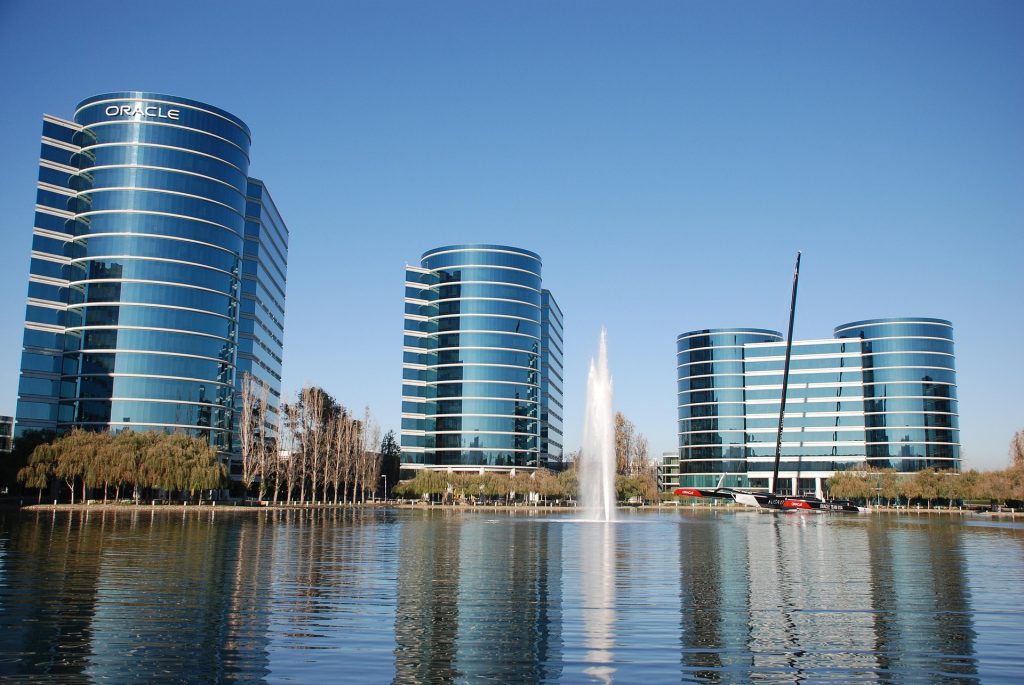
Image by JJ from Pixabay
But gains from the backlog are real
Oracle sits on a whopping $523 billion backlog, and management has raised its guidance for Oracle Cloud Infrastructure sales to top $166 billion by 2030. For perspective, Oracle’s revenue in fiscal 2025 was $57 billion. Approximately 33% of the total RPO (roughly $172 billion) is expected to be recognized as revenue within the next 12 months.
So Oracle is poised for significant sales growth in the coming years. And these aren’t just analyst estimates – this backlog reflects signed deals and the company’s own revenue projections.
What’s driving this surge? The growth is largely attributed to massive, multi-year AI infrastructure contracts with major players, including OpenAI, Meta, and NVIDIA.
And they don’t reflect in the valuation
Oracle stock is currently trading at $205, or 30 times its trailing adjusted earnings of $6.90 per share. Look at our dashboard on Oracle’s Valuation Ratios for more insight into the company’s valuation metrics. The company’s earnings are projected to reach $7.35 in fiscal 2026 and around $8 in fiscal 2027, which brings the forward earnings multiple down to 26-28x. Why does this matter? The last four-year average price-to-earnings ratio for Oracle stock is around 30x. This means that despite the company signing massive contracts and providing clear revenue visibility, the market isn’t applying any premium to its valuation multiples. Just for perspective, Microsoft trades at 34 times trailing earnings, and Amazon at 37 times.
So what are investors really afraid of? Beyond rising debt and capex’s impact on near-term profitability, investors are skeptical about backlog conversion. There are concerns about a “deployment gap” where infrastructure costs outpace immediate revenue generation. Then there’s customer concentration risk: a substantial portion of the RPO is linked to major contracts with specific AI partners like OpenAI. This creates a risk that if these key customers face funding issues or reduced demand, a large part of Oracle’s anticipated revenue could be impacted.
We respect these market concerns, but we still think there’s a lot of pessimism surrounding Oracle. We value Oracle at $300 per share, implying a 46% upside from current levels. This represents 40 times the expected fiscal 2026 earnings of $7.35 per share. We think this higher valuation multiple makes sense given the clear revenue growth visibility, and a company like Oracle shouldn’t face any significant challenges in converting 70% to 80% of the backlog into revenues.
Certainly, we could be wrong in our assessment, and investors should weigh the risks before investing. But if you’re a long-term investor, Oracle stock will likely reward you with robust returns over the next 2-3 years.
That being said, remember, investing in a single stock without comprehensive analysis can be risky. Consider the Trefis Reinforced Value (RV) Portfolio, which has outperformed its all-cap stocks benchmark (combination of the S&P 500, S&P mid-cap, and Russell 2000 benchmark indices) to produce strong returns for investors. Why is that? The quarterly rebalanced mix of large-, mid-, and small-cap RV Portfolio stocks provided a responsive way to make the most of upbeat market conditions while limiting losses when markets head south, as detailed in RV Portfolio performance metrics.
Invest with Trefis Market-Beating Portfolios
See all Trefis Price Estimates