
Wait For A Dip To Buy Oracle Stock?

Last week, Oracle stock (NYSE: ORCL) experienced a 5% dip, a move that coincided with a broader sell-off in some AI-related stocks. This selling was fueled by concerns of a potential bubble forming in the sector, particularly due to the significant capital expenditures being deployed. Despite this recent decline, Oracle has been performing strongly, driven by increasing demand for its cloud services, and the stock is still up over 60% in the last twelve months.
Given this recent downturn—with the stock falling about 10% in a month—a key question for investors is whether ORCL is now a buy or a sell. We recently published an analysis detailing the potential downside for Oracle stock if market conditions sour, and we maintain our view that the stock seems to have little room for growth. While we believe there are minimal concerns about the company’s core operations, its current valuation seems very high.
Our conclusion is based on a comparison of ORCL’s current valuation against its recent operating performance, as well as its historical and current financial condition. Our analysis, which evaluates Oracle on key parameters such as Growth, Profitability, Financial Stability, and Downturn Resilience, indicates that the company maintains a strong operational and financial foundation, as further detailed below.
That being said, if you seek an upside with less volatility than holding an individual stock, consider the High Quality Portfolio. It has comfortably outperformed its benchmark—a combination of the S&P 500, Russell, and S&P MidCap indexes—and has achieved returns exceeding 91% since its inception. Separately, see – SoundHound AI: After 6x Gains, What’s Next For SOUN Stock?
- The Number That Puts Oracle Stock To The Test
- Oracle Is Burning Billions: Is IBM Stock The Smarter Cloud Play?
- Oracle Stock’s High Stakes Gamble
- The Price of Ambition: Is Oracle Stock’s Dip a Warning or a Welcome Mat?
- Oracle Just Showed Wall Street the AI Boom, Then Handed It The Bill
- Did The Market Panic On Oracle’s Best Signal?
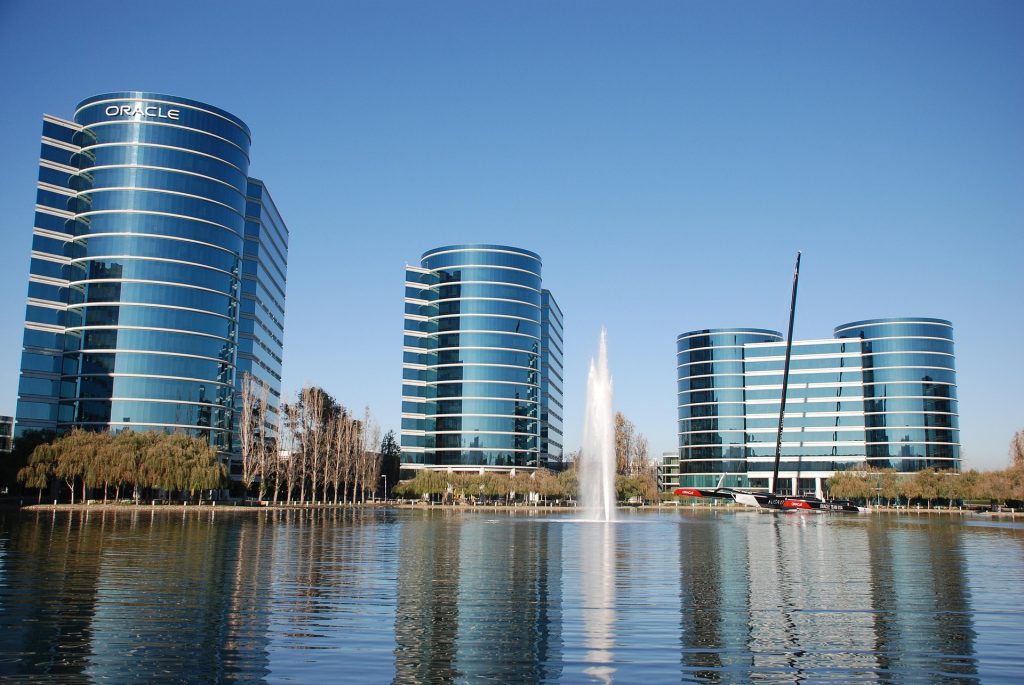
Image by JJ from Pixabay
How Does Oracle’s Valuation Look vs. The S&P 500?
Going by what you pay per dollar of sales or profit, ORCL stock looks very expensive compared to the broader market.
- Oracle has a price-to-sales (P/S) ratio of 11.1 vs. a figure of 3.3 for the S&P 500
- And, it has a price-to-earnings (P/E) ratio of 51.0 vs. the benchmark’s 24.0
How Have Oracle’s Revenues Grown Over Recent Years?
Oracle’s Revenues have seen some growth over recent years.
- Oracle has seen its top line grow at an average rate of 10.7% over the last 3 years (vs. increase of 5.3% for S&P 500)
- Its revenues have grown 8.4% from $53 Bil to $57 Bil in the last 12 months (vs. growth of 5.1% for S&P 500)
- Also, its quarterly revenues grew 11.3% to $16 Bil in the most recent quarter from $14 Bil a year ago (vs. 6.1% improvement for S&P 500)
How Profitable Is Oracle?
Oracle’s profit margins are considerably higher than most companies in the Trefis coverage universe.
- Oracle’s Operating Income over the last four quarters was $18 Bil, which represents a considerably high Operating Margin of 31.5% (vs. 18.6% for S&P 500)
- Oracle’s Operating Cash Flow (OCF) over this period was $21 Bil, pointing to a considerably high OCF Margin of 36.3% (vs. 20.2% for S&P 500)
- For the last four-quarter period, Oracle’s Net Income was $12 Bil – indicating a high Net Income Margin of 21.7% (vs. 12.7% for S&P 500)
Does Oracle Look Financially Stable?
Oracle’s balance sheet looks strong.
- Oracle’s Debt figure was $104 Bil at the end of the most recent quarter, while its market capitalization is $635 Bil (as of 9/1/2025). This implies a very strong Debt-to-Equity Ratio of 16.4% (vs. 20.3% for S&P 500). [Note: A low Debt-to-Equity Ratio is desirable]
- Cash (including cash equivalents) makes up $11 Bil of the $168 Bil in Total Assets for Oracle. This yields a moderate Cash-to-Assets Ratio of 6.7% (vs. 7.2% for S&P 500)
How Resilient Is ORCL Stock During A Downturn?
ORCL stock has been more resilient than the benchmark S&P 500 index during some of the recent downturns. Worried about the impact of a market crash on ORCL stock? Our dashboard – ORCL Down 5.9% In A Day. How Confident Are You In The Stock? – has a detailed analysis of how the stock performed during and after previous market crashes.
Inflation Shock (2022)
- ORCL stock fell 41.1% from a high of $103.65 on 15 December 2021 to $61.07 on 30 September 2022, vs. a peak-to-trough decline of 25.4% for the S&P 500
- The stock fully recovered to its pre-Crisis peak by 25 May 2023
- Since then, the stock has increased to a high of $256.43 on 6 August 2025 and currently trades at around $225
Covid Pandemic (2020)
- ORCL stock fell 28.6% from a high of $55.73 on 12 February 2020 to $39.80 on 12 March 2020, vs. a peak-to-trough decline of 33.9% for the S&P 500
- The stock fully recovered to its pre-Crisis peak by 2 July 2020
Global Financial Crisis (2008)
- ORCL stock fell 41.1% from a high of $23.52 on 8 August 2008 to $13.85 on 9 March 2009, vs. a peak-to-trough decline of 56.8% for the S&P 500
- The stock fully recovered to its pre-Crisis peak by 18 December 2009
Putting All The Pieces Together: What It Means For ORCL Stock
In summary, Oracle’s performance across the parameters detailed above are as follows:
• Growth: Strong
• Profitability: Very Strong
• Financial Stability: Strong
• Downturn Resilience: Strong
• Overall: Strong
Overall, Oracle has performed well across the key metrics we’ve analyzed, which is reflected in its high valuation of 11 times trailing revenue. This is significantly higher than its three-year average price-to-sales ratio of 6 times revenue. Given this extremely high valuation, the stock appears relatively expensive, supporting our conclusion that ORCL is a costly stock to buy right now.
Of course, our assessment could be wrong, and some investors might be willing to pay an even higher multiple for Oracle. This could be driven by the company’s strong projected revenue growth through 2029 and its historical resilience during economic downturns. However, we believe that at 11x, the current valuation already captures these potential positives.
See, there always remains a meaningful risk when investing in a single, or just a handful, of stocks. Consider the Trefis High Quality (HQ) Portfolio which, with a collection of 30 stocks, has a track record of comfortably outperforming the S&P 500 over the last 4-year period. Why is that? As a group, HQ Portfolio stocks provided better returns with less risk versus the benchmark index; less of a roller-coaster ride as evident in HQ Portfolio performance metrics.
Invest with Trefis Market-Beating Portfolios
See all Trefis Price Estimates