
Buy or Sell Moderna Stock At $50?
Moderna stock jumped 16% yesterday following encouraging clinical trial data for its experimental skin cancer vaccine. The company is developing mRNA-4157/V940, a personalized cancer vaccine created in partnership with Merck, which showed promising results in reducing melanoma recurrence when combined with Keytruda immunotherapy. In Phase 2b trials, the combination therapy demonstrated a 49% reduction in recurrence or death risk compared to Keytruda alone after three years of follow-up.
This breakthrough represents a potential expansion beyond Moderna’s COVID-19 vaccine franchise into oncology—a massive addressable market. The melanoma vaccine market alone could be worth billions annually, and success here could validate Moderna’s broader mRNA platform for treating other cancers. Investor enthusiasm is understandable given the transformative potential of personalized cancer vaccines.
But does this make Moderna stock a buy?
Not necessarily. While the clinical progress is genuinely exciting, the investment case remains problematic when you examine the underlying fundamentals.
- Palantir At 80x Earnings: What Revenue Growth Rate Justifies The Valuation?
- Should You Pay Attention To Chevron Stock’s Momentum?
- What Is Happening With Caterpillar Stock?
- What Can Trigger Microsoft Stock’s Slide?
- Is Microsoft Stock A Trap Or A Missed Opportunity?
- Earn 9.6% Today or Buy BSX 30% Cheaper – It’s a Win-Win
That being said, if you seek an upside with less volatility than holding an individual stock like MRNA, consider the High Quality Portfolio. It has comfortably outperformed its benchmark—a combination of the S&P 500, Russell, and S&P MidCap indexes—and has achieved returns exceeding 105% since its inception. Why is that? As a group, HQ Portfolio stocks provided better returns with less risk versus the benchmark index; less of a roller-coaster ride, as evident in HQ Portfolio performance metrics.
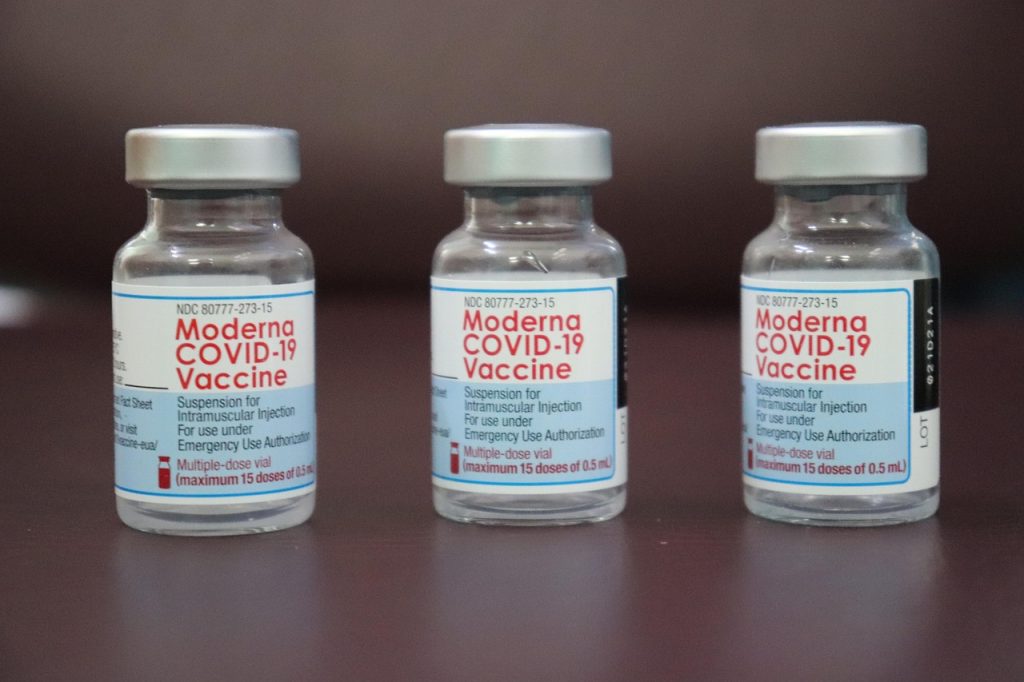
Why does the valuation look stretched? Moderna trades at a price-to-sales ratio of 7.9x—more than double the S&P 500’s 3.3x multiple. Investors are paying nearly $8 for every dollar of revenue the company generates. For this premium to make sense, you’d expect explosive growth or strong profitability. Moderna delivers neither.
How bad is the revenue decline? The numbers tell a sobering story. Moderna’s revenues have collapsed at an average annual rate of 52.3% over the past three years, while the S&P 500 grew 5.6%. In the most recent twelve-month period, revenues plunged 56.4% from $5.1 billion to $2.2 billion. The latest quarter showed revenues falling 46% year-over-year to $1.0 billion.
What’s causing this dramatic decline? The COVID-19 vaccine windfall has essentially evaporated. As pandemic urgency faded and booster uptake declined, Moderna’s core revenue driver disappeared. The company hasn’t yet replaced this lost revenue with meaningful sales from its pipeline products. While the cancer vaccine shows promise, it’s still years away from commercialization and faces regulatory hurdles.
Can Moderna actually make money? Currently, no. The profitability picture is deeply concerning: Moderna’s operating income over the trailing four quarters was negative $3.5 billion, translating to an operating margin of -157.3%. The S&P 500 averages a positive 18.8% margin. Operating cash flow was negative $2.0 billion, indicating an OCF margin of -89.8% versus 20.5% for the broader market. Net income totaled negative $3.1 billion, representing a net margin of -141.5% compared to the S&P 500’s positive 13.1%.
Why is the company bleeding so much cash? Moderna is investing heavily in R&D for its pipeline while facing minimal revenue from products beyond COVID vaccines. The company is essentially burning through its pandemic-era cash reserves to fund development programs. Without near-term commercial successes, these losses will continue mounting.
What about financial strength? Here’s the silver lining—Moderna’s balance sheet remains robust. The company has $734 million in debt against a $19 billion market capitalization, yielding a debt-to-equity ratio of just 4.2% versus 20.1% for the S&P 500. Cash and equivalents total $4.5 billion out of $12 billion in total assets, providing a cash-to-assets ratio of 37.1% compared to 7.2% for the broader market.
How long can this cash cushion last? At the current burn rate of roughly $2 billion annually in operating cash flow, Moderna has approximately two years of runway. The company will either need to achieve commercial success with pipeline products, raise additional capital, or significantly reduce expenses. The strong balance sheet provides breathing room but doesn’t eliminate the urgency around profitability.
How has the stock performed in downturns? Moderna has shown poor resilience during market stress. During the 2022 inflation shock, MRNA plummeted 85.7% from its August 2021 peak of $484.47 to $69.51 by November 2023—far worse than the S&P 500’s 25.4% decline. The stock hasn’t recovered to its previous highs, currently trading around $50 after reaching $166.61 in May 2024. During the COVID pandemic itself, ironically, Moderna fell 42.7% from July to September 2020, though it recovered by November. The pattern suggests high volatility and limited downside protection.
What’s the bottom line? Could we be wrong about this assessment? Absolutely. If the cancer vaccine successfully navigates Phase 3 trials and receives regulatory approval, Moderna could justify its current valuation. Investors betting on the company’s mRNA platform transforming oncology treatment may be willing to overlook near-term financial struggles.
However, the risk-reward profile looks unfavorable. You’re paying premium valuations for a company with collapsing revenues, massive losses, and uncertain pipeline execution. The cancer vaccine news is genuinely positive, but it’s years away from generating meaningful revenue. Meanwhile, the company continues burning cash at an alarming rate.
The overall scorecard reads: very weak growth, very weak profitability, very strong financial stability, and weak downturn resilience. The financial strength provides a margin of safety, but it doesn’t compensate for the fundamental operating challenges. For most investors, the significant execution risk and stretched valuation make Moderna an unattractive investment despite yesterday’s exciting clinical news.
Also, investing in a single stock without comprehensive analysis can be risky. Consider the Trefis Reinforced Value (RV) Portfolio, which has outperformed its all-cap stocks benchmark (combination of the S&P 500, S&P mid-cap, and Russell 2000 benchmark indices) to produce strong returns for investors. Why is that? The quarterly rebalanced mix of large-, mid-, and small-cap RV Portfolio stocks provided a responsive way to make the most of upbeat market conditions while limiting losses when markets head south, as detailed in RV Portfolio performance metrics.
Invest with Trefis Market-Beating Portfolios
See all Trefis Price Estimates