
Up 2x Since March, Is It Time To Exit IPG Photonics Stock?
IPG Photonics stock (NASDAQ: IPGP) is up more than 40% since the beginning of this year, and at the current price around $207 per share, we believe that IPG Photonics stock has over 15% potential downside.
Why is that? Our belief stems from the fact that IPG stock has doubled from its low in March this year, while the S&P has moved a little over 60% in comparison. Further, after posting weak Q3 2020 numbers, and with demand struggling to rise to pre-Covid levels, we believe IPG stock could head lower. Our dashboard What Factors Drove -3% Change In IPG Photonics Stock Between 2017 And Now? provides the key numbers behind our thinking, and we explain more below.
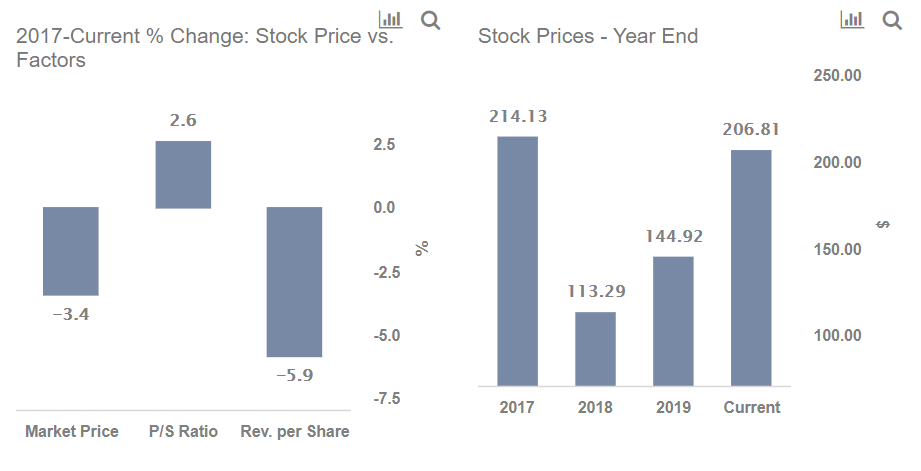
IPG Photonics is a manufacturer of optical fiber lasers, used across a variety of applications such as materials processing, and medical and telecommunication services. IPG saw a 7% drop in revenue between 2017 and 2019, which combined with a meager 1% drop in the outstanding share count, led to revenue per share dropping by 6%.
Further, IPG’s P/S (price-to-sales) ratio shrank from 8.1x in 2017 to 5.8x in 2019, as rising expenses and falling revenues led to a drop in investor expectations. IPG saw a fall in profitability from 2017 to 2019, with EPS dropping from $6.50 to $3.40 over this period. However, IPG’s P/S ratio has since risen to 8.3x currently, riding the rally in semiconductor and technology stocks. We believe given IPG’s weak Q3 ’20 performance, there is a possible downside risk for the P/S multiple.
So what’s the likely trigger and timing to this downside?
The global spread of Coronavirus and the resulting lockdowns have hampered industrial activity, leading to a drop in semiconductor demand from the industrial and materials processing sector. This has hampered demand for IPG’s lasers from these sectors, which is evident from IPG’s Q3 2020 results, where revenue came in at $318 million, down from $329 million for the same period last year. Further, IPG saw a rise in operating expenses, and despite a drop in the effective tax rate (26.2% in Q3 2019 vs 16.4% in Q3 2020), EPS came in significantly lower at $0.67 vs $1.08 for the same period last year.
Going forward, we expect revenues to stay weak in the near to medium term, and if the company is not able to control expenses, we believe the stock will see its P/S multiple decline from the current level of 8.3x to around 7x, which combined with a reduction in revenues and margins could result in the stock price shrinking to as low as $170, a downside of more than 15% from the current price near $207.
What if you’re looking for a more balanced portfolio instead? Here’s a high quality portfolio to beat the market, with over 100% return since 2016, versus 55% for the S&P 500. Comprised of companies with strong revenue growth, healthy profits, lots of cash, and low risk, it has outperformed the broader market year after year, consistently.
See all Trefis Price Estimates and Download Trefis Data here
What’s behind Trefis? See How It’s Powering New Collaboration and What-Ifs For CFOs and Finance Teams | Product, R&D, and Marketing Teams