
Is Rivian’s R2 The Pivot That Could Reprice The Stock?

On April 22, 2026, Rivian (RIVN) commenced customer production of the R2 SUV in Normal, Illinois. The pricey R1 series established the brand. The R2 will determine the business.
Has this happened before? Yes, just look at Tesla (TSLA). Its move from high-end vehicles to the mass-market Model 3 remains the most successful product pivot in EV history, returning over 15x for shareholders since mid-2017.
For early TSLA backers sitting on those massive, concentrated gains, the immediate priority isn’t finding the next EV winner – it is securing zero-cost downside protection without capping the upside. But for investors who missed that wave and are hunting for the next structural pivot, Rivian is now attempting the exact same transition.
What does it mean for the stock?
- The Number That Could Test GE Stock
- The Secret Chipmaker Inside Amazon Stock
- The Supply-Chain Bet That Underpins The NVIDIA Stock Story
- Everyone Is Watching Caterpillar Stock’s AI Story. Watch This Number Instead.
- Micron’s Upbeat Forecast Lifts SOXX Earnings Outlook
- Is The Price You Pay For Vanguard’s VUG Justified?
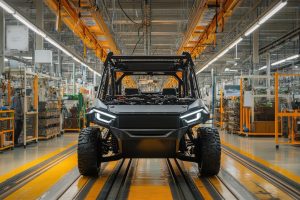
The Vehicle And Market Opportunity
The R2 is priced to reach a significantly larger buyer pool than the R1 series, which starts above $70,000. Units that will start rolling off the line are $58,000 Launch Edition performance models, which will be delivered starting in Spring, offer 330 miles of range, and provide lifetime access to Rivian’s Autonomy+ driver assistance suite. A $45,000 entry-level variant is slated for late 2027. By sequencing higher-margin trims first, Rivian is managing cash flow while working through a substantial reservation backlog. The R2 sits in the heart of the mainstream SUV segment, where volume is measured in millions of units annually rather than hundreds of thousands.
The Economics
The R2 is engineered differently from the R1, and the manufacturing changes are as significant as the price reduction. That matters because Rivian’s operating margin has run at under negative 60% over the last twelve months. See Rivian margins and growth verusus peers like Tesla, Ford (F) and GM (GM)
The R2 does not erase those losses immediately, but it changes the underlying cost structure in ways that could meaningfully improve the trajectory.
Rivian’s zonal electrical architecture, first proven on the Gen 2 R1, further improves in the R2, reducing both control unit count and wiring complexity across the smaller platform. It also moved from 2170 cylindrical battery cells to larger 4695 cells, which carry six times the volumetric capacity. Fewer cells means fewer welds, a simpler assembly process, and a claimed 45% improvement in battery pack assembly efficiency. On the body side, following the Tesla playbook, Rivian introduced large-section die casting, consolidating hundreds of individual stamped components into single structural pieces and reducing both labor requirements and manufacturing variability.
The plant decision may prove equally important. By retooling its existing Illinois facility rather than proceeding with the planned Georgia factory, Rivian preserved $2.25 billion in capital.
Overall consensus projects a 60% revenue growth for FY ’27. Volume is what converts these efficiency gains into margin improvement, and the R2 is Rivian’s first vehicle with the scale potential to deliver it.
The Trade
Tesla trades at 13x forward sales; Rivian sits at 3x, despite being projected to grow at nearly four times Tesla’s pace over the coming year. The gap reflects execution risk, not a verdict on the opportunity.
A few catalysts could close it. The April 30 earnings call is the first test: investors will be looking for concrete R2 production ramp targets. Beyond that, the more important signal will be gross margin progression. If Rivian can demonstrate narrowing losses per vehicle as R2 volume absorbs R1 overhead, the cash burn concern that has weighed on the stock loses its force.
With R2 deliveries underway, Rivian transitions from a company valued on potential to one valued on delivery. If production ramp targets are met, the current multiple may prove conservative.
Besides this, we believe the software and services business, anchored by the Volkswagen platform deal, represents additional upside that is not fully reflected in the valuation. See A $20 Billion Opportunity Hiding Inside Rivian Stock