
The Other Side of Coinbase Stock

Its recent dip is one thing, but its behavior in a true market shock is another. Here is the risk you are carrying.
Coinbase Global (COIN) stock fell 7.1% on June 5th, extending a slide that has it trading about 64% below its 52-week high. The drop follows a tough first quarter report where the financial exchange for digital assets posted a second straight quarterly loss amid a softer trading market. Management highlighted gaining an “all-time high in Coinbase crypto trading volume market share” and new revenue from derivatives, but the market is weighing that against a 21% sequential drop in total revenue.
The recent drop shifts focus to a larger issue: the stock’s behavior during a genuine market shock. Its history shows that when the broader market panics, Coinbase stock tends to fall much harder, a key risk for any portfolio.
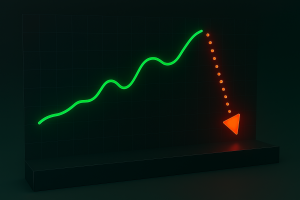
When the Market Breaks, How Hard Does Coinbase Global Fall?
- Micron Traded Its Cost-Cutting Story For A Contract Story
- Why Cleveland-Cliffs Stock Jumped Despite Its Latest Quarterly Loss
- Booz Allen Soared On A Beat, Not A Boom
- Uber Technologies Stock Slides 11% Over 6 Straight Down Days
- CrowdStrike Stock Slides 13% Over 8 Straight Down Days
- Intel More Than Quadrupled In A Year, So Why Has It Cooled
History provides a clear, if sobering, picture. Across the 5 major market shocks it has traded through, Coinbase Global stock fell an average of 37% from peak to trough. For comparison, the S&P 500 fell an average of 13% during those same periods. The stock’s single deepest drawdown was a steep 81%.
Its worst-hit environment has been what analysts call a “Rate & Valuation Shock,” where it has fallen 55% on average. Those were not abstract events; they were the memorable 2022 Inflation Shock & Fed Tightening and the Summer-Fall 2023 Five Percent Yield Shock. When the market catches a cold, this stock has historically caught pneumonia.
Does Coinbase Global Climb Back, Or Stay Down?
The flip side of a steep fall has, in the past, been a relatively quick recovery. Of the shocks it has fully recovered from, the stock took a median of about 4 months to climb back to its pre-shock high. That suggests past dips have behaved more like air pockets than lasting impairments.
However, the slowest recovery took about 26 months, following the 2022 inflation shock. A fast rebound is a pattern, not a promise, and a two-year wait to get back to even can test any investor’s discipline.
Every Major Shock Coinbase Global Has Traded Through
Peak-to-trough drawdown in each shock, and how long the stock took to reclaim its pre-shock high. Stock vs. the S&P 500, long-duration bonds, and its sector.
| Shock Event | Stock | S&P 500 | Bonds | Sector | Recovery |
|---|---|---|---|---|---|
| 2022 Inflation Shock & Fed Tightening | -81% | -24% | -35% | -22% | ~26 mo |
| 2023 SVB Regional Banking Crisis | -14% | -6.7% | -4.3% | -16% | ~4 mo |
| Summer-Fall 2023 Five Percent Yield Shock | -28% | -9.5% | -17% | -11% | ~4 mo |
| 2024 Yen Carry Trade Unwind | -19% | -7.8% | -1.2% | -2.6% | ~4 mo |
| 2025 US Tariff Shock | -41% | -19% | -3.8% | -16% | ~3 mo |
[1] 2022 Inflation Shock & Fed Tightening: 9.1% CPI forced aggressive rate hikes, crushing both stocks and bonds simultaneously.
[2] 2023 SVB Regional Banking Crisis: SVB’s rate-driven bond losses triggered a social-media bank run, seized by FDIC.
[3] Summer-Fall 2023 Five Percent Yield Shock: Strong economic data pushed 10-year yields to 5%, compressing yield-sensitive sector valuations.
[4] 2024 Yen Carry Trade Unwind: BOJ rate hike unwound yen carry trades, briefly crashing tech stocks globally.
[5] 2025 US Tariff Shock: 145% China tariffs crashed equities and the dollar on supply chain disruption fears.
Has Coinbase Global Changed Since Those Crashes?
Of course, Coinbase is not the same company it was during that 2022 crash. Today, management points to real progress in diversifying the business. New ventures like derivatives trading are now generating over $200 million in annualized revenue, and prediction markets are scaling quickly. The company also posted its “12th consecutive quarter of net native unit inflows,” a sign of customer trust even as prices fell.
Yet, the core business remains highly sensitive to crypto market conditions. The latest quarter brought a $394 million net loss and a 21% drop in revenue, driven by a crypto market where trading volumes were down more than 20%. While new revenue streams are growing, they have not yet been large enough to insulate the company from its core cyclicality. The old pattern of amplified downside risk still fits.
Sizing Up Your Coinbase Global Risk
To make this concrete, consider what that deepest 81% drawdown does to a portfolio. On a position sized at 10% of your holdings, it would have cut about 8% from your entire portfolio’s value. At a 20% position weight, that hit becomes about 16%, an impact that can pressure an investor to sell at the worst possible time.
This is the risk you carry. The lever you control is not the market but your exposure. While disciplined position sizing is the practical response, the key factor to watch is whether new revenue streams can grow large enough to finally temper this volatility.
That discipline is exactly what the Trefis High Quality (HQ) Portfolio is built to deliver: it pairs the upside of strong businesses with the stability of a 30-stock portfolio, sized and rebalanced with discipline, and has a track record of outpacing the S&P 500, S&P Mid-Cap, and Russell 2000. Pairing a concentrated holding with an approach like this is how you keep compounding without a single drawdown derailing the plan.