
How Would Your Portfolio Do If You Invested Like The Rich?
The world’s high-net-worth individuals (HNWIs) entered 2025 with portfolios reflecting both caution as well conviction. They have dialed up exposure to equities, kept real estate steady, trimmed back bonds, and parked a strikingly large share in cash. Alternatives like private equity and crypto also remain firmly in play. In short, the wealthy are balancing safety with selective risk-taking as the markets evolve.
Why should this matter to you? Because they act as early signals of where sophisticated capital sees risk and opportunity, often guided by top-tier research and advisors. Retail investors can adapt the same themes through accessible tools such as ETFs, REITs, and bonds to improve long-term outcomes.
Protecting wealth is always a dominant theme in what we do. Trefis works with Empirical Asset Management – a Boston area wealth manager – whose asset allocation strategies yielded positive returns during the 2008-09 period when the S&P lost more than 40%. Empirical has incorporated the Trefis HQ Portfolio in this asset allocation framework to provide clients better returns with less risk versus the benchmark index; less of a roller-coaster ride, as evident in HQ Portfolio performance metrics.
High net worth asset allocation
Here is a quick overview of asset allocation by HNW individuals, based on data from Capgemini Research Institute.
Public Equities (22%)
-
Why: The focus is on growth and allocations have ticked up by about 1% year-over-year. The single biggest draw has been the secular growth story around AI, which is increasingly viewed not just as a technology trend but as a potential driver of industrial transformation.
Fixed Income (18%)
-
Why: Bonds provide safety and income stability. However, allocations are down about 200 bps from last year due to interest rate cuts reducing yields. Investors are trimming exposure, seeing less relative value here.
Real Estate (19%)
-
Why: Viewed as both an inflation hedge and a long-term portfolio diversifier. Allocations are slightly above historical norms, reflecting demand for tangible assets that can preserve value through market cycles.
Alternative Assets (15%)
-
Why: Appetite for diversification and non-traditional sources of return. This includes private equity, hedge funds, commodities, and crypto. Investors are seeking higher returns and uncorrelated assets outside mainstream markets.
-
Private Equity (16% of Alternatives): HNW investors favor private equity for its access to both high-growth and high-value companies outside public markets, offering diversification and better long-term return potential.
-
Cryptocurrencies (15% of Alternatives): Crypto is viewed as a small but high-upside bet, with investors seeing it both as a speculative growth play as well as a hedge against inflation and currency risk.
-
Cash & Cash Equivalents (26%)
-
Why: The single largest allocation, highlighting a premium placed on liquidity and optionality. Holding significant cash reflects caution amid global uncertainty, while positioning investors to quickly seize new opportunities or asset mispricing in markets.
What if you had invested like this in the last 10 years?
SPY delivered higher raw returns over the last decade (13.5% vs 11.8%), but the HNW-style portfolio was far smoother, with volatility of just 10.6% compared to 15.5%. That lower volatility translated into a meaningfully higher Sharpe ratio (92.4% vs 77.6%), meaning better returns per unit of risk. In other words, while you would have given up some annualized return versus going all-in on SPY, you would have massively reduced portfolio volatility while maintaining cash liquidity. That’s might be the essence of smart asset allocation – accepting slightly lower raw returns in exchange for a higher risk-adjusted payoff.
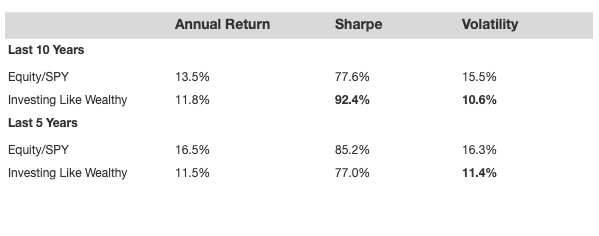
Risk vs. Return
That said, there are some caveats too. Small investors need to be mindful that allocating too much to illiquid assets or paying higher fees can reduce flexibility and drag on returns. Without the same scale, access, and safety net, the risks of over-diversification or concentrated losses are greater.
Bottom Line
The allocations of the millionaires reveal a clear strategy: protect liquidity, pursue growth, and diversify smartly. But are these allocation weights optimized? The possibilities are unlimited – Consider what could long-term performance for your portfolio be if you combined 10% commodities, 10% gold, and 2% crypto with equities?