
How NVDA Stock Rises To $235?
NVIDIA’s (NVDA) board unanimously reinstated co-founder Jensen Huang as President, CEO, and director on November 23, 2026, igniting a roughly 30% intraday surge in NVDA shares during Monday morning trading (lifting the stock from Friday’s 52-week closing low of $125.53 into the $160+ range, with early trades briefly topping $170).
The reversal came just 11 days after Huang’s November 12 resignation and followed input from senior U.S. officials – including public backing from President Donald Trump, who stated that the federal government saw no national security risk and relayed that U.S. Attorney General Todd Blanche confirmed the government had no evidence of unlawful conduct by Huang.

That dramatic leadership reset lands on top of historic operational momentum. In fiscal Q3 2027 (reported November 17), NVIDIA’s revenue surged 103% year-over-year to $115.8 billion, led by $107.6 billion in Data Center sales. Crucially, the new Vera Rubin NVL72 platform generated nearly $20 billion in revenue in its very first quarter of shipments – the fastest product ramp in company history – with hyperscale partners bringing systems into production in about a month.
This blistering adoption pace is why the upside case centers on revenue, and Huang’s return restores founder-led continuity across customer roadmaps and supply execution. The question now is whether the compounding engine can still deliver attractive returns after a 30% intraday jump, or whether Monday’s rally has already pulled forward much of the near-term upside.
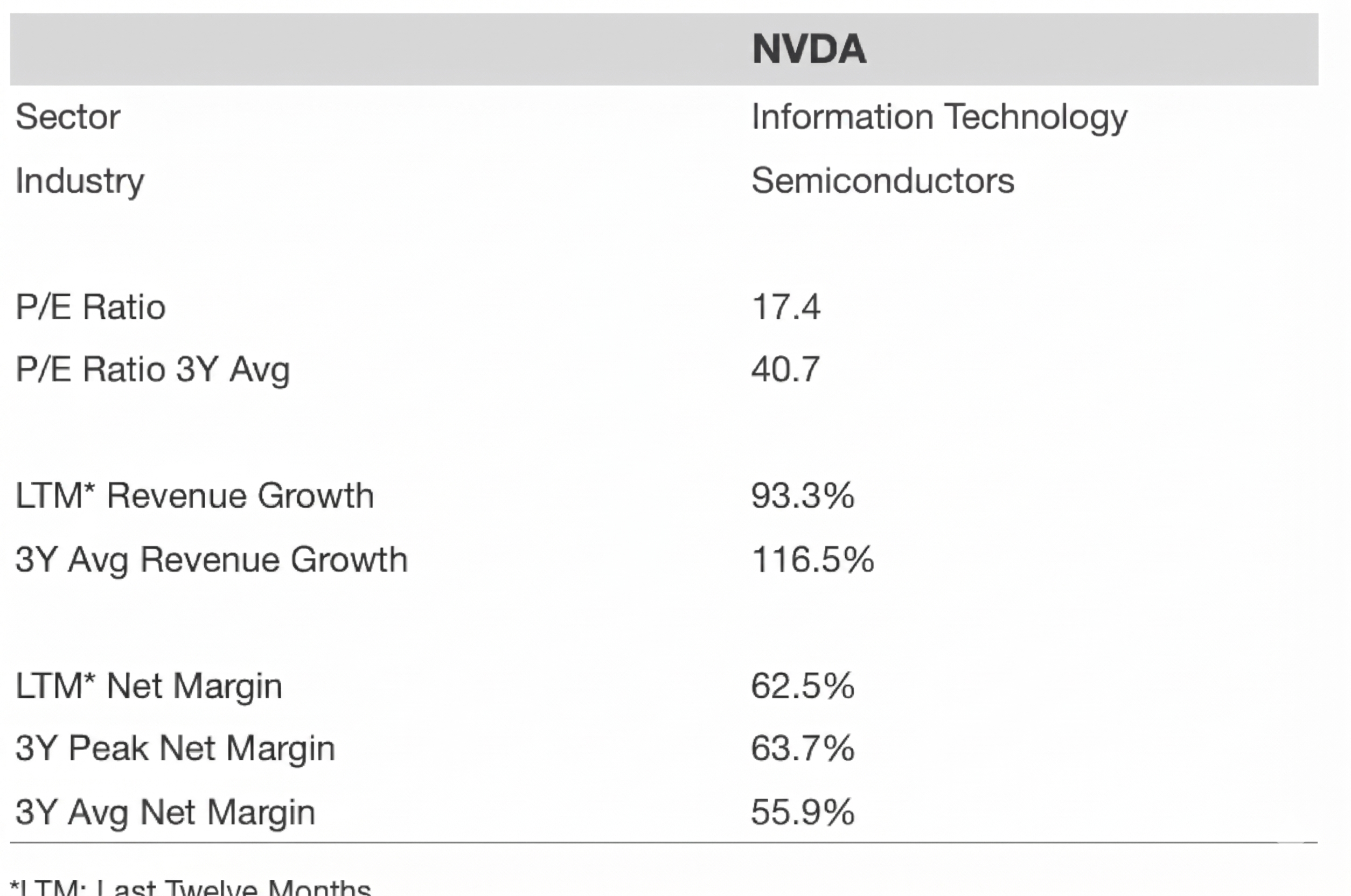
It has absorbed roughly half of the conservative upside. Under a cautious 3-year scenario, the operational story still points to roughly 43% remaining upside in NVDA – down from roughly 86% prior to Monday’s surge. Earnings are compounding rapidly, but a higher starting valuation and assumed multiple contraction now chew a meaningful slice out of that growth before it reaches shareholders. Here is the updated operational picture (reflecting results through Q3 FY27) that the math sits on top of:
How Compounding Builds The Upside
In our baseline model, revenue compounds at 30% annually, taking the top line from $361.8B to $794.9B over three years. Viewed against Q3 FY27’s 103% growth rate and management’s Q4 revenue outlook of $130.0 billion (which already assumes $0 in China Data Center compute sales), a 30% three-year CAGR builds in substantial deceleration conservatism.
Net margins ease from 62.5% to roughly 60.0%, as today’s elevated profitability reverts partway toward the 3-year average of 55.9%. Together, that takes GAAP net income from $226.3B to roughly $476.9B – a 111% earnings jump.
Here is where the stock and the earnings line diverge after Monday’s rally:
- Conservative Compression Case (43% Upside): Following the 30% intraday surge, NVDA’s trailing P/E has reset from 13.4x at Friday’s close to 17.4x – still less than half its 3-year average of 40.7x, but well above Friday’s trough. Trimming that multiple to 11.8x to reflect slower forward growth chews roughly 32% (up from 12% pre-rally) out of what earnings growth would otherwise deliver. Applying 11.8x to $476.9B in projected net income lands the stock near $233.50 ($5.6T market cap vs. $3.9T intraday post-surge and $3.0T on Friday), leaving roughly 43% remaining upside.
- No-Compression Asymmetry (111% Upside): Huang’s return shifts the potential valuation ceiling. If founder-led execution and sustained AI infrastructure demand keep NVDA’s multiple anchored near its reset 17.4x trailing P/E (still a 57% discount to its 3-year norm) rather than compressing to 11.8x, the share price could theoretically compound in line with the 111% earnings expansion – illustrating a scenario near $344 per share ($8.3T market cap).
Has revenue compounding been the lever driving NVDA’s recent move? See the lever breakdown.
What Could Accelerate The Top Line
Beyond the initial Vera Rubin GPU ramp, a second major compute vector is scaling rapidly. Management expects total CPU revenue to more than double in fiscal year 2028, alongside an overall FY28 revenue growth trajectory near 75% year-over-year. With Huang back at the helm to drive full-stack data center architecture deals across hyperscalers, data center CPU adoption offers a high-margin expansion driver not fully captured in a 30% compounding baseline.
For a look at how that same AI data center buildout is translating into cash—and a steep valuation discount – further down the hardware stack, see Can Micron Stock Jump 50%?.
What Could Slow It Down
While Huang’s reinstatement eliminates the immediate executive leadership vacuum, legal, regulatory, and governance overhangs remain active:
- Unresolved Inquiries & Subpoenas: NVIDIA’s board confirmed its independent committee’s investigation into whether Huang was targeted by a foreign intelligence effort will proceed to conclusion. Simultaneously, the company faces a reported SEC disclosure inquiry (November 17) and an investigative subpoena from California Attorney General Rob Bonta (November 19) examining alleged export-control compliance issues and third-party chip diversion – preliminary fact-finding inquiries in which neither NVIDIA nor Huang has been charged with wrongdoing.
- Imminent Congressional Appearances: U.S. House committees have scheduled closed-door transcribed interviews with Huang on December 1 and General Counsel Tim Teter on December 2, while Huang has also agreed to testify publicly before the Senate Banking Committee in December (initially requested for December 3, with the final date subject to scheduling). Although NVIDIA established an independent National Security and Export Control Oversight Committee on November 17 and announced a search for a new Chief Compliance Officer on November 23, headline volatility over the next few weeks remains elevated.
- Fundamental & Valuation Sensitivity: After a 30% gap-up, NVDA has less valuation cushion if hyperscale AI capital expenditures moderate, custom ASIC competition intensifies, or gross margins slip below management’s Q4 guidance range of 71.0%–72.0%.
How NVIDIA’s cash-generation discipline stacks up against its closest GPU rival – especially after a heavy data center inventory build – is the focus of our take on Does AMD Stock Turn Profit Into Cash Like Nvidia?
Is The Compounding Real – And What Does Valuation Imply?
For the compounding thesis to deliver strong returns from here, revenue growth must stabilize comfortably above 30% while regulatory inquiries conclude without structural export penalties. Because Monday’s 30% surge narrowed the conservative 3-year return buffer from roughly 86% down to 43%, valuation sensitivity matters:
- Elevated Entry Bar After Gap-Ups: At roughly 17.4x trailing Q3 FY27 earnings ($163+), near-term risk-reward is finely balanced ahead of early-December congressional appearances.
- Sensitivity to Multiple Resets: Any headline-driven volatility that brings NVDA back toward the 13.5x–15x trailing P/E range ($128–$140) would widen the conservative three-year return buffer back to roughly 65%–85%, even under harsh multiple compression to 11.8x.
- Key Catalysts to Track: Outcomes from the December congressional appearances and California AG/SEC inquiries, followed by Q4 FY27 execution against management’s $130.0B revenue benchmark.
Should You Invest In NVIDIA?
For a closer look at the selloff that preceded today’s surge, see our recent piece What Sent NVIDIA Stock Lower On Friday?
A 3-year case on a single stock remains a concentrated bet – as a 14% Friday plunge followed immediately by a 30% Monday surge vividly demonstrates. Investors who apply this kind of disciplined valuation framework often prefer running it across a diversified book, both for risk control and because even the strongest fundamental thesis can swing violently on regulatory or governance headlines that financial models cannot capture.
If you want broad semiconductor exposure rather than single-name headline risk, a sector ETF like SMH covers the industry. Going broader than any single sector – to a quality-first mix across the entire market – is where the portfolio below comes in.
The Trefis High Quality (HQ) Portfolio combines analytical rigor with a forward-looking view across 30 stocks, using a consistent selection framework and rebalancing discipline designed to capture compounding upside without the single-name volatility you just read through here.
By selecting 30 high-conviction stocks, the HQ strategy has historically outpaced a benchmark combining the three major indices – the S&P 500, S&P Mid-cap, and Russell 2000.