
In 2015, L’Oreal Demonstrated Broad-Based Growth Despite Economic Slowdown
L’Oreal (OTC:LRLCY) posted its Q4 2015 earnings on February 11th. In line with its past quarters, L’Oreal’s performance continued to be aided by currency tailwinds. However, other notable takeaways from the company’s earnings were that some of its acquisitions are helping the company revive in its important markets. For example, L’Oreal’s 2014 acquisition of makeup brand NYX, helped revive the company’s Consumer division business in North America. The Consumer division witnessed significant improvement in performance across different geographies in 2015. Besides, L’Oreal’s sales in most of the emerging markets are growing at a faster pace than the general beauty market growth. All its divisions performed well in 2015, except for a slight decline in like-for-like sales for The Body Shop in the fourth quarter on account of problems in some Asian markets and lackluster demand in North America during the holiday season. For Q4 2015, the company’s revenues grew by 9% year-on-year (~4% like-for-like) to stand at €6.5 billion. For the full fiscal year 2015, L’Oreal’s sales stood at around €25 billion reflecting 12% reported growth (~4% like-for-like growth). ((2015 Annual Results, L’Oreal Press Release, Feb 11, 2016))
We are in the process of updating our $36 price estimate for L’Oreal.
- For 2015, L’Oreal’s Professional segment reported around 12% year-on-year reported growth (~3% like-for-like). The biggest driver was haircare supported by brands such as Pro Fiber and Serioxyl by L’Oréal Professionnel, Chronologiste, Thérapiste and Fusio-Dose by Kérastase, and Frizz Dismiss and Extreme Length by Redken. The top geographies boosting growth in this segment were the U.S., the U.K., and India.
- The Consumer division demonstrated 10% reported growth (~3% like-for-like) with an improved performance in the second half of 2015. The division has made a great comeback and strengthened its dominance in its top category, makeup, where every brand demonstrated impressive growth. Maybelline, regained its popularity in the U.S. and maintained its positions as the number 1 makeup brand in the world. L’Oreal’s NYX continued demonstrating a strong performance. The Consumer division has made an impressive comeback in North America and is enjoying double digit growth in Eastern Europe, Africa, and the Middle East.
- L’Oreal Luxe grew by around 17% in reported terms (6% like-for-like) and exceeded the growth rate of the market primarily due to its makeup and fragrance brands and rising eCommerce sales. Some of the successful brands under this umbrella were: Yves Saint Laurent, Giorgio Armani, Lancôme, and Kiehl’s.
- L’Oreal’s Active Cosmetics grew by almost 10% year-on-year on reported terms (8% like-for-like) and it also outperformed the market growth rate primarily due to brands such as Vichy, La Roche-Posay, Roger&Gallet, etc. The division is witnessing huge growth in the Asia, Pacific, Latin America, Africa, and the Middle East regions.
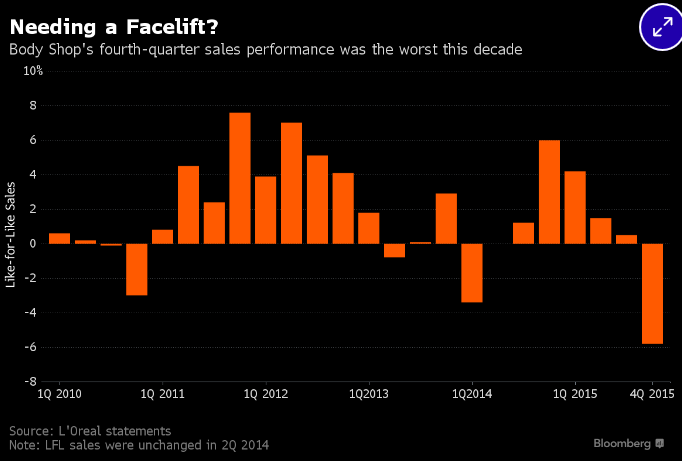
- The only disappointing performance for the company came from The Body Shop which had over 10% reported growth but around a 1% like-for-like decline. The Body Shop recorded its worst quarter in a decade in Q4 2015. The grim Asian markets, such as Hong Kong, and the weak performance in the holiday season in North America were the biggest contributors to the poor performance. [2]
- North America: L’Oreal’s sales grew by around 24% for fiscal 2015 (~4% like-for-like) and the company is witnessing steady improvement of sales in the region. Brands such as L’Oréal Luxe, Urban Decay, Kiehl’s, and Yves Saint Laurent witnessed double-digit growth. L’Oreal’s professional division is showing steady improvement driven mainly by the Redken brand. L’Oreal’s consumer division came out of a slump in 2015 particularly due to the makeup brand NYX (which was acquired in 2014). The NYX brand, which is a direct competitor of Estee Lauder‘s M-A-C brand, has displayed almost 70% growth in sales in the first half of 2015. Brand Maybelline also displayed a steady improvement in sales.
- Western Europe: L’Oreal’s sales grew by almost 5% (~2% like-for-like). The company is growing at a higher pace than the beauty market in this region. The Consumer division is yet to recover in this region with the exception being the Garnier brand which is gaining market share in both haircare and skincare.
- Eastern Europe: This is the only region where the reported sales declined by around 4% (~10% like-for-like growth) due to currency headwinds . The Consumer, Professional, and Luxe all demonstrated growth in double digits due to the healthy performance of Russia, Turkey, and Ukraine. All the divisions are gaining market shares especially the Consumer division in most categories (haircare, hair color, skincare, and deodorants) with brand Maybelline demonstrating the strongest growth.
- Asia Pacific: In 2015, sales in this region grew by 20% (~5% like-for-like) in spite of problems in Hong Kong. L’Oreal Luxe continued growing due to a boost from Japan. Some of the successful brands in Asia Pacific were Yves Saint Laurent, Kiehl’s, Giorgio Armani, and Urban Decay. L’Oreal’s Consumer division demonstrated growth in India, Australia and Thailand, and China.
- Latin America: L’Oreal’s sales grew by less than 1% in Latin America (~5% like-for-like) and was dampened primarily due to Brazil’s grim economic scenario. Excluding Brazil, all other Latin American regions experienced double-digit growth.
- Middle East And Africa: L’Oreal’s sales in this region were over 28% (~12% like-for-like) and regions such as Egypt, Pakistan, and Saudi Arabia demonstrated over 20% growth in 2015. In context of the recent slowdown in beauty across many regions, it is notable to mention that not only did this region not show any signs of slowdown but L’Oreal gained market share in all its divisions in the Middle East and Africa.
Conclusion
The cosmetics leader seems to have revived its performance across its slow performing divisions and geographies through its strategic alliances, digital initiatives, and research and development focus. This is particularly impressive given the economic slowdowns in several geographies at present.
[trefis_slideshow ticker=”LRLCY” rhs=”03″]
View Interactive Institutional Research (Powered by Trefis):
Global Large Cap | U.S. Mid & Small Cap | European Large & Mid Cap
Notes:
- ref:1 [↩] [↩]
- Body Shop’s `Terrible Quarter’ Is L’Oreal’s Sole Blemish: Chart, Bloomberg Business, Feb 12, 2016 [↩]