
Stryker (SYK)
Market Price (10/19/2026): $294.68 | Market Cap: $113.0 BilSector: Health Care | Industry: Health Care Equipment
Stryker (SYK)
Market Price (10/19/2026): $294.68Market Cap: $113.0 BilSector: Health CareIndustry: Health Care Equipment
Investment Highlights Why It Matters Detailed financial logic regarding cash flow yields vs trend-riding momentum.
Attractive operating marginsOp Mgn LTMOperating Margin = Operating Income / Revenue Reflects profitability before taxes and before impact of capital structure (interest payments). is 22% Attractive cash flow generationCFO/Rev LTMCash Flow from Operations / Revenue (Sales), Last Twelve Months (LTM) is 21%, FCF/Rev LTMFree Cash Flow / Revenue (Sales), Last Twelve Months (LTM) is 18%, CFO LTM is 5.5 Bil, FCF LTM is 4.7 Bil Low stock price volatilityVol 12M is 30% Megatrend and thematic driversMegatrends include Aging Population & Chronic Disease, Automation & Robotics, Digital Health & Telemedicine, and Precision Medicine. Show more. | Weak multi-year price returns2Y Excs Rtn is -47%, 3Y Excs Rtn is -58% | Expensive valuation multiplesP/EPrice/Earnings or Price/(Net Income) is 30x Key risksSYK key risks include [1] intense competition from rivals like Medtronic and Johnson & Johnson, Show more. |
| Attractive operating marginsOp Mgn LTMOperating Margin = Operating Income / Revenue Reflects profitability before taxes and before impact of capital structure (interest payments). is 22% |
| Attractive cash flow generationCFO/Rev LTMCash Flow from Operations / Revenue (Sales), Last Twelve Months (LTM) is 21%, FCF/Rev LTMFree Cash Flow / Revenue (Sales), Last Twelve Months (LTM) is 18%, CFO LTM is 5.5 Bil, FCF LTM is 4.7 Bil |
| Low stock price volatilityVol 12M is 30% |
| Megatrend and thematic driversMegatrends include Aging Population & Chronic Disease, Automation & Robotics, Digital Health & Telemedicine, and Precision Medicine. Show more. |
| Weak multi-year price returns2Y Excs Rtn is -47%, 3Y Excs Rtn is -58% |
| Expensive valuation multiplesP/EPrice/Earnings or Price/(Net Income) is 30x |
| Key risksSYK key risks include [1] intense competition from rivals like Medtronic and Johnson & Johnson, Show more. |
Qualitative Assessment
AI Analysis | Feedback
Stryker (SYK) stock has lost about 5% since 6/30/2026 because of the following key factors:
1. Persistent Manufacturing and Supply Chain Disruptions.
Stryker reported a significant supply disruption in its peripheral vascular business during fiscal Q2 2026, leading to lost sales and backorders. The company's CFO later indicated in September 2026 that these manufacturing issues, exacerbated by a 2026 cyberattack, would persist into fiscal Q4 2026, causing the stock to decline by 8.8% on September 8, 2026.
2. Weakening Analyst Sentiment and Price Target Revisions.
Several analyst firms downgraded Stryker's stock or lowered their price targets within the specified period, reflecting a more cautious outlook. For instance, Wall Street Zen downgraded Stryker from a "buy" to a "hold" rating on October 3, 2026, and Wolfe Research lowered its rating from "outperform" to "peer perform" on August 13, 2026. Multiple firms also reduced their price targets, contributing to negative investor sentiment.
Show more
Stryker (SYK) stock has lost about 5% since 6/30/2026 because of the following key factors:
1. Persistent Manufacturing and Supply Chain Disruptions.
Stryker reported a significant supply disruption in its peripheral vascular business during fiscal Q2 2026, leading to lost sales and backorders. The company's CFO later indicated in September 2026 that these manufacturing issues, exacerbated by a 2026 cyberattack, would persist into fiscal Q4 2026, causing the stock to decline by 8.8% on September 8, 2026.
2. Weakening Analyst Sentiment and Price Target Revisions.
Several analyst firms downgraded Stryker's stock or lowered their price targets within the specified period, reflecting a more cautious outlook. For instance, Wall Street Zen downgraded Stryker from a "buy" to a "hold" rating on October 3, 2026, and Wolfe Research lowered its rating from "outperform" to "peer perform" on August 13, 2026. Multiple firms also reduced their price targets, contributing to negative investor sentiment.
3. Significant Insider Selling Activity.
Stryker experienced substantial insider selling during the three months leading up to October 2026, totaling approximately $118.2 million, with no recorded buy orders. A notable transaction included Director Ronda E. Stryker's sale of 50,000 shares valued at over $17 million on August 19, 2026, signaling a lack of strong insider confidence.
4. Slower Demand in Key Segments.
Slower-than-expected hip sales, particularly in Europe, contributed to a softer market for joint replacements during the summer. This decline in demand for a key product segment, alongside ongoing operational challenges, impacted overall growth expectations for the company.
Show less
Stock Movement Drivers
Fundamental Drivers
The -6.1% change in SYK stock from 6/30/2026 to 10/18/2026 was primarily driven by a -15.9% change in the company's P/E Multiple.| (LTM values as of) | 6302026 | 10182026 | Change |
|---|---|---|---|
| Stock Price ($) | 313.85 | 294.66 | -6.1% |
| Change Contribution By: | |||
| Total Revenues ($ Mil) | 25,270 | 25,837 | 2.2% |
| Net Income Margin (%) | 13.2% | 14.4% | 9.3% |
| P/E Multiple | 36.0 | 30.3 | -15.9% |
| Shares Outstanding (Mil) | 383 | 384 | -0.2% |
| Cumulative Contribution | -6.1% |
Market Drivers
6/30/2026 to 10/18/2026| Return | Correlation | |
|---|---|---|
| SYK | -6.1% | |
| Market (SPY) | 2.2% | -1.1% |
| Sector (XLV) | 11.4% | 59.7% |
Fundamental Drivers
The -9.8% change in SYK stock from 3/31/2026 to 10/18/2026 was primarily driven by a -21.3% change in the company's P/E Multiple.| (LTM values as of) | 3312026 | 10182026 | Change |
|---|---|---|---|
| Stock Price ($) | 326.68 | 294.66 | -9.8% |
| Change Contribution By: | |||
| Total Revenues ($ Mil) | 25,116 | 25,837 | 2.9% |
| Net Income Margin (%) | 12.9% | 14.4% | 11.7% |
| P/E Multiple | 38.5 | 30.3 | -21.3% |
| Shares Outstanding (Mil) | 382 | 384 | -0.3% |
| Cumulative Contribution | -9.8% |
Market Drivers
3/31/2026 to 10/18/2026| Return | Correlation | |
|---|---|---|
| SYK | -9.8% | |
| Market (SPY) | 17.7% | -1.3% |
| Sector (XLV) | 21.1% | 60.5% |
Fundamental Drivers
The -19.4% change in SYK stock from 9/30/2025 to 10/18/2026 was primarily driven by a -36.7% change in the company's P/E Multiple.| (LTM values as of) | 9302025 | 10182026 | Change |
|---|---|---|---|
| Stock Price ($) | 365.62 | 294.66 | -19.4% |
| Change Contribution By: | |||
| Total Revenues ($ Mil) | 23,818 | 25,837 | 8.5% |
| Net Income Margin (%) | 12.3% | 14.4% | 17.8% |
| P/E Multiple | 47.9 | 30.3 | -36.7% |
| Shares Outstanding (Mil) | 382 | 384 | -0.3% |
| Cumulative Contribution | -19.4% |
Market Drivers
9/30/2025 to 10/18/2026| Return | Correlation | |
|---|---|---|
| SYK | -19.4% | |
| Market (SPY) | 15.5% | 6.8% |
| Sector (XLV) | 28.6% | 56.1% |
Fundamental Drivers
The 11.1% change in SYK stock from 9/30/2023 to 10/18/2026 was primarily driven by a 32.8% change in the company's Total Revenues ($ Mil).| (LTM values as of) | 9302023 | 10182026 | Change |
|---|---|---|---|
| Stock Price ($) | 265.30 | 294.66 | 11.1% |
| Change Contribution By: | |||
| Total Revenues ($ Mil) | 19,455 | 25,837 | 32.8% |
| Net Income Margin (%) | 13.9% | 14.4% | 3.7% |
| P/E Multiple | 37.2 | 30.3 | -18.5% |
| Shares Outstanding (Mil) | 380 | 384 | -1.0% |
| Cumulative Contribution | 11.1% |
Market Drivers
9/30/2023 to 10/18/2026| Return | Correlation | |
|---|---|---|
| SYK | 11.1% | |
| Market (SPY) | 84.7% | 35.4% |
| Sector (XLV) | 43.7% | 57.2% |
Price Returns Compared
| 2021 | 2022 | 2023 | 2024 | 2025 | 2026 | Total [1] | |
|---|---|---|---|---|---|---|---|
| Returns | |||||||
| SYK Return | 10% | -7% | 24% | 21% | -1% | -16% | 27% |
| Peers Return | 7% | -6% | 10% | 18% | 15% | -9% | 36% |
| S&P 500 Return | 27% | -19% | 24% | 23% | 16% | 14% | 108% |
Monthly Win Rates [3] | |||||||
| SYK Win Rate | 67% | 50% | 67% | 58% | 42% | 50% | |
| Peers Win Rate | 47% | 50% | 48% | 57% | 60% | 42% | |
| S&P 500 Win Rate | 75% | 42% | 67% | 75% | 67% | 50% | |
Max Drawdowns [4] | |||||||
| SYK Max Drawdown | -15% | -31% | -17% | -12% | -15% | -30% | |
| Peers Max Drawdown | -21% | -29% | -22% | -13% | -19% | -32% | |
| S&P 500 Max Drawdown | -5% | -25% | -10% | -8% | -19% | -9% | |
[1] Cumulative total returns since the beginning of 2021
[2] Peers: MDT, JNJ, ZBH, BSX, ISRG. See SYK Returns vs. Peers.
[3] Win Rate = % of calendar months in which monthly returns were positive
[4] Max drawdown represents maximum peak-to-trough decline within a year
[5] 2026 data is for the year up to 10/16/2026 (YTD)
How Low Can It Go
| Event | SYK | S&P 500 |
|---|---|---|
| 2025 US Tariff Shock | ||
| % Loss | -13.0% | -18.8% |
| % Gain to Breakeven | 14.9% | 23.1% |
| Time to Breakeven | 34 days | 79 days |
| Summer-Fall 2023 Five Percent Yield Shock | ||
| % Loss | -12.5% | -9.5% |
| % Gain to Breakeven | 14.3% | 10.5% |
| Time to Breakeven | 35 days | 24 days |
| 2022 Inflation Shock & Fed Tightening | ||
| % Loss | -29.1% | -24.5% |
| % Gain to Breakeven | 41.0% | 32.4% |
| Time to Breakeven | 198 days | 427 days |
| 2020 COVID-19 Crash | ||
| % Loss | -43.8% | -33.7% |
| % Gain to Breakeven | 77.9% | 50.9% |
| Time to Breakeven | 200 days | 140 days |
| Q4 2018 Fed Policy Error / Growth Scare | ||
| % Loss | -17.3% | -19.2% |
| % Gain to Breakeven | 20.9% | 23.8% |
| Time to Breakeven | 37 days | 105 days |
| 2015-2016 China Devaluation / Global Growth Scare | ||
| % Loss | -15.3% | -12.2% |
| % Gain to Breakeven | 18.1% | 13.9% |
| Time to Breakeven | 53 days | 62 days |
In The Past
Stryker's stock fell -13.0% during the 2025 US Tariff Shock. Such a loss loss requires a 14.9% gain to breakeven.
Preserve Wealth
Limiting losses and compounding gains is essential to preserving wealth.
Asset Allocation
Actively managed asset allocation strategies protect wealth. Learn more.
| Event | SYK | S&P 500 |
|---|---|---|
| 2022 Inflation Shock & Fed Tightening | ||
| % Loss | -29.1% | -24.5% |
| % Gain to Breakeven | 41.0% | 32.4% |
| Time to Breakeven | 198 days | 427 days |
| 2020 COVID-19 Crash | ||
| % Loss | -43.8% | -33.7% |
| % Gain to Breakeven | 77.9% | 50.9% |
| Time to Breakeven | 200 days | 140 days |
| 2011 US Debt Ceiling Crisis & European Contagion | ||
| % Loss | -23.0% | -17.9% |
| % Gain to Breakeven | 29.9% | 21.8% |
| Time to Breakeven | 392 days | 123 days |
| 2010 Eurozone Sovereign Debt Crisis / Flash Crash | ||
| % Loss | -21.3% | -15.4% |
| % Gain to Breakeven | 27.1% | 18.2% |
| Time to Breakeven | 173 days | 125 days |
| 2008-2009 Global Financial Crisis | ||
| % Loss | -58.6% | -53.4% |
| % Gain to Breakeven | 141.7% | 114.4% |
| Time to Breakeven | 1653 days | 1085 days |
In The Past
Stryker's stock fell -13.0% during the 2025 US Tariff Shock. Such a loss loss requires a 14.9% gain to breakeven.
Preserve Wealth
Limiting losses and compounding gains is essential to preserving wealth.
Asset Allocation
Actively managed asset allocation strategies protect wealth. Learn more.
About Stryker (SYK)
Stryker Corporation (SYK) is a leading global medical technology company that develops and sells a comprehensive range of innovative products for various medical specialties. The company operates through two main segments: Orthopaedics and Spine, and MedSurg and Neurotechnology, providing essential tools, implants, and equipment that enhance surgical procedures and patient care worldwide.
The Orthopaedics and Spine segment focuses on implants for hip and knee joint replacements, trauma, and extremities surgeries. It also offers a broad portfolio of spinal implant products, including cervical, thoracolumbar, and interbody systems used to treat spinal injuries, deformities, and degenerative conditions. The MedSurg and Neurotechnology segment provides surgical equipment, navigation systems, endoscopic and communication systems, patient handling devices, emergency medical equipment, and neurotechnology products. These neurotechnology offerings include solutions for minimally invasive endovascular techniques, brain surgery, stroke treatment, craniomaxillofacial implants, and orthobiologic products like synthetic bone grafts.
Stryker primarily serves doctors, hospitals, and other healthcare facilities across approximately 75 countries. The company distributes its products through a robust network that includes company-owned subsidiaries and branches, as well as third-party dealers and distributors. This extensive global presence ensures that Stryker's advanced medical technologies are widely accessible to healthcare providers, supporting improved patient outcomes in numerous medical fields.
AI Analysis | Feedback
The Johnson & Johnson for surgical and orthopedic technology.
AI Analysis | Feedback
- Hip and Knee Joint Replacement Implants: Implants designed for use in hip and knee joint replacement surgeries.
- Trauma & Extremities Implants: Implants used in surgeries for trauma and extremities.
- Spinal Implants: Systems including cervical, thoracolumbar, and interbody products for spinal injury, deformity, and degenerative therapies.
- Surgical Equipment & Navigation Systems: Equipment and advanced navigation systems used in various surgical specialties.
- Endoscopic & Communications Systems: Systems for endoscopic procedures and communication within healthcare facilities.
- Patient Handling & Emergency Medical Equipment: Products for patient positioning, transport, and use in emergency medical situations.
- Intensive Care Disposable Products: Disposable items designed for use in intensive care units.
- Reprocessed & Remanufactured Medical Devices: Medical devices that have undergone reprocessing or remanufacturing for safe and effective reuse.
- Minimally Invasive Endovascular Products: Products used in minimally invasive techniques within the body's vascular system.
- Brain & Open Skull Base Surgical Products: Devices and tools for surgical procedures involving the brain and open skull base.
- Orthobiologic & Biosurgery Products: Products like synthetic bone grafts and vertebral augmentation materials.
- Stroke Treatment Products: Minimally invasive products for treating acute ischemic and hemorrhagic stroke.
- Craniomaxillofacial Implants: Implants for cranial, maxillofacial, and chest wall applications, including dural substitutes and sealants.
AI Analysis | Feedback
AI Analysis | Feedback
AI Analysis | Feedback
Kevin A. Lobo, Chairman, CEO & President
Kevin A. Lobo assumed the role of President and CEO of Stryker in October 2012, and became Chairman of the Board in July 2014. He joined Stryker in 2011 as Group President of Orthopaedics. Prior to joining Stryker, Mr. Lobo held senior leadership positions at Johnson & Johnson, including President of Ethicon Endo Surgery, President of J&J Medical Products Canada, and CFO roles within its consumer and women's health divisions. His extensive career also includes finance and management roles at Rhone-Poulenc, Kraft Canada, Unilever, and KPMG. He holds a Bachelor of Commerce from McGill University and an MBA from the University of Toronto. Under his leadership, Stryker has completed more than 60 acquisitions and has expanded its global presence and innovation. He serves on the Boards of Parker Hannifin Corporation and the Advanced Medical Technology Association (AdvaMed).
Preston Wells, Vice President, Chief Financial Officer
Preston Wells was appointed Vice President and Chief Financial Officer, effective April 1, 2025. Before this role, he served as Group CFO for Stryker's Orthopaedics Group. Mr. Wells has held various finance positions at Stryker, including leading Investor Relations and Enterprise Financial Planning & Analysis, and managing sales finance and sales operations for the Spine business. Prior to his time at Stryker, he accumulated 17 years of experience in senior accounting and financial management roles at other companies, including Dialight Corporation and Johnson & Johnson. He holds a bachelor's degree in accounting from Bucknell University and an MBA in Supply Chain Management from Lehigh University.
Spencer S. Stiles, President and Chief Operating Officer
Spencer S. Stiles was appointed President and Chief Operating Officer (COO), effective January 1, 2026. In this role, he is responsible for leading the company's global businesses, strategy, and mergers and acquisitions. A twenty-seven-year Stryker veteran, Mr. Stiles previously served as Group President of Orthopaedics and Spine since 2019. His career at Stryker includes leadership roles across Orthopaedics, MedSurg, and Neurotechnology, as well as overseeing international regions and key supporting functions.
Viju S. Menon, Group President, Global Quality & Operations
Viju S. Menon serves as Group President of Global Quality & Operations. He joined Stryker with extensive experience from various industries. His expertise spans operations management, process optimization, and strategic development, and he has been instrumental in enhancing Stryker's operational efficiencies and supply chain management.
J. Andrew Pierce, Group President, MedSurg & Neurotechnology
J. Andrew Pierce is the Group President of MedSurg & Neurotechnology.
```AI Analysis | Feedback
Key Risks to Stryker's Business
- Cybersecurity Incidents and Supply Chain Disruption: Stryker is currently experiencing a significant cyberattack that has disrupted portions of its global Microsoft environment, impacting order processing, manufacturing, and shipping. This incident, attributed to an Iranian-linked group, is described as a "destructive wiper attack" that may have permanently deleted data rather than holding it for ransom, complicating recovery. Such attacks pose risks of operational delays, potential data integrity issues, unauthorized data release, regulatory scrutiny, litigation, and significant reputational and financial harm, including adverse effects on revenue, operating income, and cash flows.
- Product Liability Lawsuits and Recalls: As a medical technology company, Stryker faces ongoing risks related to product liability lawsuits and potential recalls of its medical devices. Historically, the company has dealt with numerous lawsuits and recalls concerning defective hip and knee implants, such as the Stryker V40 femoral heads and the Rejuvenate Modular and ABG II Modular-Neck Stem hip systems. These issues can lead to substantial financial settlements, legal expenses, and damage to the company's brand reputation and customer trust.
- Intense Competition and Pricing Pressure: The medical device industry is highly competitive, with Stryker competing against large, diversified companies like Medtronic, Johnson & Johnson, Zimmer Biomet, and numerous smaller, specialized firms. This competitive landscape leads to continuous pricing pressure, particularly in international markets such as China and EMEA. To maintain market share and leadership, Stryker must consistently invest in innovation, including robotics and digital ecosystems, to differentiate its products and services, while also navigating hospital budget cyclicality and stringent demands for evidence supporting the value of premium-priced technologies.
AI Analysis | Feedback
AI Analysis | Feedback
Stryker Corporation (SYK) operates in diverse medical technology markets. The addressable market sizes for its main products and services are outlined below:
Orthopaedics and Spine Segment
- Hip and Knee Joint Replacements: The global joint replacement devices market was valued at approximately USD 22.50 billion in 2023 and is projected to grow to USD 31.09 billion by 2030, with a compound annual growth rate (CAGR) of 4.8%. North America held a dominant share of 36.13% in the global orthopedic joint replacement market in 2025. The global market for joint replacement devices was estimated at USD 17.43 billion in 2023 and is forecast to reach USD 27.97 billion by 2032, exhibiting a CAGR of 5.4%. The knee replacement segment alone constituted about 43% of this market in 2020 and 43.0% in 2026.
- Trauma and Extremities Surgeries Implants: The global trauma and extremities devices market was valued at USD 14.17 billion in 2023 and is expected to reach USD 21.49 billion by 2030, growing at a CAGR of 5.2% from 2024 to 2030. North America accounted for the largest share of this market, at 46.2% in 2023, with the U.S. contributing 89.3% of the North American market. Another estimate places the global trauma and extremities market at USD 15,105.60 million in 2025, projected to grow to USD 22,563.68 million by 2032 at a CAGR of 5.9%.
- Spinal Implant Products (Cervical, Thoracolumbar, and Interbody Systems): The global spine and vertebral compression fracture (VCF) market reached USD 21.4 billion in 2024 and is projected to grow to USD 32 billion in the coming years. The global spinal implants market was valued at $11.32 billion in 2022 and is expected to grow to $15.77 billion in 2026, at a CAGR of 8.6%. The Spinal Implants and Surgical Devices Market was valued at USD 14.23 billion in 2026 and is projected to reach USD 18.05 billion by 2031, with a CAGR of 4.86%. The U.S. spinal fusion market was valued at an estimated USD 5.7 billion in 2024 and is expected to reach USD 6.7 billion by 2034, with a CAGR of 1.64%. The global spine devices market is expected to grow at a modest CAGR of 3.9% from 2024 to 2029.
MedSurg and Neurotechnology Segment
- Surgical Equipment and Surgical Navigation Systems: The global surgical navigation systems market was estimated at USD 8.38 billion in 2024 and is projected to reach USD 18.47 billion by 2030, growing at a CAGR of 14.00% from 2025 to 2030. North America held a dominant share of 41.80% in this market in 2024. Other estimates for the global surgical navigation systems market indicate a value of USD 1.35 billion in 2024, projected to grow to USD 2.33 billion by 2034 at a CAGR of 8.3%.
- Endoscopic and Communications Systems: The global endoscopy equipment market is projected to reach USD 53.54 billion by 2030, rising from USD 37.08 billion in 2025, at a CAGR of 7.6%. The U.S. endoscopy devices market size was estimated at USD 21.07 billion in 2023 and is projected to grow at a CAGR of 6.4% from 2024 to 2030. In 2025, the global endoscopy devices market was valued at USD 61.91 billion and is projected to reach USD 84.52 billion by 2034, with a CAGR of 3.56%. North America dominated this market with a 40.68% share in 2025. The global endoscopy visualization systems market size was valued at USD 26.39 billion in 2024 and is projected to grow at a CAGR of 6.3% from 2025 to 2034.
- Patient Handling, Emergency Medical Equipment, and Intensive Care Disposable Products: The global patient handling equipment market was valued at USD 18.0 billion in 2023 and is projected to reach USD 28.2 billion by 2030, growing at a CAGR of 6.6% from 2024 to 2030. North America held the dominant market share, with 36.6% in 2023. The global patient handling equipment market was valued at USD 12.47 billion in 2025 and is projected to grow at a CAGR of 5.8% between 2026 and 2034. The global emergency medical equipment market was valued at USD 26.7 billion in 2023 and is anticipated to reach USD 47.2 billion by 2032, at a CAGR of 6.5%. North America held a 36.3% share of the global emergency medical equipment market in 2023.
- Neurotechnology Products:
- Orthobiologics and Biosurgery Products: The global orthobiologics market size was valued at USD 9.7 billion in 2025 and is projected to grow from USD 10.22 billion in 2026 to USD 15.06 billion by 2034, exhibiting a CAGR of 5.00%. North America dominated this market with a 47.69% share in 2025. The U.S. orthobiologics market is projected to reach USD 3.0 billion by the end of 2024 and grow to USD 4.8 billion by 2033, at a CAGR of 5.4%. The global biosurgery market, valued at US$14.96 billion in 2024, is projected to advance at a CAGR of 6.4% from 2025 to 2030, reaching US$21.59 billion.
- Minimally Invasive Products for Acute Ischemic and Hemorrhagic Stroke Treatment: The global acute ischemic stroke diagnosis and treatment market was estimated to be worth USD 8.27 billion in 2024 and is anticipated to reach USD 34.8 billion by 2035, expanding at a CAGR of 13.96% between 2025 and 2035. The global ischemic stroke market is projected to grow from USD 12.6 billion in 2024 to USD 18.7 billion by 2030, at a CAGR of 6.8%. The global neurovascular devices market is projected to reach USD 7.22 billion in 2030 from USD 4.64 billion in 2025, with a CAGR of 9.3%. The global hemorrhagic and ischemic stroke treatment devices market is valued at USD 4.03 billion in 2025 and is predicted to reach USD 7.65 billion by 2035, growing at a 6.8% CAGR. The overall stroke market size was USD 39.72 billion in 2025, expected to grow to USD 64.75 billion in 2030 at a CAGR of 10.2%.
- Craniomaxillofacial Implant Products: The global craniomaxillofacial devices market was valued at USD 2.2 billion in 2024 and is estimated to reach USD 4.2 billion by 2033, exhibiting a CAGR of 7.1% from 2025-2033. North America holds a significant share of this market at 78.0%. The U.S. craniomaxillofacial devices market size was exhibited at USD 2.35 billion in 2025 and is projected to hit around USD 5.82 billion by 2035, growing at a CAGR of 9.5%. The global craniomaxillofacial implants market was valued at USD 2.23 billion in 2025 and is projected to grow from USD 2.44 billion in 2026 to USD 5.11 billion by 2034, at a CAGR of 9.66%.
AI Analysis | Feedback
Expected Drivers of Future Revenue Growth for Stryker (SYK)
Stryker Corporation (SYK) is poised for continued revenue growth over the next two to three years, driven by several strategic initiatives and strong market dynamics. Key drivers include sustained product innovation, particularly within its robotic-assisted surgery platforms, a proactive mergers and acquisitions (M&A) strategy, expansion into international and emerging markets, robust performance in high-demand product segments, and a growing focus on digital health solutions.1. Continued Product Innovation and Robotic-Assisted Surgery Platforms
Stryker's commitment to innovation, especially through its Mako robotic-assisted surgery system, is expected to be a primary driver of future revenue. The Mako system has consistently driven growth, with its installed base surpassing 3,000 systems worldwide and contributing to strong organic sales growth in Orthopaedics, particularly in knee and hip procedures. Recent advancements, such as the launch of Mako 4 and its expanded capabilities for primary hip cases and revisions, along with the introduction of the Mako RPS (Robotic Power System) for Total Knee, are anticipated to further enhance its market presence and adoption. Beyond Mako, new product launches across its portfolio, including devices like the Artix Thrombectomy System, Steri-Shield 8, and Sync Badge, demonstrate a consistent pipeline of innovative solutions aimed at addressing evolving healthcare needs and improving patient outcomes.2. Strategic Mergers and Acquisitions (M&A)
Stryker has a stated strategy of utilizing M&A as a significant avenue for growth, with the company's CEO highlighting it as the "number one use of cash going forward." This aggressive and focused approach has seen Stryker complete numerous acquisitions, which have historically contributed to substantial revenue increases. A notable recent example is the acquisition of Inari Medical in February 2025, which has significantly strengthened Stryker's position in the high-growth peripheral vascular segment and is expected to continue driving robust procedural growth. The company maintains a healthy deal pipeline, indicating a continued focus on acquiring businesses that complement its existing portfolio and expand into high-growth medtech markets.3. Expansion in International and Emerging Markets
International markets represent a substantial opportunity for Stryker's future growth. The company has explicitly stated its view of these markets as a "big opportunity" and has seen notable contributions from regions like South Korea and other emerging markets. Key product approvals in Europe, such as for Insignia hip stems and Pangea plating systems, are expected to accelerate international sales as these products have already demonstrated strong traction in the U.S. Stryker's diversified global presence, with approximately one-fourth of its revenue generated from international markets, provides a solid foundation for continued expansion and market penetration in the coming years.4. Growth in High-Demand Product Segments and Increased Procedural Volumes
Stryker anticipates sustained healthy procedural volumes across its diverse business segments, contributing significantly to revenue growth. The MedSurg and Neurotechnology segment has shown strong organic sales growth, driven by robust performance in instruments, endoscopy, medical, vascular, and neuro cranial products. Specifically, the vascular business experienced a substantial increase in fiscal year 2025, largely due to the Inari Medical acquisition. In Orthopaedics, strong demand for knees, hips, and trauma and extremities products, partly fueled by the Mako system, is expected to persist. The neurovascular products market, with an estimated global total addressable market of $4 billion and a high single-digit compound annual growth rate through 2026, also presents a strong growth avenue.5. Expansion into Digital Health and Connected Hospital Solutions
Stryker is strategically expanding its presence in the digital health sector, exemplified by the recent launch of its SmartHospital Platform in March 2026. This platform aims to unify devices, data, and care teams to streamline hospital operations and enhance healthcare efficiency. This initiative positions Stryker more prominently in the digital health and connected hospital segment, adding a software and services layer to its traditional medical device offerings. The creation of the SmartCare business unit, which combines Vocera and care.ai, further underscores Stryker's commitment to leveraging digital solutions for future growth. This shift is expected to influence the product mix, potentially leading to increased recurring revenue from digital offerings.AI Analysis | Feedback
Share Repurchases
- Stryker completed the repurchase of over 7 million shares for approximately US$967 million as part of a buyback program initially announced in 2015, as of November 2025.
- In fiscal year 2024, the company's share repurchases amounted to $195 million.
- As of June 30, 2021, Stryker had an authorized share repurchase program with $1,033 million remaining, though the company intended to suspend repurchases through 2021.
Share Issuance
- In May 2025, shareholders approved amendments and restatements to the 2011 Long-Term Incentive Plan, the 2011 Performance Incentive Award Plan, and the 2008 Employee Stock Purchase Plan, which aim to increase the number of shares available under these plans and extend their duration.
- The company grants equity-based compensation awards on pre-determined dates, with annual grants typically made at the February Board meeting and acquisition-related grants often occurring on the acquisition closing date or employment start date.
Outbound Investments
- In January 2025, Stryker entered a definitive agreement to acquire Inari Medical, Inc. for approximately $4.9 billion in cash to expand its presence in the high-growth peripheral vascular segment, particularly for venous thromboembolism (VTE) treatment.
- In January 2022, Stryker acquired Vocera Communications for $3.1 billion to enhance its digital coordination and communication capabilities within medical solutions.
- Stryker has pursued a continuous acquisition strategy, including OrthoSensor (2021) for smart device technologies, TMJ Concepts (2021) for patient-specific joint reconstruction, Cerus (2023) for neurovascular products, and multiple undisclosed acquisitions in 2024 such as MOLLI Surgical Inc., Artelon, care.ai, Vertos Medical, and NICO.
Capital Expenditures
- Stryker's capital expenditures for fiscal years 2021 to 2025 averaged $640.8 million.
- Capital expenditures peaked at $761 million in December 2025 and reached a five-year low of $525 million in December 2021. In 2024, capital expenditures were $755 million.
- These expenditures are primarily focused on funding ongoing research and development and expanding manufacturing capabilities, particularly benefiting sales of implants, robotics, and capital equipment.
Peer Outperformance in Health Care Equipment
| Ticker | Name | Rev Growth 3Y Avg | P/E | 1Y | 3Y | 5Y | 5Y Gap |
|---|---|---|---|---|---|---|---|
| SYK | Stryker | 9.9% | 30.3x | -20.4% | 13.1% | 18.5% | — |
| ITGR | Integer | 8.4% | 33.6x | 20.9% | 74.5% | 44.6% | +26pp |
| Industry | Names | 1Y med | 3Y med | 5Y med | Top 3 by 5Y |
|---|---|---|---|---|---|
| Health Care Distributors | 6 | 17.1% | 54.9% | 108.3% | CAH 490% · MCK 413% · COR 204% |
| Health Care Services | 20 | 17.0% | 37.2% | 11.9% | HIMS 253% · RDNT 137% · DGX 80% |
| Managed Health Care | 8 | 38.6% | -3.3% | 5.8% | OSCR 115% · HQY 45% · ELV 19% |
| Health Care Facilities | 24 | 3.4% | 12.3% | 3.8% | THC 324% · NHC 294% · EHC 147% |
| Health Care Equipment ← | 50 | -4.4% | 3.3% | -11.4% | UFPT 353% · GKOS 263% · TMDX 169% |
| Pharmaceuticals | 61 | -10.5% | 0.5% | -32.8% | LQDA 876% · KNSA 635% · CORT 481% |
| Health Care Supplies | 11 | 14.7% | -7.3% | -40.4% | LNTH 338% · HAE 76% · MMSI 29% |
| Life Sciences Tools & Services | 108 | -12.7% | -14.3% | -67.6% | NTRA 253% · MEDP 233% · GH 59% |
| Biotechnology | 363 | -26.7% | -27.3% | -82.0% | DNTH 1009% · ELVN 893% · ADMA 871% |
| Health Care Technology | 22 | -33.5% | -62.9% | -83.9% | VEEV 0% · DOCS -56% |
Latest Trefis Analyses
Research & Analysis
Invest in Strategies
Wealth Management
Peer Comparisons
| Peers to compare with: |
Financials
| Median | |
|---|---|
| Name | |
| Mkt Price | 175.12 |
| Mkt Cap | 117.2 |
| Rev LTM | 23,416 |
| Op Inc LTM | 5,012 |
| FCF LTM | 3,962 |
| FCF 3Y Avg | 3,033 |
| CFO LTM | 5,027 |
| CFO 3Y Avg | 4,192 |
Growth & Margins
| Median | |
|---|---|
| Name | |
| Rev Chg LTM | 9.2% |
| Rev Chg 3Y Avg | 8.0% |
| Rev Chg Q | 8.5% |
| QoQ Delta Rev Chg LTM | 2.0% |
| Op Inc Chg LTM | 20.9% |
| Op Inc Chg 3Y Avg | 11.5% |
| Op Mgn LTM | 21.4% |
| Op Mgn 3Y Avg | 19.7% |
| QoQ Delta Op Mgn LTM | 0.5% |
| CFO/Rev LTM | 21.5% |
| CFO/Rev 3Y Avg | 20.9% |
| FCF/Rev LTM | 17.3% |
| FCF/Rev 3Y Avg | 16.2% |
Segment Financials
Revenue by Segment| $ Mil | 2025 | 2024 | 2023 | 2022 | 2021 |
|---|---|---|---|---|---|
| MedSurg and Neurotechnology | 15,647 | 13,518 | 12,163 | 10,893 | 9,538 |
| Orthopaedics | 9,469 | 9,077 | 8,335 | 7,556 | |
| Orthopaedics and Spine | 7,570 | ||||
| Total | 25,116 | 22,595 | 20,498 | 18,449 | 17,108 |
| $ Mil | 2025 | 2024 | 2023 | 2022 | 2021 |
|---|---|---|---|---|---|
| MedSurg and Neurotechnology | 4,672 | 4,004 | 3,470 | 2,831 | 2,807 |
| Orthopaedics | 2,820 | 2,591 | 2,265 | 2,202 | |
| Regulatory and legal matters | -17 | -36 | -92 | -76 | 2 |
| Medical device regulation | -38 | -58 | -96 | -140 | -107 |
| Recall-related matters | -58 | -40 | -18 | 15 | -103 |
| Goodwill and other impairments | -170 | -977 | -36 | -270 | |
| Inventory stepped up to fair value | -173 | -46 | 0 | 0 | |
| Structural optimization and other special charges | -191 | -138 | -170 | -295 | -386 |
| Acquisition and integration-related charges | -335 | -108 | -20 | -138 | -585 |
| Amortization of intangible assets | -732 | -623 | -635 | -627 | -619 |
| Corporate and Other | -889 | -880 | -780 | -649 | -605 |
| Orthopaedics and Spine | 2,180 | ||||
| Total | 4,889 | 3,689 | 3,888 | 2,853 | 2,584 |
| $ Mil | 2025 | 2024 | 2023 | 2022 | 2021 |
|---|---|---|---|---|---|
| MedSurg and Neurotechnology | 27,647 | 23,115 | 20,514 | 18,283 | 15,218 |
| Orthopaedics | 18,641 | 18,507 | |||
| Corporate and Other | 1,556 | 1,349 | 1,085 | 1,306 | 1,264 |
| Orthopaedics and Spine | 18,313 | 17,295 | 18,149 | ||
| Total | 47,844 | 42,971 | 39,912 | 36,884 | 34,631 |
Price Behavior
| Market Price | $294.66 | |
| Market Cap ($ Bil) | 113.0 | |
| First Trading Date | 02/01/1988 | |
| Distance from 52W High | -23.3% | |
| 50 Days | 200 Days | |
| DMA Price | $299.23 | $324.82 |
| DMA Trend | down | down |
| Distance from DMA | -1.5% | -9.3% |
| 3M | 1YR | |
| Volatility | 36.0% | 30.1% |
| Downside Capture | 71.04 | 32.29 |
| Upside Capture | 19.07 | 1.46 |
| Correlation (S&P 500) | 0.9% | 7.1% |
| 1M | 2M | 3M | 6M | 1Y | 3Y | |
|---|---|---|---|---|---|---|
| Beta | 0.46 | 0.66 | -0.12 | -0.06 | 0.15 | 0.56 |
| Up Beta | -0.52 | -0.14 | -0.87 | 0.12 | 0.29 | 0.66 |
| Down Beta | 1.29 | 3.16 | 0.16 | -0.06 | 0.09 | 0.58 |
| Up Capture | -35% | 7% | -21% | -22% | -3% | 16% |
| Bmk +ve Days | 6 | 16 | 27 | 66 | 132 | 424 |
| Stock +ve Days | 7 | 17 | 29 | 61 | 118 | 378 |
| Down Capture | 238% | 170% | 55% | 13% | 41% | 78% |
| Bmk -ve Days | 16 | 26 | 37 | 60 | 120 | 328 |
| Stock -ve Days | 15 | 25 | 35 | 64 | 133 | 373 |
[1] Upside and downside betas calculated using positive and negative benchmark daily returns respectively
Based On 1-Year Data
| Annualized Return | Annualized Volatility | Sharpe Ratio | Correlation with SYK | |
|---|---|---|---|---|
| SYK | -19.5% | 30.1% | -0.71 | - |
| Sector ETF (XLV) | 25.7% | 16.1% | 1.22 | 57.9% |
| Equity (SPY) | 15.8% | 12.7% | 0.86 | 6.0% |
| Gold (GLD) | -1.4% | 29.4% | -0.05 | -0.8% |
| Commodities (DBC) | 52.4% | 20.7% | 1.92 | -24.8% |
| Real Estate (VNQ) | 4.8% | 13.7% | 0.09 | 38.4% |
| Bitcoin (BTCUSD) | -26.5% | 43.6% | -0.59 | -5.0% |
Smart multi-asset allocation framework can stack odds in your favor. Learn How
Based On 5-Year Data
| Annualized Return | Annualized Volatility | Sharpe Ratio | Correlation with SYK | |
|---|---|---|---|---|
| SYK | 3.3% | 25.7% | 0.11 | - |
| Sector ETF (XLV) | 8.5% | 15.2% | 0.36 | 61.3% |
| Equity (SPY) | 13.2% | 17.1% | 0.59 | 51.9% |
| Gold (GLD) | 18.4% | 18.9% | 0.79 | 6.6% |
| Commodities (DBC) | 9.9% | 19.5% | 0.39 | -0.3% |
| Real Estate (VNQ) | 1.6% | 18.8% | -0.02 | 51.4% |
| Bitcoin (BTCUSD) | 8.6% | 51.8% | 0.34 | 17.9% |
Smart multi-asset allocation framework can stack odds in your favor. Learn How
Based On 10-Year Data
| Annualized Return | Annualized Volatility | Sharpe Ratio | Correlation with SYK | |
|---|---|---|---|---|
| SYK | 10.9% | 27.0% | 0.41 | - |
| Sector ETF (XLV) | 11.3% | 16.7% | 0.55 | 66.6% |
| Equity (SPY) | 15.2% | 17.9% | 0.72 | 63.1% |
| Gold (GLD) | 12.3% | 16.4% | 0.61 | 4.3% |
| Commodities (DBC) | 8.3% | 18.1% | 0.37 | 14.4% |
| Real Estate (VNQ) | 5.2% | 20.7% | 0.21 | 58.7% |
| Bitcoin (BTCUSD) | 63.1% | 66.2% | 1.03 | 15.7% |
Smart multi-asset allocation framework can stack odds in your favor. Learn How
Returns Analyses
Earnings Returns History
Updated 9/1/2026| Forward Returns | |||
|---|---|---|---|
| Earnings Date | 1D Returns | 5D Returns | 21D Returns |
| 7/30/2026 | -6.4% | -3.0% | -5.0% |
| 4/30/2026 | -6.5% | -6.6% | -5.0% |
| 1/29/2026 | 4.3% | 2.3% | 9.2% |
| 10/30/2025 | -3.5% | -4.1% | -0.6% |
| 7/31/2025 | -3.8% | -4.2% | -0.3% |
| 5/1/2025 | 1.1% | 2.3% | 1.8% |
| 1/28/2025 | -1.0% | -0.7% | -1.6% |
| 10/29/2024 | 1.2% | 3.0% | 8.1% |
| ... | |||
| SUMMARY STATS | |||
| # Positive | 9 | 11 | 15 |
| # Negative | 15 | 13 | 9 |
| Median Positive | 2.9% | 2.5% | 4.6% |
| Median Negative | -2.1% | -3.6% | -5.0% |
| Max Positive | 9.9% | 7.3% | 13.6% |
| Max Negative | -6.5% | -6.9% | -9.3% |
| Forward Returns | |||
|---|---|---|---|
| Earnings Date | 1D Returns | 5D Returns | 21D Returns |
| 7/30/2026 | -6.4% | -3.0% | -5.0% |
| 4/30/2026 | -6.5% | -6.6% | -5.0% |
| 1/29/2026 | 4.3% | 2.3% | 9.2% |
| 10/30/2025 | -3.5% | -4.1% | -0.6% |
| 7/31/2025 | -3.8% | -4.2% | -0.3% |
| 5/1/2025 | 1.1% | 2.3% | 1.8% |
| 1/28/2025 | -1.0% | -0.7% | -1.6% |
| 10/29/2024 | 1.2% | 3.0% | 8.1% |
| 7/30/2024 | -0.8% | -2.3% | 7.9% |
| 4/30/2024 | -2.5% | -1.3% | 1.2% |
| 1/30/2024 | 5.9% | 7.3% | 10.2% |
| 11/2/2023 | -0.7% | -2.7% | 4.6% |
| 8/3/2023 | 2.9% | 2.7% | 3.2% |
| 5/1/2023 | -2.0% | -3.9% | -8.1% |
| 1/31/2023 | 9.9% | 7.3% | 3.3% |
| 10/31/2022 | -4.0% | -6.9% | 2.0% |
| 7/26/2022 | 3.6% | 4.3% | 4.0% |
| 4/28/2022 | -4.3% | -4.3% | -6.2% |
| 1/27/2022 | 1.2% | 2.2% | 7.3% |
| 10/28/2021 | -0.9% | 0.6% | -9.3% |
| 7/27/2021 | 0.1% | -0.1% | 1.2% |
| 4/27/2021 | -2.1% | -3.6% | -4.8% |
| 1/27/2021 | -0.3% | 1.4% | 5.2% |
| 10/29/2020 | -1.6% | 2.5% | 13.6% |
| SUMMARY STATS | |||
| # Positive | 9 | 11 | 15 |
| # Negative | 15 | 13 | 9 |
| Median Positive | 2.9% | 2.5% | 4.6% |
| Median Negative | -2.1% | -3.6% | -5.0% |
| Max Positive | 9.9% | 7.3% | 13.6% |
| Max Negative | -6.5% | -6.9% | -9.3% |
SEC Filings
Expand for More| Report Date | Filing Date | Filing |
|---|---|---|
| 06/30/2026 | 07/31/2026 | 10-Q |
| 03/31/2026 | 05/11/2026 | 10-Q |
| 12/31/2025 | 02/11/2026 | 10-K |
| 09/30/2025 | 10/31/2025 | 10-Q |
| 06/30/2025 | 08/01/2025 | 10-Q |
| 03/31/2025 | 05/02/2025 | 10-Q |
| 12/31/2024 | 02/12/2025 | 10-K |
| 09/30/2024 | 10/30/2024 | 10-Q |
| 06/30/2024 | 07/31/2024 | 10-Q |
| 03/31/2024 | 05/01/2024 | 10-Q |
| 12/31/2023 | 02/14/2024 | 10-K |
| 09/30/2023 | 11/03/2023 | 10-Q |
| 06/30/2023 | 08/04/2023 | 10-Q |
| 03/31/2023 | 05/02/2023 | 10-Q |
| 12/31/2022 | 02/10/2023 | 10-K |
| 09/30/2022 | 11/01/2022 | 10-Q |
| Report Date | Filing Date | Filing |
|---|---|---|
| 06/30/2026 | 07/31/2026 | 10-Q |
| 03/31/2026 | 05/11/2026 | 10-Q |
| 12/31/2025 | 02/11/2026 | 10-K |
| 09/30/2025 | 10/31/2025 | 10-Q |
| 06/30/2025 | 08/01/2025 | 10-Q |
| 03/31/2025 | 05/02/2025 | 10-Q |
| 12/31/2024 | 02/12/2025 | 10-K |
| 09/30/2024 | 10/30/2024 | 10-Q |
| 06/30/2024 | 07/31/2024 | 10-Q |
| 03/31/2024 | 05/01/2024 | 10-Q |
| 12/31/2023 | 02/14/2024 | 10-K |
| 09/30/2023 | 11/03/2023 | 10-Q |
| 06/30/2023 | 08/04/2023 | 10-Q |
| 03/31/2023 | 05/02/2023 | 10-Q |
| 12/31/2022 | 02/10/2023 | 10-K |
| 09/30/2022 | 11/01/2022 | 10-Q |
| 06/30/2022 | 07/27/2022 | 10-Q |
| 03/31/2022 | 04/29/2022 | 10-Q |
| 12/31/2021 | 02/11/2022 | 10-K |
| 09/30/2021 | 10/29/2021 | 10-Q |
| 06/30/2021 | 07/28/2021 | 10-Q |
| 03/31/2021 | 04/28/2021 | 10-Q |
| 12/31/2020 | 02/11/2021 | 10-K |
| 09/30/2020 | 10/30/2020 | 10-Q |
| 06/30/2020 | 07/31/2020 | 10-Q |
| 03/31/2020 | 05/01/2020 | 10-Q |
| 12/31/2019 | 02/06/2020 | 10-K |
| 09/30/2019 | 10/30/2019 | 10-Q |
Recent Forward Guidance
Updated 7/31/2026Latest: Q2 2026 Earnings Reported 7/30/2026
| Forward Guidance | Guidance Change | |||||||
|---|---|---|---|---|---|---|---|---|
| Metric | Source | Low | Mid | High | % Chg | % Delta | Change | Prior |
| 2026 Adjusted Net Earnings Per Diluted Share | Reported | 14.95 | 15.03 | 15.1 | 0.2% | Raised | Guidance: 15 for 2026 | |
| 2026 Organic Net Sales Growth | Reported | 8.3% | 8.8% | 9.3% | 0.6% | 0.0% | Raised | Guidance: 8.75% for 2026 |
Prior: Q1 2026 Earnings Reported 4/30/2026
| Forward Guidance | Guidance Change | |||||||
|---|---|---|---|---|---|---|---|---|
| Metric | Source | Low | Mid | High | % Chg | % Delta | Change | Prior |
| 2026 Organic Net Sales Growth | Reported | 8.0% | 8.75% | 9.5% | 0.0% | Affirmed | Guidance: 8.75% for 2026 | |
| 2026 Adjusted EPS | Reported | 14.9 | 15 | 15.1 | 0.0% | Affirmed | Guidance: 15 for 2026 | |
Q4 2025 Earnings Reported 1/29/2026
| Forward Guidance | Guidance Change | |||||||
|---|---|---|---|---|---|---|---|---|
| Metric | Source | Low | Mid | High | % Chg | % Delta | Change | Prior |
| 2026 Adjusted Net Earnings Per Diluted Share | Reported | 14.9 | 15 | 15.1 | 10.7% | Higher New | Guidance: 13.55 for 2025 | |
| 2026 Organic Net Sales Growth | Reported | 8.0% | 8.75% | 9.5% | -12.5% | -1.2% | Lower New | Guidance: 10.0% for 2025 |
Q3 2025 Earnings Reported 10/30/2025
| Forward Guidance | Guidance Change | |||||||
|---|---|---|---|---|---|---|---|---|
| Metric | Source | Low | Mid | High | % Chg | % Delta | Change | Prior |
| 2025 Organic Net Sales Growth | Reported | 9.8% | 10.0% | 10.2% | 0.2% | Raised | Guidance: 9.75% for 2025 | |
| 2025 Adjusted EPS | Reported | 13.5 | 13.55 | 13.6 | 0.4% | Raised | Guidance: 13.5 for 2025 | |
Insider Activity
Updated 9/28/2026| # | Owner | Title | Holding | Action | Filing Date | Price | Shares | Transacted Value | Value of Held Shares | Form |
|---|---|---|---|---|---|---|---|---|---|---|
| 1 | Brainerd, Mary K | Held by Husband's Revocable Trust | Buy | 9022026 | 225.19 | 18 | 4,054 | 29,501 | Form | |
| 2 | Brainerd, Mary K | Held by Husband's Revocable Trust | Buy | 9022026 | 185.65 | 3 | 557 | 18,936 | Form | |
| 3 | Brainerd, Mary K | Held by Husband's Revocable Trust | Buy | 9022026 | 193.21 | 36 | 6,956 | 19,128 | Form | |
| 4 | Brainerd, Mary K | Held by IRA | Buy | 9022026 | 221.03 | 11 | Form | |||
| 5 | Brainerd, Mary K | Held by Husband's Revocable Trust | Buy | 9022026 | 202.21 | 63 | 12,739 | 12,739 | Form |
| # | Owner | Title | Holding | Action | Filing Date | Price | Shares | Transacted Value | Value of Held Shares | Form |
|---|---|---|---|---|---|---|---|---|---|---|
| 1 | Brainerd, Mary K | Held by Husband's Revocable Trust | Buy | 9022026 | 225.19 | 18 | 4,054 | 29,501 | Form | |
| 2 | Brainerd, Mary K | Held by Husband's Revocable Trust | Buy | 9022026 | 185.65 | 3 | 557 | 18,936 | Form | |
| 3 | Brainerd, Mary K | Held by Husband's Revocable Trust | Buy | 9022026 | 193.21 | 36 | 6,956 | 19,128 | Form | |
| 4 | Brainerd, Mary K | Held by IRA | Buy | 9022026 | 221.03 | 11 | Form | |||
| 5 | Brainerd, Mary K | Held by Husband's Revocable Trust | Buy | 9022026 | 202.21 | 63 | 12,739 | 12,739 | Form | |
| 6 | Crotty, Dylan Bram | Group President | Dylan B Crotty Trust | Sell | 8262026 | 328.61 | 441 | 144,915 | 2,005,148 | Form |
| 7 | Stryker, Ronda E | Revocable Trust | Sell | 8202026 | 340.10 | 50,000 | 17,005,165 | 765,700,086 | Form | |
| 8 | Stryker, Ronda E | Revocable Trust | Sell | 8202026 | 335.90 | 300,000 | 100,770,963 | 773,039,249 | Form | |
| 9 | King, Debra | See Remarks | Direct | Sell | 8182026 | 336.30 | 826 | 277,787 | 2,088,448 | Form |
| 10 | Fletcher, Robert S | VP, Chief Legal Officer | Direct | Sell | 5292026 | 306.87 | 4,544 | 1,394,409 | 3,247,279 | Form |
| 11 | Stryker, Ronda E | Revocable Trust | Sell | 5282026 | 312.23 | 310,000 | 96,792,669 | 601,013,782 | Form | |
| 12 | Fink, M Kathryn | VP, Chief HR Officer | Direct | Sell | 5122026 | 283.85 | 5,220 | 1,481,671 | 3,728,872 | Form |
| 13 | Fink, M Kathryn | VP, Chief HR Officer | 2023 Mary Fink Living Trust | Sell | 5122026 | 283.45 | 3,500 | 992,085 | 50,171 | Form |
| 14 | Stryker, Ronda E | Revocable Trust | Sell | 2062026 | 363.95 | 250,000 | 90,988,528 | 803,367,194 | Form | |
| 15 | Stryker, Ronda E | Revocable Trust | Sell | 2062026 | 362.92 | 250,000 | 90,730,741 | 891,821,846 | Form | |
| 16 | Pierce, James Andrew | Group President | Direct | Sell | 2032026 | 368.87 | 475 | 175,215 | 26,028,785 | Form |
| 17 | Wells, Preston Wendell | VP, Chief Financial Officer | Direct | Sell | 11202025 | 365.88 | 165 | 60,370 | 2,449,201 | Form |
| 18 | Berry, William E JR | VP, Chief Accounting Officer | Direct | Sell | 11172025 | 365.49 | 1,953 | 713,802 | 1,035,433 | Form |
| 19 | Stryker, Ronda E | Revocable Trust | Sell | 11072025 | 353.28 | 276,173 | 97,565,694 | 954,593,828 | Form | |
| 20 | Stryker, Ronda E | Revocable Trust | Sell | 11072025 | 356.98 | 243,827 | 87,040,447 | 1,063,175,572 | Form |
Investor Activity (13F)
Updated Oct 19, 2026Active managers (13F portfolio over $250M, at least 3 holdings) with a position over $5M that is either over 10% of their portfolio or held in a concentrated book of 50 or fewer total positions. Index/ETF, sovereign, bank, community-bank and charitable/donor-advised filers are excluded.
| Active Manager | Value | % of Portfolio | Total Positions | QoQ | Filing |
|---|---|---|---|---|---|
| Greenleaf Trust | $5.2 Bil | 51.5% | 1325 | Hold | 13F |
| First Western Trust Bank | $992.2 Mil | 50.1% | 280 | TRIM -7.2% | 13F |
| CWS Financial Advisors, LLC | $79.9 Mil | 20.5% | 157 | Hold | 13F |
| BlueSpruce Investments, LP | $65.2 Mil | 10.3% | 10 | TRIM -79.0% | 13F |
| Fundsmith Investment Services LTD. | $389.7 Mil | 8.8% | 24 | TRIM -9.3% | 13F |
| Fundsmith LLP | $1.0 Bil | 7.8% | 34 | TRIM -17.0% | 13F |
| Rempart Asset Management Inc. | $17.0 Mil | 3.6% | 36 | TRIM -8.9% | 13F |
| Mar Vista Investment Partners LLC | $34.1 Mil | 3.4% | 35 | Hold | 13F |
| Atle Fund Management AB | $9.6 Mil | 3.1% | 39 | Hold | 13F |
| Dundas Partners LLP | $31.2 Mil | 2.5% | 49 | Hold | 13F |
| MayTech Global Investments, LLC | $16.5 Mil | 2.0% | 23 | Hold | 13F |
| Martin Investment Management, LLC | $5.9 Mil | 1.8% | 46 | Hold | 13F |
| Haverford Financial Services, Inc. | $5.9 Mil | 1.8% | 46 | Hold | 13F |
| DSM Capital Partners LLC | $9.5 Mil | 0.2% | 44 | ADD +53.0% | 13F |
| Active Manager | Value | % of Portfolio | Total Positions | QoQ | As Of | Filing |
|---|---|---|---|---|---|---|
| Kensico Capital Management Corp | $42.7 Mil | 0.7% | 22 | Exited | Dec 31, 2025 | 13F |
| BlueSpruce Investments, LP | $65.2 Mil | 10.3% | 10 | TRIM -79.0% | Mar 31, 2026 | 13F |
| Fundsmith LLP | $1.0 Bil | 7.8% | 34 | TRIM -17.0% | Mar 31, 2026 | 13F |
| Fundsmith Investment Services LTD. | $389.7 Mil | 8.8% | 24 | TRIM -9.3% | Mar 31, 2026 | 13F |
| Rempart Asset Management Inc. | $17.0 Mil | 3.6% | 36 | TRIM -8.9% | Mar 31, 2026 | 13F |
| First Western Trust Bank | $992.2 Mil | 50.1% | 280 | TRIM -7.2% | Mar 31, 2026 | 13F |
| Active Manager | Value | % of Portfolio | Total Positions | QoQ | Filing |
|---|---|---|---|---|---|
| Greenleaf Trust | $5.2 Bil | 51.5% | 1325 | Hold | 13F |
| Fundsmith LLP | $1.0 Bil | 7.8% | 34 | TRIM -17.0% | 13F |
| First Western Trust Bank | $992.2 Mil | 50.1% | 280 | TRIM -7.2% | 13F |
| Fundsmith Investment Services LTD. | $389.7 Mil | 8.8% | 24 | TRIM -9.3% | 13F |
| CWS Financial Advisors, LLC | $79.9 Mil | 20.5% | 157 | Hold | 13F |
| BlueSpruce Investments, LP | $65.2 Mil | 10.3% | 10 | TRIM -79.0% | 13F |
| Mar Vista Investment Partners LLC | $34.1 Mil | 3.4% | 35 | Hold | 13F |
| Dundas Partners LLP | $31.2 Mil | 2.5% | 49 | Hold | 13F |
| Rempart Asset Management Inc. | $17.0 Mil | 3.6% | 36 | TRIM -8.9% | 13F |
| MayTech Global Investments, LLC | $16.5 Mil | 2.0% | 23 | Hold | 13F |
| Atle Fund Management AB | $9.6 Mil | 3.1% | 39 | Hold | 13F |
| DSM Capital Partners LLC | $9.5 Mil | 0.2% | 44 | ADD +53.0% | 13F |
| Martin Investment Management, LLC | $5.9 Mil | 1.8% | 46 | Hold | 13F |
| Haverford Financial Services, Inc. | $5.9 Mil | 1.8% | 46 | Hold | 13F |
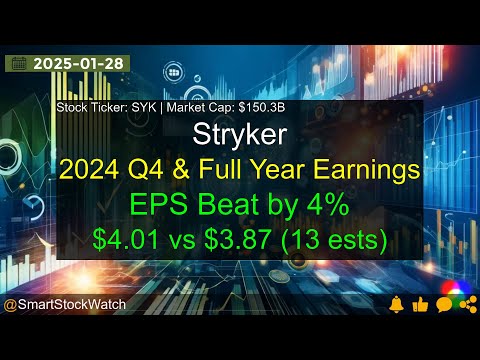
Stryker — Investor Video Playlist




External Quote Links
| Y Finance | Barrons |
| TradingView | Morningstar |
| SeekingAlpha | ValueLine |
| Motley Fool | Robinhood |
| CNBC | Etrade |
| MarketWatch | Unusual Whales |
| YCharts | Perplexity Finance |
| FinViz |
Prefer one of these to Trefis? Tell us why.