
Buy, Sell, Or Hold Anthropic Stock At $100?
Today’s big story: Could Anthropic Stock Fall 25%?
Anthropic just raised $81.3 billion in the largest initial base IPO on record (excluding over-allotment options). At $100 a share, it would be worth $1.8 trillion, yet its latest quarter showed a GAAP operating loss. Is that price justified for a 3- to 5-year timeframe?

What market cap does $100 imply?
At $83, the IPO price, Anthropic is worth about $1.1 trillion on shares outstanding and $1.5 trillion fully diluted. About 13.2 billion shares are outstanding, and an independent estimate puts the diluted count near 18 billion. At $100, that is about $1.3 trillion basic and $1.8 trillion diluted. Options, convertible notes, and RSUs explain the gap: 1.77 billion options and 1.13 billion RSUs.
What does revenue look like?
Revenue was $4.6 billion in 2025 and $33.2 billion in the first nine months of 2026. Q3 revenue of $17.0 billion was 47% above Q2, and the October run rate was about $81 billion. At $1.8 trillion, $100 is about 22 times that run rate. Management expects growth to slow. Base-case 2027 estimates run from $111 billion to $135 billion. Reuters reported a company forecast of $190 billion to $200 billion for 2028, and New Street projects $505 billion by 2030. On 2027 numbers, $100 equals 13 to 16 times revenue.
Are margins positive?
Not on a GAAP basis. The nine-month operating loss was $1.26 billion. Q2 showed a $974 million operating profit, then Q3 swung to a $567 million loss because compute expense rose 77% to $9.9 billion against 47% revenue growth. Adjusted operating margin, which excludes stock compensation and charitable contributions, was 15% in Q3. Gross margin is about 85%, derived from footnotes rather than reported on the income statement. The $104 billion net loss is mostly a $94.3 billion non-cash fair-value charge, and nine-month operating cash flow was positive $6.6 billion.
When does GAAP turn sustainably positive?
The quarterly table suggests non-compute costs run near 45% of revenue, so compute must stay below roughly 55% of revenue. That equals about $1.80 of revenue per compute dollar, versus $1.72 in Q3. If that holds, 2027 is plausible. The risk is that $70.7 billion of commitments fall due within 12 months, against a Q3 compute run rate near $39 billion.
That kind of single-line cost sensitivity leaves little room for error when investors are already paying up for a 2027 profit inflection. It is a tension playing out well beyond AI – even in healthcare, where buyers paying a market multiple for an earnings rebound still have to contend with stubborn commercial medical cost trends, as we break down in Can UnitedHealth Group Stock Crash From Here?.
What about cash and debt?
Cash and short-term investments were $131.8 billion at September 30. No borrowings were drawn on the $15 billion revolver, and $6.2 billion of Amazon notes are expected to settle in shares. The IPO adds about $79.4 billion gross. Financial debt is minimal. The real obligation is $900.9 billion of compute commitments, $451.6 billion of it before 2031, some with take-or-pay terms.
Does $100 earn a return?
A 10% annual return over four years needs a $2.65 trillion diluted value in late 2030. At an assumed 25 times earnings, that requires about $106 billion of net income. That is a 21% net margin on New Street’s $505 billion, or 18% on Goldman’s $600 billion-plus. Stock compensation of $3.3 billion in nine months raises the bar through dilution. Morningstar’s base-case fair value is $92. Near $75, the same hurdle needs about $80 billion.
What should you do?
At $100 per share, the valuation leaves very little margin for error on either revenue growth or compute-cost discipline.
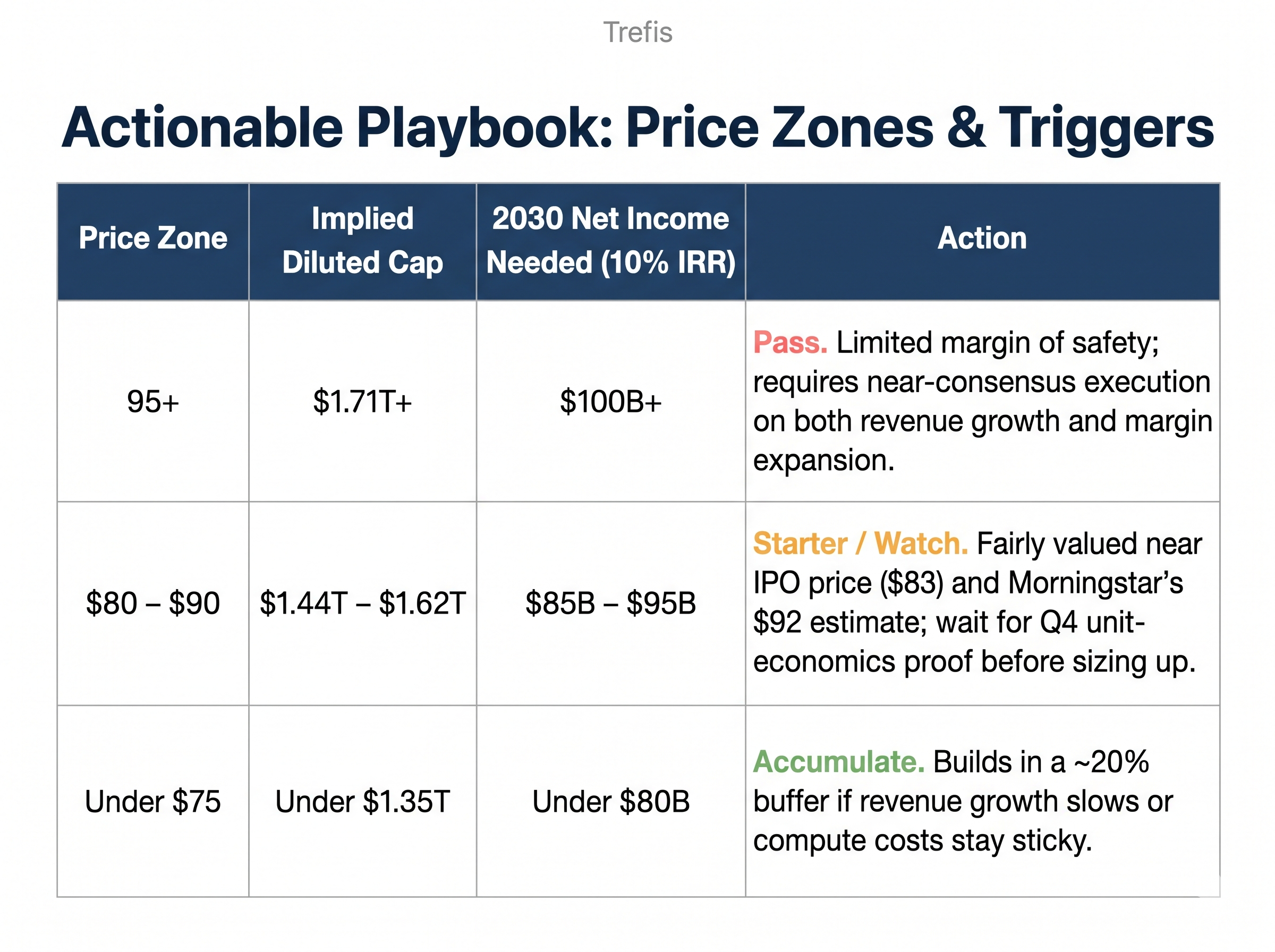
Key valuation checkpoints to monitor
Q4 / FY26 Earnings (Form 10-K due by March 31, 2027): Your primary thesis checkpoint.
- Bullish Signal (Thesis Confirmation): Revenue-per-compute-dollar crosses $1.80+ (compute falls below 55% of revenue) and Q4 revenue confirms the $81 billion October run rate is holding.
- Bearish Signal (Thesis Risk): Revenue-per-compute-dollar stays below $1.72 while the $70.7 billion near-term compute commitments begin hitting the income statement.
Post-IPO Lock-Up Expirations: Expect supply-driven volatility as insider and early-investor lock-ups release following FY26 earnings. If the fundamentals hold up, lock-up sell-offs are the most likely window to get a $75–$80 entry.
Bottom-line strategy
We think that at $100, the risk-reward profile appears unfavorable for long-term buyers. Those evaluating the stock may prefer to monitor trading around the $83 IPO price or wait for a pullback near $75, scaling in gradually only after the FY26 10-K confirms compute costs are stabilizing.
Betting on a single $1.8 trillion IPO means underwriting years of near-flawless execution on both hypergrowth and compute costs. That is why we lean on a strategy we are proud of, and we would like to hear about a better one.
Found a better strategy? We’d love to learn.
Ours is the Trefis High Quality (HQ) Portfolio: 30 quality stocks in equal weight. Since its September 2020 launch, it has returned more than 105%, ahead of a benchmark that combines the S&P 500, S&P MidCap, and Russell 2000. If yours has done better, tell us about it. If not, come take a look.